
Eye of the Storm
9/10/2026 | 26m 46sVideo has Closed Captions
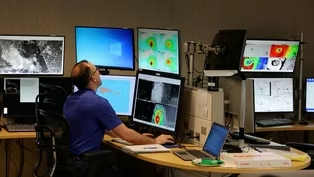
Predicting hurricanes, cooling pavement to lower heat and saving an endangered salamander.
How technology is transforming hurricane forecast models, and how cooling pavement could reduce city heat. Plus, scientists try to save a rare salamander species that was almost wiped out by Hurricane Helene.
Problems playing video? | Closed Captioning Feedback
Problems playing video? | Closed Captioning Feedback
SCI NC is a local public television program presented by PBS NC
Sci NC is supported by a generous bequest gift from Dan Carrigan and the Gaia Earth-Balance Endowment through the Gaston Community Foundation.
Eye of the Storm
9/10/2026 | 26m 46sVideo has Closed Captions
How technology is transforming hurricane forecast models, and how cooling pavement could reduce city heat. Plus, scientists try to save a rare salamander species that was almost wiped out by Hurricane Helene.
Problems playing video? | Closed Captioning Feedback
Where to Watch SCI NC
SCI NC is available to stream on pbs.org and the PBS app.
Related to This Episode
Providing Support for PBS.org
Learn Moreabout PBS online sponsorship- Coming up on "Sci NC," can a computer tell us what a hurricane will do and where it will go?
Can a road wear sunscreen?
And how far would you go to save one tiny salamander?
Next.
- Quality public television is made possible through the financial contributions of viewers like you, who invite you to join them in supporting PBS NC.
- "Sci NC" is supported by a generous bequest gift from Dan Carrigan and the Gaia Earth Balance Endowment, through the Gaston Community Foundation.
[gentle music] ♪ - Hi, and welcome to "Sci NC."
I'm Laura Smith.
We're glad you're here.
A tropical system doesn't even need a name to do real damage.
The rain, the flooding, reaches far beyond the shore and the ocean.
It's far beyond the shore inland, where people don't always see it coming.
So how do we get ahead of it?
Producer Evan Howell takes us inside the technology that's transforming how we predict these storms and their impact.
- We brace for the worst when hurricanes make landfall.
Powerful winds trailing inland, and torrential rain from storms that don't even have an eye.
The threat isn't just at the coast anymore, it's everywhere.
And the problem is these storms are getting stronger, and the strong winds are what forecasters find the hardest to predict.
- For those kind of events, you need to have accurate forecasts.
- Tropical storm Chantal dropped nearly 10 inches of rain on parts of Central North Carolina.
Here at the Eno River, the flood from Hurricane Fran in 1996 came just shy of this sign.
But Chantal, the water rose even higher.
Flood officials now call a 500 to a 1,000 year flood event.
That doesn't mean once in a thousand years.
It means rare, but it's getting more common now, and it could happen again and sooner than we think.
At NC State, scientists look beyond radar.
They use powerful computers to build 3D models of storms.
Models shaped not just by satellites and service data, but by aircraft that fly straight into the heart of hurricanes.
Those onboard sensors and those they drop deep inside send back real-time measurements, feeding those models and sharpening the forecast.
Dr.
Lackmann, what are the models still getting wrong?
- The most extreme weather events are the ones where they struggle the most, and those are also the highest stakes forecasts.
So when you have extremely heavy rain, hurricane, strong wind, atmospheric river, models struggle with the extremes, but that's when you need to get the forecast right the most.
- Radar observation.
- Getting the forecast right has taken decades of scientific research, starting in the 1950s when computers were first used to simulate what a storm was going to do.
- UNIVAC can take the past histories of thousands and thousands of storms, analyze them, compare them with developing conditions, and make predictions.
- Since then, forecasting has advanced dramatically.
Today's models capture wind, rain, and storm surge with a level of detail and precision that early scientists never thought possible.
We looked at an image from Hurricane Isabel that hit North Carolina in 2003.
- If you look within the eye, you can get what are called eye wall vortices, where you get little circulations that are embedded within the eye, and those can concentrate damage when a hurricane makes landfall.
- Researchers now run massive models that track a storm's path, while a second high-resolution model zooms in.
- What we had, we have kind of a large, large-scale model that shows kind of the whole Western North Atlantic, and these lines tell us where Hurricane Isabel is, and then the colors are the rain that it left behind in its wake, but then to get more detail, we have another part of the model that follows the storm.
- But even with better modeling, like what happens when a hurricane makes landfall, remains one of forecasting's greatest gaps, and Cameron Masiello is trying to close it.
- So this is actually one of the model simulations that I use a lot for my research, and so what this is is a numerical representation of a hurricane, so what you see here is this kind of black line, this represents the coastline in my numerical simulation, so everything to the north of it is over land, everything to the south of it is over water.
The blue colors to green are tropical storm force intensity.
Where you're seeing these yellow and reds, these are like hurricane force intensity winds, so these would be like Cat 3, Cat 4 winds here.
And so this is kind of what we think of as a one-minute sustained wind.
Doesn't tell us kind of the turbulence or the gusts, what are happening.
♪ - It's those fleeting violent blasts that can destroy life and property and remain one of the hardest things for models to predict.
- What that means is we get outputs that are extremely math intensive.
- Since wind is a fluid, Masiello says they use what's called a Navier-Stokes equation, which is a math formula that helps determine how air moves, and without it, it would be difficult to accurately predict the weather.
- In a hurricane, there's kind of a primary and secondary circulation, so the primary circulation, you know, is those swirling winds, which we call tangential or azimuthal winds.
And then there's the secondary circulation of winds kind of going in towards the hurricane center, up, and then out.
And so you're kind of seeing right here at the top of the atmosphere, you're seeing the outflow, where you see the kind of striations moving radially away from the TC center, or the hurricane center right there.
That is kind of outflow, basically vecting mass away from the hurricane center.
♪ - No single model can predict a storm with perfect accuracy.
Each run will get something wrong.
So they run multiple models.
Only then can they see patterns emerge.
Those patterns help forecast more than just hurricane winds.
They reveal so-called atmospheric rivers, which are narrow bands of moisture that can carry more water than the Mississippi.
- We are worried about them intensifying to a point where they go from being beneficial to more destructive.
- While they provide valued rainfall in places like the West Coast, they can have a different impact elsewhere in the East.
- So here we have imagery of the integrated water vapor for the whole world.
Integrated water vapor is just the moisture from the surface to the top of the atmosphere.
And where we start to see these streamers really condense, that's where we would be looking for.
Those are atmospheric rivers.
- Even in the Southeast, those streamers can stretch from the Gulf of Mexico, feeding moisture into powerful storms.
They're part of the Earth's water cycle, but when they grow stronger, the balance shifts.
Easthom says some models can get confused when weather hits barriers like mountains or ridges like you'd see in the North Carolina Blue Ridge, and that can affect speed to the system in some areas.
- So what I'm doing is I'm taking what we call a re-forecast.
That's when we just rerun the forecast model with historical data and try to diagnose where it went wrong with these atmospheric river forecasts.
And then I was able to diagnose where we were seeing the primary errors, which was either the forecasts were too fast or too slow or they were too intense or they were too weak.
So for, actually, for a lot of the too-fast cases, we saw this anomalous trough.
And then, conversely, with the too-slow cases, we saw this really predominant ridge here, and that really inhibited the landfall of those atmospheric rivers.
- These findings help explain why long-range forecasts can often miss the mark but offer clues for improving future predictions.
At NOAA, researchers are flying into storms and conducting atmospheric recon missions and have increased precipitation accuracy by up to 12%.
And these missions that work at NC State, much of it depends on funding.
- This research, everything that goes into these observations and these weather models is funded by taxpayer dollars and science funding to help make all these capabilities possible.
If that goes away, it's going to be a tremendous loss of investment.
- And possibly valuable warnings on extreme weather.
And so, in a future of warming seas and stronger storms, the American forecast may depend not just on the science but on whether we choose to invest in it.
- We slather on sunscreen before a day outside, so why not our roads?
In a city, all that pavement soaks up the sun, throws the heat right back at us.
But what if a road could wear sunscreen too?
Wild, huh?
Producer Michelle Lotker shows us a new pavement coating that might just pull it off.
[traffic noise] - It's hot today, and it feels even hotter because I'm in a city.
But scientists are experimenting with a common sunscreen ingredient to see if they can help with that problem.
- Titanium dioxide is found in a lot of sunscreens and makeup and is also a new ingredient in this road rejuvenation treatment, which is used to extend the life of an asphalt road.
Asphalt is bound together by a substance called asphalt cement.
- Asphalt cement can be broken down into two major components.
Those are asphaltenes.
Those are the dark, hard-bodying parts.
And then you have the maltenes.
Those are the light oils and resins.
It's the light oils and resins that keep asphalt flexible and adhesive and slow down the aging inside the pavement.
- Asphalt rejuvenators put those maltenes back into the road, and the city of Raleigh, North Carolina, has been incorporating them into their road maintenance plan since 2004.
- Adding a pavement rejuvenator will hopefully get us five to seven years of expanded life throughout the pavement.
- Now they're adding a new ingredient to these treatments, titanium dioxide, to help mitigate what's known as the urban heat island effect.
- So the urban heat island is just an environmental phenomenon where urban areas tend to be hotter than the surrounding rural and suburban areas.
And basically, there are a few factors that cause this.
One of the main ones is that man-made materials tend to absorb heat and release it later on.
Roads are typically made out of asphalt, which is one of the materials, the kind of man-made materials that has the greatest capacity to absorb and re-radiate heat.
And because roads have such a large surface area and urban areas, if we can address the impact from roads, then we can have a really big impact on hopefully reducing the urban heat island effect.
- So how does the treatment work?
Applying it doesn't take long.
- So the process is gonna take us anywhere from 30 minutes to an hour on any one road.
- When we first put down the material on the street with the distributor truck, it does have an indicator dye in it to where we know we're getting proper coverage on the road.
- Now, this is not a coating that's gonna lay on top of the road.
It's a penetrant.
So that yellow color is only there during the application phase.
- Once the material's laid down, it starts to absorb into the roadway.
And with good wind, ambient temperature, and sunlight, actually, it'll penetrate pretty quickly.
And once that happens, we're able to put slag material, and vehicles are able to drive on it.
- Globally, cities are exploring using cool pavement technologies like this one to reduce urban heat.
- The goal of cool pavement is to try to do what we can to lower the impact of the heat island effect that's created by a hard surface.
We're putting a penetrant into the pavement that will lower that heat island effect by influencing the solar reflective index.
The solar reflective index is basically taking not just the solar reflectivity or reflectance that a material would make, but it's taking into other factors of how much energy is actually stored and held into that surface.
So we're not changing the thermal capacity of the roadway.
What we're changing is the amount of heat energy that soaks into the pavement that can be radiated back out as the surrounding area begins to cool.
- As the sun shines on the treated roadway, titanium dioxide gets to work, first by physically refracting sunlight.
- So if you think of titanium dioxide as having a bunch of facets, like a bunch of little diamonds, we're putting that into the pavement.
And so as heat energy comes into the pavement, it's redirected in many directions, kind of like the sparkle of a diamond.
- There's also a chemical reaction occurring.
- So the titanium dioxide being a photocatalyst, UV light or the heat energy that comes into the road, it's going to excite the titanium dioxide.
When I say excite, basically it makes the electrons inside of that titanium dioxide move faster.
And then eventually one is going to jump out of the containment of the titanium dioxide.
And as it escapes, it's gonna release energy.
Energy is not created or destroyed, right?
It's just changed from one form to another.
So the sunlight or heat energy's coming in, it's gonna expend some energy, freeing electrons.
And there's a lot of titanium dioxide that we're putting into the roadway.
So there are a lot of electrons being expended constantly.
- Besides dispersing heat from the sun, pavement technology is excited about additional potential benefits having titanium dioxide in roadway treatments could provide, specifically related to pollution.
- As we drive on a roadway, our tires wear.
That's a microplastic.
And so the photocatalytic process has been shown to break down these plastics.
It also breaks down tailpipe emissions.
So nitrous oxide, sulfur oxides, volatile organics, they're coming out of the tailpipe.
Effectively what we're doing is creating an oxidative or rusting.
So you think about oxidation on metal, it's a rust.
So we're beginning to break down that pollution to give Mother Nature a little helping hand to start breaking down what's coming out of the tailpipe and what other pollution may be around the pavement.
- And rejuvenating a road is more affordable than resurfacing one.
- Cost to resurface, fully resurface a road could be upwards of $40 a square yard.
As to add this treatment to try to get five to seven years could be up to $2.50 per square yard.
- This is still new technology.
They've seen it work well in the lab and now need to better understand what happens when it's actually applied to roadways.
Part of that is measuring the impact treating a road with titanium dioxide has on the urban heat island effect in the surrounding area.
The city of Raleigh has been strategically choosing which streets to prioritize applying this treatment to based on measured heat data.
And scientists like Katherine are working to measure the treatment's effects.
- We have a pretty good sense that the coatings that they do, these cool pavement treatments will lower surface temperatures.
And we're interested in seeing if that is also contributing to air temperatures.
- Okay, so this is one of your sensor sites.
- Yeah, so this is one of 60 sensors that I have out in Raleigh and they look like this.
So this like white honeycomb is a radiation shield.
It protects it from weather and it protects the sensor from getting heated up from the sun rather than from the air temperature around it.
So inside is the sensor.
So there are these like little orange guys.
- Looks kind of like a Tamagotchi.
- Yes, and it's got a tiny little white temperature probe inside and these are all mounted on utility poles and light poles all around the city alongside the streets.
- Sensors are mounted at around two meters height to measure what someone's experience would be when they're walking alongside the road.
What is the sensor actually measuring?
- So the sensor is capturing air temperature and humidity and then also calculating heat index which is a better thermal comfort measure of how you would feel standing by the street.
I'm collecting 20 minute interval data so we're really getting a good picture of like the whole day, what it looks like in different weather conditions over a long period of time at all of these different locations.
- Katherine has been collecting data at these sites all summer and chose the locations based on streets that Raleigh planned to treat with titanium dioxide.
- So one of the things that Raleigh does is they apply this treatment to streets that were repaved three years ago or six years ago.
So we narrowed down all of the other streets in Raleigh based on when they were repaved and then matched the treatment streets to the potential comparison streets based on different street characteristics.
- Looking at things like street size, amount of shade and satellite data of land surface temperatures for the streets being treated, Katherine found similar streets that weren't being treated to use as a control.
- We have 30 sensors on treatment streets and 30 sensors on comparison streets that hopefully we can use to get a sense of what the impacts are.
- The results of Katherine's study and others like it will help show the impact that cool pavement technology can have when applied in an urban setting.
And although cool pavement may not solve urban heat issues on its own, it's part of the toolbox cities can use to reduce heat impacts to urban populations.
- So it can be like a really nice compliment to something like tree planting.
You plant your trees and you expect that impact to grow.
You can do the cool pavements and you expect that impact to kind of happen right away, be a little bit more immediate, address any of the kind of heat concerns that are most pressing in the city and use other techniques to address kind of longer term heat.
- What you're about to see is a little wild.
Scientists in full hiking gear climbing over boulders, squeezing under rocks all to save an endangered salamander whose habitat was nearly wiped out by Hurricane Helene.
Producer Frank Graff went along for the rescue and the race to give this species a second chance.
- This is a rescue mission.
- There's a main line of rocks that we'll hit and we can show you that haven't done it how to look for them in there.
- We have to do some bouldering up through there.
And again, just some narrow passages.
- Climbing over trees and under trees and up the remains of a landslide.
- Be careful, see what we can find.
- The team is scrambling to save the Hickory Nut Gorge Green Salamander.
It is one of the rarest salamanders in the world.
- Our best estimates over years of doing surveys put the total number in the wild at like three to 500 individuals.
- And it's an endemic species.
It only lives in tiny pockets in the Hickory Nut Gorge in the Western North Carolina mountains.
- So we're talking about an extremely endangered salamander here that's in our backyard and without intervention is likely to go extinct in my lifetime.
- J.J.
Apodaca, the executive director of the Amphibian and Reptile Conservancy discovered the Hickory Nut Gorge Green Salamander species in 2019.
- For me, that's a very personal mission and very important task to be working to save the species.
- The Hickory Nut Gorge is a 14-mile-long ecological treasure.
Over eons of time, the Rocky Broad River carved the steep and narrow canyon through the Blue Ridge Mountains.
Hundreds of microclimates, small areas with unique temperatures, moistures, and ecosystems are found throughout the landscape.
That's why 37 rare plant species and 14 rare animal species are found throughout the 20,000-acre gorge, including the critically endangered subject of the rescue mission.
- When you see them in their natural habitat, you can just totally picture why they evolve that way is because, I mean, they're perfectly blended in.
- Typically, you're gonna find these salamanders in very tight, moist, but not necessarily, like, wet crevices.
- But scientists are searching for the Hickory Nut Gorge Green Salamander because in September of 2024, Hurricane Helene pummeled the gorge with almost two feet of rain and high winds.
The salamander's perfect habitat became a death trap.
- Yeah.
- See it in there?
- I don't easily get choked up, but I got pretty choked up walking in there 'cause it was such a beautiful sight with just amazing understory vegetation, lots of beautiful native flowers and really probably old-growth trees.
It was just wiped clean by a landslide.
'Cause we could do a hand line over here, too.
- Oh, like back in there?
- Making things even more tragic, the Hickory Nut Gorge Green Salamander spends most of the summer in the trees, migrating down to rocks to breed in the fall, just when Hurricane Helene slammed into the gorge.
- Luckily, females would have been in the rocks at this time, but males likely would have still been in the trees, and a lot of those trees were knocked over.
A lot of those trees were cut in half, and so we might have lost a lot of the population just purely in the trees being taken out.
The reason this species is in such trouble is because we just had so few populations.
Can you-- how far over can you get?
When you have a species this close to the edge of extinction, every population is important.
Every population counts.
- Rope I've got.
- Some crevices on the other side of this rock that are too tall for us to get to.
So Jen's gonna anchor and repel.
- There was so much rain, it created rivers and landslides that came down the mountain, which took out all the trees.
And because it's a salamander, it depends on, A, the trees, they go up and they forage, they go up and they feed in the trees, but also those trees provide a lot of moisture in the air and keep the temperatures down.
So the gorge is relatively hot for salamanders.
It's only at 1,000 feet, and so they require those kind of cooler moisture areas.
These salamanders are completely lungless, so all of their respiration has to occur across their skin.
All their breathing, all their gas exchange just happens across their skin.
The downside of that is that you have to have moist skin.
So if you are out in the sun, you dry out, you can't breathe.
Not breathing is bad.
So this is a great example.
This was just, like, an amazing canopy tree.
And if you look up here, the whole thing's broken off, so while there are still trees around, almost all of them are broken off and the canopy's completely gone.
So now it's totally open to the sun, and this site has changed for decades.
Natural disturbances within the forest happen all the time, and in a sense, that's a good thing.
It brings new life into the forest.
It brings a different age class of trees into the forest, and that's just the natural succession.
Unfortunately, these canopy openings, which provide sunlight and the right ingredients for native plants to thrive, also provide those ingredients for non-natives to really take over.
They don't have any predators, so they will out-compete the natives, and they will basically just swallow up the landscape.
- So in a last-ditch attempt to save the hickory-nut gorge green salamander from extinction, Apodaca is leading an effort to capture salamanders in the gorge and bring them to the North Carolina Zoo to start a captive breeding program.
- In our back area, we have this room set up where we have its own air-conditioning system.
We have our own filtered water, and we're setting up these kind of tiny micro-habitats, and then it will be loaded with rocks that are stacked up because these are considered a crevice-dwelling species.
So they live most their lives in rock crevices.
Every once in a while, they'll come out and climb trees, but there's a lot we really don't know about this species.
We try to provide a substrate that's similar to what they would experience in the wild, but also all these different rock crevices that have the same sort of micro-climates and micro-habitat they would experience in the wild.
- 25 salamanders were rescued from the gorge to start the program.
It took multiple trips to find them, and the program will be slow-going.
The salamanders only lay about 10 eggs per year, and they don't reach sexual maturity until age 7.
Salamanders can live 20 to 30 years in the wild.
- Most of the plants and the rocks and even some of the props, like the bark, we actually collected from the site itself.
So they truly are experiencing a little miniature version of what they had in the wild.
- It's as exact as you can possibly make it.
- Yeah, it's next to impossible to duplicate it, but we're pretty close.
- The long-term goal is to return the salamanders to the wild.
- We need a sufficient number to get out in the wild, and we want to make sure that we're not damaging what we do have as far as a population in captivity.
We certainly want to get them back out in the wild, but we've also never done that.
No one's done that for this species, and so reintroducing them is also going to be a learning curve, and it's going to take time for us to probably get that right.
You know, for me, the hard line is always extinction.
I think, you know, extinction is forever, is the saying.
I believe that when we lose a species, we lose millions of years of evolutionary history.
We lose something special in the world that we can never bring back.
So for me, that's always the hard line, is that we don't let anything go extinct, and we put in effort.
- And that's it for "Sci NC" this week.
We are so glad you joined us.
If you want more "Sci NC," we know you do, be sure to follow us online.
I'm Laura Smith.
Thanks for watching.
[gentle music] ♪ - "Sci NC" is supported by a generous bequest gift from Dan Carrigan and the Gaia Earth Balance Endowment through the Gaston Community Foundation.
- Quality public television is made possible through the financial contributions of viewers like you, who invite you to join them in supporting PBS NC.
Video has Closed Captions
Predicting hurricanes, cooling pavement to lower heat and saving an endangered salamander. (20s)
Providing Support for PBS.org
Learn Moreabout PBS online sponsorship

- Science and Nature

Explore scientific discoveries on television's most acclaimed science documentary series.
 New Episode

 New Episode






Support for PBS provided by:
SCI NC is a local public television program presented by PBS NC
Sci NC is supported by a generous bequest gift from Dan Carrigan and the Gaia Earth-Balance Endowment through the Gaston Community Foundation.