
Mike Faist Embraces the Unknown
Special | 44mVideo has Closed Captions
Actor Mike Faist explores the creative process behind his work on East of Eden.
For Mike Faist, acting is about finding freedom in the unknown and staying curious. In this interview, we explore the preparation and process behind his performance as Charles Trask in the new limited television series, East of Eden.
Problems playing video? | Closed Captioning Feedback
Problems playing video? | Closed Captioning Feedback
Support for American Masters is provided by AARP, The Rosalind P. Walter Foundation, Thea Petschek Iervolino Foundation, Burton P. and Judith B. Resnick Foundation, The Philip and Janice Levin Foundation,...
Support provided by:

Mike Faist Embraces the Unknown
Special | 44mVideo has Closed Captions
For Mike Faist, acting is about finding freedom in the unknown and staying curious. In this interview, we explore the preparation and process behind his performance as Charles Trask in the new limited television series, East of Eden.
Problems playing video? | Closed Captioning Feedback
Where to Watch American Masters
American Masters is available to stream on pbs.org and the PBS app.
Buy Now
A front row seat to the creative process
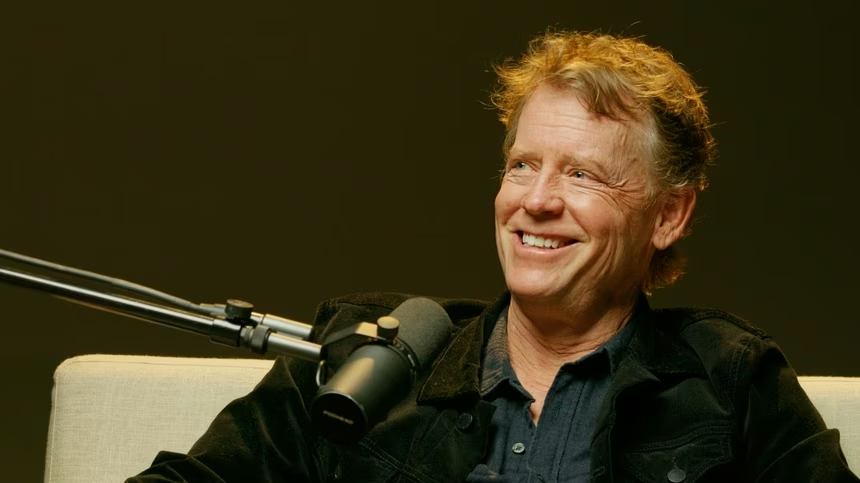
How do today’s masters create their art? Each episode an artist reveals how they brought their creative work to life. Hear from artists across disciplines, like comedian Chris Fleming, actor Greg Kinnear, sports journalist Taylor Rooks, and more on our video podcast "American Masters: Creative Spark."Providing Support for PBS.org
Learn Moreabout PBS online sponsorshipMore from This Collection
How do today’s masters create their art? "Creative Spark" presents narrative interviews that go in-depth with an iconic artist about the creation of a single work. Each episode offers a unique window into the world of art and the creative process of artists and cultural icons across a wide range of disciplines, from music and comedy to poetry and film.

The Many Passions of Matteo Lane
Video has Closed Captions
Comedian Matteo Lane on stand-up, painting, singing, performing on Broadway and much more. (55m 8s)
Michael Sarnoski: What Robin Hood and Folklore Tell Us About Ourselves Today
Video has Closed Captions
Filmmaker Michael Sarnoski breaks down his revisionist version of the Robin Hood story. (28m 4s)
Tyler James Williams on 30 Years of Acting and Protecting the Next Generation
Video has Closed Captions
Actor Tyler James Williams talks about his acting process and what drives his work. (35m 23s)
Why Atsuko Okatsuka’s Comedy Connects Across Cultures
Video has Closed Captions
Comedian Atsuko Okatsuka returns to the show to talk about her creative process. (30m)
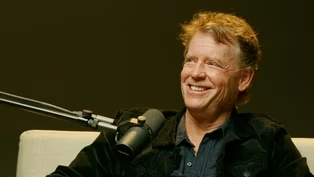
Greg Kinnear on Acting, AI, and Why Movies Still Matter
Video has Closed Captions
Oscar-nominated actor Greg Kinnear shares some "big thoughts." (27m 33s)
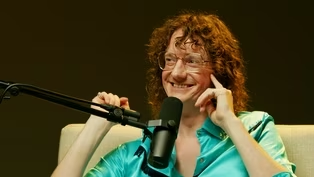
Chris Fleming Embraces the Chaos
Video has Closed Captions
Comedian Chris Fleming talks about the process behind his iconic manic stage persona. (39m 17s)
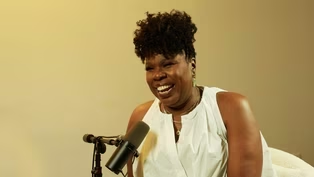
How Leslie Jones Became a Comedian
Video has Closed Captions
Comedian and actress Leslie Jones does a deep dive on her creative process. (31m)
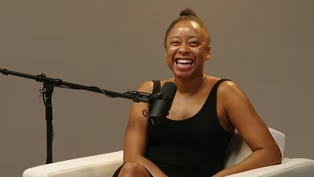
Phoebe Robinson Shows Her Work
Video has Closed Captions
Comedian Phoebe Robinson takes on hustle-culture in biting comedy special. (31m 45s)
Sarah McLachlan: Making Music to Connect and Heal
Video has Closed Captions
Singer-songwriter Sarah McLachlan opens up in a candid interview about making music. (37m 19s)
How Natasha Rothwell’s Life Brought Her to “The White Lotus”
Video has Closed Captions
Actress Natasha Rothwell on her creative process in "The White Lotus." (33m 40s)
Daniel Dae Kim Leads Spy Drama and Fights for Industry Change
Video has Closed Captions
Actor Daniel Dae Kim on his groundbreaking career and new project, "Butterfly." (21m 48s)
Phil Rosenthal’s Secret Recipe: Good Food and a Laugh
Video has Closed Captions
TV writer and host Phil Rosenthal talks about finding our shared humanity in food and comedy. (22m 53s)
Providing Support for PBS.org
Learn Moreabout PBS online sponsorship- I love this thing very, very much, but I want to hold it, I don't want to hold it so tightly 'cause I think if you hold it too tightly, maybe it'll die.
So you want to kind of like be gentle with it and allow it to inform you as life unfolds.
(bright music) - This is American Masters Creative Spark, and I'm your host, Joe Skinner.
Our guest is actor Mike Faist.
You might have seen Faist's film work in projects like "Challengers," "The Bike Riders," and "West Side Story," or his stage work and his breakthrough Tony nominated performance in "Dear Evan Hansen."
Today we talk about his most recent work as Charles Trask in the limited series adaptation of the John Steinbeck epic novel, "East of Eden."
I appreciate you coming in.
- Thanks for having me.
It means a lot.
- So we talk mostly about creative process, supposed to be a really comfortable space to just kind of think about the craft, but also reflect on some of the bigger ideas with the project and just with acting in general too.
So we'll see where we go.
- Sounds good.
- But there was one quote that you gave recently, this idea of dread and that once you have a feeling of dread, you know that you really care about something.
- Yeah.
- Just if you could unpack that idea a little bit.
- Well, I mean, I was saying, I moved to New York when I was 17 to become an actor from Ohio.
And I remember saying when I was leaving that I was just really excited to get better.
You know, like that was the thing.
I was like, "Man, maybe I'll be good at this.
That would be cool if I could get good at this."
I remember really genuinely feeling that way.
I still feel that way.
Maybe I'll be good one day.
That'd be cool.
- That shows a lot of maturity, I think in a certain way though, because I remember I moved to New York when I was 18, and I thought I'm already good.
I wasn't, but I thought I was already good.
When you're 18, that's kind of how you think.
- That is amazing.
I did not feel that way (laughs).
That is amazing though.
Good for you, honestly.
But I think because of that, I think the thought behind that was is that like, oh, I get to kind of join the ranks of these icons maybe in the sense of what this city was and what that city meant to those actors in terms of Brando, Newman, James Dean.
And when you land on James Dean, the movies that you think of are "East of Eden" is one of them.
It's like a very integral part of your desire to be an actor watching the Kazan films "On the Waterfront," and all of these movies.
And so when Zoe reached out and asked like, "Hey, would you be interested in doing this?"
It's that feeling (chuckles).
It's that feeling of hell yes and oh shit, you know?
And that is because it is this... You are playing in the same ball field as these people that you've been aspiring to.
And I joked with Zoe when she asked, "Hey, do you want to be a part of this?"
I was like, "Yeah, it's a little meta you wanting to do this."
And then we joked about that and then it became very apparent and clear.
You know, she had a really specific point of view, which is really what you want.
You know, you want a director and a leader that's going to say, "No, we're doing this.
Let's get specific.
Let's get clear on what we want to do."
That helps any sort of anxieties because it's like, well, someone's steering the ship.
Someone knows what they're doing (laughs).
- Well, I mean, it's important, even as a viewer, it's important to feel like you can trust the director and the production team, just because you feel like you're in good hands.
- You're in good hands.
Yeah, that is very, very true.
Yeah.
And it became that way, you know?
And the movie, the original film, it really only tackles the last third of the book.
And even then there's characters that aren't even in the film.
The character that I'm really talking about in that film is Lee where that does exist in the book of "East of Eden."
But when Zoe said she wanted to tackle the first, you know, the whole book and the first third specifically around, because for people who aren't familiar with that movie, it's more so the story of James Dean's character, Cal, and his relationship with his brother Aaron, and the relationship that he has with Kathy, who I won't spoil what that is for the people, but their father Adam.
But then when you read the book, the father Adam is really the through line of the book.
We follow Adam's story.
And so when you go back, it actually talks about his relationship with his brother Charles and that Cain and Abel relationship.
And I read Zoe's scripts and then I read the book and I just remember after it was like this description of Charles, the first description of Charles and who he was.
And I just was like (beep) I love him.
- What was it about that description that you loved so much?
- It was really honest.
It was really, really honest.
It was a very honest depiction of this man.
I think there was this idea of... Honestly, it's this idea of a person that they could be nurtured into the belief of having this innate badness in them and then them watching them work extremely hard to fix that, which is also a huge part of the original film.
It's the continuation of this belief of a person that if they could contain this, then do they have the ability to exorcise that thing out of themself almost in a way?
And you really see it in all of Charles' actions, you know, when he does this terrible act against his brother.
I mean, it's Cain and Abel story, so he does this terrible act against his brother and then he's kind of banished to the farm to live there for years in isolation alone with his own shame.
And it's like, that's interesting.
I found that to be very interesting.
- Well?
- I brought you supper.
- Well, I think if I'm hungry, I can feed myself.
- Just trying to help.
- Oh, I don't need your help.
- Do you find me so repellent?
- You may have been able to turn my brother's head, but well, he'll come around even if I have to lick him.
- Could you lick him?
He's a big man.
- Well, why don't you just ask my brother what I'm capable of?
- It's a rich character to dive into.
How do you do the work to build that interiority, to build that kind of character?
And also it's just, it's from such a different era.
So how do you put yourself in the shoes of that?
- Well, it's funny you say, how do you put yourself in the shoes of that?
Look, I think it's a funny thing, you know?
It's really commendable you wanting to do this podcast to talk about craft first.
And I think that there is this kind of funny thing that maybe has happened now in culture that like it's almost maybe borderline taboo to talk about craft, whereas before it was kind of like, what would people talk about the craft?
But it's a funny thing because if I talk... I guess what I'm trying to say is that it's very easy to come across as like loo-loo, is the term that I use when it comes to acting.
I don't know if that makes sense.
It's very easy to sound like pretentious or something like this is important when the reality is that it's like acting is the ability to more or less just pretend very, very well.
It's all very playful.
I'm playing dress up and it's embarrassing if you really... And it's funny, the older I get, the more embarrassed I get to be an actor.
- But to push back on that a little bit - But yeah.
- Oh, sorry.
- No, no, go ahead.
- I was just going to say, I think people also just are so hungry for any kind of earnesty in the world we live in today too.
- That might be true - And vulnerability.
And I think that's something that you do get to do in that space.
- Well, I mean, that is the thing that I like.
And when we do touch on Charles, it is like, okay, you ask like, "Okay, well, how do you put yourself in the shoes of this thing?"
And there's like, look, you know, it's very human character.
I think that there's obviously things that when you read the book and you read any of these characters, what Steinbeck has done and then what Zoe has done on top of it is they're just very human.
I think it's very easy to empathize and sympathize with these people.
I think it is because the things that they're struggling with are this... It comes down to this really succinct idea of questioning their own morality.
We all do that, you know?
But if you want to talk about practical things like what I did, I suppose, like, you know, one of the things is we got there a month early, a little bit over a month.
It was maybe like six weeks early.
And one of the things that you do is you work with the costumers and you start putting on clothes.
And clothes I find to be very, very helpful for the character because it's like, well, what they wear is how they hold themself, how do they walk?
And one of the things I remember are the boots that I was given and they just hurt like hell.
And it reminded me of this passage in the book, which was that adult Charles just never spent any money on himself.
Every single dollar that he made, it went back into the farm because after Adam left, he was left to this farm and he's just kind of like... Every energy, every ounce of energy that he put in went into that as this kind of self-masochistic kind of way of, again, exorcising this shame that he's carrying and dealing with.
And so when the shoes hurt, I said, "Well, that makes sense."
(Mike laughs) Makes sense.
So I guess his shoes hurt.
And of course he wouldn't, like, you know, buy new shoes.
He would just keep working with the shoes that he's got.
And so that was very informative and I'm walking with a bit of a limp and it's because the (beep) shoes hurt.
(Mike laughs) But like that's great, you know?
I love that part of it.
I love that part.
And then there's this other part too that's just being in isolation.
One of the great things about when we shot in New Zealand is that there's no predators.
So you could just camp.
- There's no bears to worry about and things.
I never thought about that with New Zealand.
- Yeah, they're very, very protective of their ecosystem there.
- [Joe] Oh, wow.
- And yeah, you can just go off and camp.
And so the land that we were shooting on where the brother's house was, they built that house.
The whole thing was built.
Not only did they build that house just on this raw land, but they tilled the field to create that.
And also they were saying last night at this talk back we had to do, but they actually planted their own real life working vegetable garden, which is amazing.
And I remember saying to Zoe, I was like, "I think it would be... If you wouldn't mind, I think it would be a pretty good idea if you wouldn't mind if I would spend any sort of time out there.
Just any sort of time that you would give me would be really helpful."
And so I would spend weekends out there when the guys weren't actually building and constructing the house.
I would spend weekends out there.
And when I told that to props department and costume department as we were building this character and doing the things, they got so excited and they were like, "Okay, well, here's a tub.
Here's a tub full of toys.
Look, here's cigarettes, here's lighters, here's candles, here's pens."
They gave me everything.
And then same with wardrobe.
They're like, "Okay, well, here's those shoes that you really hate," and then here's all this wardrobe and things like that.
And so I would just go out there on the weekends and just be.
And you don't bring your phone, you don't bring your laptop, you allow yourself to just be out there.
And that was interesting.
It was really interesting.
It's quiet.
And so then that's the thing about acting.
Again, it sounds like... I think it's very easy to come across as sounding pretentious or like silly, but especially just in the times that we work in today, it's very hard to get that kind of quiet no matter where we are.
I think it's just like we live in a different time.
That's the reality.
So if you're trying to make a movie that happened in turn of the century, 1800s to 1900s, it's a different time.
So just being able to try to pretend as best as you can, allowing yourself all the tools that you could possibly give to help you out, because at the end of the day, you do all of this work and then you have to show up on set and you have to let it all go 'cause then you have to do the scene and there's a person there and you don't know what they're going to bring, but all of it is so... It's just helpful.
I don't know.
It's just helpful.
Yeah.
- So then you do get to set and all this work that you're doing to build up the character, how much of that just kind of has to wash away when you realize- - But that's kind of the hope is that it doesn't actually wash away.
It's just all there, like, you know, part of the thing too was is that we had this really great thing.
One of our directors was Garth Davis who directed the first four, five, four episodes, I think.
And the Trask brothers, Adam and Charles, you see them at different age groups when they're kids, when they're teenagers, and then when they're adults.
But there's such really important scenes that happen when they're children that obviously Chris Abbott and myself didn't get the chance to actually play in front of camera.
So Garth, the director, had this great idea, which was, "Well, why don't we go out to the farm and let you guys just run the scenes that happened when you were kids?"
And I think there's kind of like this funny thing where you're like acting games.
I'm not sure about acting games kind of thing.
But then you do it and it was really helpful because the reality is that the very first scene that Chris and I shot together as the brothers is the very first scene that you see of the two adult brothers, which is Adam returning home after many, many years.
And so having done that scene as children, it did leave that sense memory for us of being like, "Right, this is what happened."
- Totally.
I was just re-watching that scene last night and the subtext is so rich of that memory.
And you can really feel your character trying to navigate that in a way.
- You know, it's just like this funny thing that we do no matter what.
And it's like you're just constantly having to do a lot of mental gymnastics.
And so I think the reality is that you just try to give yourself as many tools as possible to allow the scene to just do its thing and take flight so you can not think, so you can just be, so you can just be present.
You know, that was the thing.
I mean, that's what Kazan was trying to get at, that's what Dean was trying to get at, Newman, Brando, for sure.
I mean, Brando was just always just about like, "Well..." I mean, he went so far as just being present.
It was like, "Well, I don't even know what I'm going to say next."
Which is true, by the way.
Like, you know, I don't know what I'm going to say right now, you know?
The hardest thing is to just be present, just be, 'cause I think the thing about it is like, well, if you start to see where I'm going, like if an audience member's able to start to see where I'm going, then they're already ahead.
- That makes sense.
This might kind of sound like a pedestrian question, but also I think a lot of people think this when they're watching.
It's like, okay, there's this idea of you have to be present as an actor, but then also you're working from a script.
- Exactly.
- So how do you juggle those two things?
- Exactly, you know?
No, exactly.
- [Joe] That seems like the job, right?
- That's the job.
Exactly.
- And then it's like, how do you stay in that mode while also, oh, your feet have to be at where this tape mark is on the ground?
- Exactly.
There's so many things.
So, like, you know, you just try your best to... I don't know.
I don't know, you know?
And it's still like an invisible dragon that I'm trying to wrestle always as well.
I don't know.
I'm not going to claim to know.
I don't know.
It's just always like, "Well, let me try."
I think that's what it always comes back to.
It's just like, "Well, let me just try.
Let me play.
I don't know if this is going to work."
I have this idea.
You know, I remember there was this idea that I had with this scene between Florence and me, is when she comes out and she brings a little lunch for Charles or dinner for Charles, a little supper.
And there's a whole scene that takes place.
And I remembered she comes out, she brings this basket and he's like, "Well, I brought you some food."
And it was a kind of peace offering.
And I had this instinct, this idea to just pull an apple out of my knapsack and just start eating it in front of her.
And so I did that., instead of saying the lines, I just sat there and I just started eating this apple while she was offering me the food that she had made.
And I'm just sitting there eating my own apple and just staring at her.
And I loved watching her figure out what to do.
She had no idea what to do with that.
That's interesting.
It wasn't right.
It didn't ultimately work, but it was helpful.
It's informative.
And just being able to kind of play.
It's just play.
It's just like allowing yourself to play.
It sounds so serious, but it's not serious.
You know, it's like the opposite.
It's just play.
- You said you're fighting this invisible dragon still, and to me, I read that as you stay excited because you haven't... It's unsolvable, like it's an unsolvable job and craft and that can keep you on your toes and keep you interested in it.
- That's true, and I think the minute that you start to get into a thing where you're like, "I have to have this outcome," then something becomes very uninteresting about that.
Because I remember when I worked on "West Side" with Spielberg, he really was averse to rehearsals Because of this thing.
He didn't want to know what everybody was going to do.
He just wanted to get everybody in the room and capture it 'cause he didn't want to know.
He just wanted... You know what I mean?
He just wanted to kind of see what was going to happen and let that inform what the next take would be.
And because he was always really interested to see what the actors were going to bring.
He really didn't want us to rehearse.
And I understand that.
You know, I do, I do, I do.
- And he's so famous too for just shot listing on the spot and kind of creating the shots.
He's the perfect example of that.
Yeah.
Yeah.
It is.
It's just about... The reality is that you go... And I think this kind of goes back to this theory of the dread part kicking in, is that the interesting thing is the curiosity, 'cause there's a bunch of questions.
So that's the thing.
It's kind of like, "Ah, there's a question here that I really have about this.
I can't let go of this question, so I'm going to say yes to this thing and I'm going to go continue to ask the question," which then just ends up leading to more questions.
And then all of a sudden that's a wrap, you're done.
And you're like, "Well, I haven't figured anything out."
There's actually a great anecdote that I have about Michael Shannon in this when we shot The Bikeriders."
I will never forget this.
It was amazing because we had this scene together and I chose that job because all I had to do was just be the observer.
And I wanted to just be on set and watch all of these amazing actors, Jodie Comer and Tom Hardy and Mike Shannon.
Like, I just wanted to sit there and be a fly on the wall.
And I remember I did this scene with Mike and he's got this scene.
He's just like, you know, he does a take and it's good.
He does another take and it's good.
Third take, it's good.
And then something happened on the fourth take where, I don't know, it was like magic.
You just watched this man, I don't know, putting the ball in the kaplunk machine.
Everything fell.
And then they said, "Cut.
Okay, moving on."
And he's like, "Wait, I just figured it out, I think."
(Mike laughs) - [Joe] We need more.
- He wanted to do it again 'cause he was like, wait, wait, wait, wait.
I think I'm onto something.
And they're like, "No, we're done."
Because it was... I don't know.
It was like magic.
It was magic.
I don't know how to explain it.
- That's cool.
- But I'm a nerd.
That's what makes it cool.
You know what I mean?
Like, I don't know.
It's a funny thing.
Again, I think it's like this double-edged sword talking about acting because people think like, you know, they get annoyed with you about talking about acting, but I'm a nerd, so I like talking about acting.
You know, I do think it's cool.
Sorry, you know.
I don't know.
Sorry.
I know.
- [Joe] I don't really have to apologize for caring about something.
- Yeah, man.
I don't know.
- I think it's important to care about things.
- I think so.
I think so.
- And it sounds so simple, but I do think more and more in the world we live in, it's important to care about something earnestly and deeply.
- I hope.
I would like to think that's true.
Yeah.
- I mean, this process and results thing is very interesting to me because in the interviewing world, it's the same exact thing.
I mean, I will do so many hours and days of research and prep for a conversation like this, but then I haven't looked at my notes once and it's just you kind of... It's there.
It's not washed away.
It's there, but you have to kind of just be more open to- - What's going to happen.
- What's going to happen that you don't know about.
- Yeah, that makes sense.
And I do think that that is true with anything in life.
Yeah.
- So when you first moved to New York, what kind of training were you building upon to get to this point that you're at now?
Were you thinking about acting in the same way when you first moved here?
- No, I had no idea what I was doing.
No, I had no idea what I was doing.
I remember... It was great.
I mean, first off, I was really not good.
I really wasn't (laughs).
I really wasn't.
And that was like- - How could you tell you weren't good?
- Because there were people in my class that were, you know?
And you would watch them and you'd be like, "Whoa, you're good at this.
How are you good at this?"
And I found that to be very interesting.
I don't know, it's a hard industry, you know, because it's this interesting thing where there's so many good actors.
Like, there's so many good actors, especially... I don't know, there's actors that are in theater that I've watched for years and I've admired, and I'm like, "How are you not the greatest thing?"
- [Joe] Right.
It's such a cruel industry in that way.
- It is.
It is, because there's just so many incredibly gifted and interesting weirdos in the best sense.
And I don't know.
They're just amazing.
I don't know.
- So is this sort of just this idea of being immersed in a city filled with amazing people that you think kind of helped guide you?
- I mean, here's a good example of that specifically, was the first time that I met Paul Dano and Zoe Kazan, Tony Kushner asked if I would do... He was doing an evening celebration of John Guare, who's an American playwright.
And they were doing a series of small vignette readings of his different plays.
And the one that they asked me to be involved with was reading of "The House of Blue Leaves," and there's a monologue in that by a young man.
And I went to Lincoln Center to watch the archive videos, because they have archive footage going back to the '60s of pretty much every stage production in New York at that time.
And so you're watching this really deteriorating footage of this play.
And there's another play or another version of it that happened in late '80s maybe.
And then there's this version that happened at Lincoln Center in the 2010s, and I remember watching this young man's performance, and I thought, "Oh, this is the first performance that actually makes sense to me of what this person is going through and trying to deal with."
This is the first thing that actually makes sense to me.
I'm going to build off of this and what this person is doing.
And that person was Chris Abbott.
It's cool.
- [Joe] Yeah, life has a way.
- Yeah, right?
Yeah, yeah, yeah, yeah.
Yeah, it really does.
But, it's just like, but when you go and watch it, I mean, he's amazing.
I mean that.
I'm not like blowing smoke.
I remember watching that performance and being like, "Who's this guy?"
And there's just been so many times, I can't say this enough, in the most crappiest places, like, you know, hole in the wall places.
I remember going up to Vassar College, they do this thing, New York Stage and Film over the summer.
They do these developmental readings of these plays that they're trying to bring back to New York or something and get up off the ground.
I remember watching this one actor whose name I can't remember, and I remember watching this guy and being like, "This guy's Brando."
And then I remember I saw him in Off-Broadway play and he had a smaller role and I was like, "Hey man, I saw you in this thing upstate.
You're amazing.
What's going on with that play?"
And he was like, "It's dead."
And I can't remember his name.
- [Joe] Wow.
- And he was amazing.
I mean, he was amazing.
He's amazing.
It's just like time and time and time again, there's just so many amazing people.
Yeah, I don't know.
They're amazing.
Yeah, I just wanted to be amongst a bunch of weirdos, I guess, yeah.
- Two questions about New York.
What made you feel like New York was the most romantic place to be when you first moved here?
And what was the thing that made New York feel like the most impossible place to be when you first moved here?
(Mike laughs) - I think you just summed up New York in two questions.
(Mike laughs) It's like so incredibly amazing.
I think you always have this vision in your head of living, especially as a young person, living this Bohemian lifestyle and maybe rolling cigarettes on your fire escape and you're brewing your first coffee of the day, you know, and brooding (laughs).
- Listening to Velvet Underground or something.
- Yeah, exactly.
Yeah, exactly.
And then you're like, "Oh (beep), I'm just so poor."
(Mike laughs) Like, yeah, man.
It's an expensive city and that has made it harder for the weirdos as well.
That sucks.
That part of it sucks.
I think we really need the artists and unfortunately it's like a port, it's an expensive city.
So it's harder for people to be able to do and make the things.
And it just is getting harder and harder as things just get more and more expensive.
That's just true.
But the reality is we really need the arts.
Yeah, we just do because they're so influential.
They're just so important.
I mean, you know, Ilia Kazan has a very shaded history around him.
Zoe talks about this, you know?
And obviously feeling conflicted about it in both ways, but, you know, that whole group and what they were doing and trying to do, you know, at their studio at the time doing these kind of causes that they believed in and the stories that they were telling.
And you go back to Eugene O'Neill, and these kind of stories that they were telling and the groups that they were making and the movement that they were trying to make within the art, it's important.
It's important.
The arts are really important.
- I think it's also important, like you've been talking about to have this communal space to rub elbows and run into these people.
- Absolutely, and being able to have the candor, you know, to talk to these people and push each other and challenge each other in a real way as well and also just pick each other's brains and build off of each other.
I mean, no one has the answers.
No one has the answers.
It really does require a community of people to build a thing because it's just so hard, yeah.
- And to bring it back to "East of Eden" too, you talked about how amazing Christopher Abbott was when you first discovered him on tape.
Like, I'm always curious with acting, how do you navigate working with actors that might come to projects, come to the practice with a different approach to the discipline?
Or even if you have the same approach, just everyone has different personalities.
How do you navigate realizing these characters together?
- I mean, it's two things.
All right, for instance, with this, I remember Florence, man, she's so amazing is the truth.
And I don't know how she does it because Florence... Chris is similar.
They're able to just, when they say action, they're there.
And when they say cut, they're able to not be there.
They're amazing.
I'm not good enough (laughs) is the truth.
And it's not like, I don't know.
I said to them before we started shooting, you know, there's pleasantries, you know, you want to get really comfortable and friendly with the people that you're making with because you want to build this sort of trust and you want to ensure everybody that, okay, we're going to build this thing together.
And that's really, really important.
And I just remember letting them both know, I was like, "Hey, just so you know, I'm just going to be quiet.
I just want to be over here.
I'm just going to be off in a corner."
I feel like I need that and I wanted to make sure that I was communicating that with them.
And they were like, "Yeah, shut up."
(Mike laughs) It's hard.
It's hard what we do.
And I think allowing space for everybody's freak flag to fly a little is important because you are building an environment of trust and safety.
And I think that there's a real responsibility for each person that steps on that set to ensure that they're holding their own lane, not only just when it comes to the work, but also just a professional decorum.
You know, everybody needs what they need.
And yeah, I mean, ultimately it does go back to this thing that it's like, I don't know, man, it's tricky, man.
The truth is that there are people that get into this business for different reasons.
I love wrestling with actors in the moment, whether it's my coverage or their coverage.
In fact, I almost prefer it when it's their coverage.
I do, because then what I'm doing is I'm getting them to react, you know?
If the camera's on them, I'm over here, but whatever I'm doing is actually informing whatever they're doing.
Does that make sense?
- [Joe] Totally.
Yeah.
- That's fun.
That's really fun.
That's really fun to play.
So acting is just constantly giving.
You have to be really giving to whatever that person needs.
And it's a team effort and it's really important that you're there for your scene partner.
I mean, you hear these crazy stories.
There's a crazy story about when I think Dustin Hoffman, or maybe it was Pacino or someone was, I think it was Hoffman, and he booked some TV show, he was just getting started in some procedural something.
And he was on the stand being asked a series of questions by the leading lawyer of the series.
And I think he talked about just like, when they shot Dustin's coverage and the guy just sat there with his lines, just reading his lines while Dustin did his thing.
And then when it turned to the other guy, he's like, "I hope you don't mind."
And he leaned over and he taped his sides on Dustin's forehead.
(Mike laughs) It's crazy.
It's crazy behavior.
That's crazy behavior.
Isn't that crazy?
- [Joe] Yes.
- But it happens.
(Mike laughs) And I just think that's such a shame.
- It's a missed opportunity.
- It's a missed opportunity.
That's exactly correct, you know?
And I don't know, my favorite movies are PTA's movies, because you watch that and you just see in every single one of his movies how much he cares about actors because they're all just so alive.
Like, every single performance is just so alive and it's like, there's nothing better to watch.
It's so fun.
Why would you want to not have anything less than that?
I don't understand it.
Yeah.
- Yeah, I was just re-watching that clip's been going around from "One Battle after Another" with Leonardo DiCaprio and just how lived that role is with the vaping and everything.
- Come on.
Come on.
It's amazing.
It's amazing.
And it's like, yeah, it's just so, you know, it's like, I don't know.
It's the whole reason I became an actor.
So be able to try on another person's skin.
And also it's like, again, like, actors aren't necessarily like the cool kids growing up (laughs).
So you just want to play with your friends, you know what I mean, in that kind of way.
So it's important to give.
It's important to be really giving, really, really giving 'cause it's hard.
- I love that.
Well, we're heading towards the end of the interview and something that I usually ask at the beginning of the interview is, but I think it's relevant here, is what was the creative spark that... The spark that made you fall in love with this?
And I guess because of where this conversation has gone, I'm curious in two ways.
What was the spark that made you first fall in love with this, but also what's the spark that makes you continue to love it?
- Yeah.
These are good questions.
All right.
I'll try and be quick.
The reason I... How I fell in love with this industry and the reason I knew I wanted to do it was when I was growing up, my family, we took care of my great-grandmother for a period of time who was suffering from dementia.
And so as a way to help her cope, we put on these old MGM films, and one of the films that we would watch on repeat was "Singin' in the Rain."
And so I would be in my childhood basement with my great-grandmother watching "Singin' in the Rain."
watching Gene Kelly.
And I was just like, "This is amazing.
Can you do this for a living?"
Are you able to pay your bills and do this?
That's cool.
I just knew.
I was like, "I want to do this.
I want to do this.
Whatever this is, I want to do this."
So that's how I got into it.
And then what keeps me going?
I love humans.
I think, you know, at first it was this funny thing.
There was always a goal of like, "Oh, I want to be on Broadway."
And something kind of like, I don't know, not a complex thought.
It's a hard thing to achieve, not a complex thought though.
It was like, "I want to be on Broadway."
I did that.
And then it's like, well you keep searching for the next thing.
I think that's... The truth, I don't have a good answer for it it's the truth of the matter.
I mean, part of me feels like, if I'm really honest with you, part of me feels like I'm like, "Oh, well, I don't really have anything else to contribute."
(Mike laughs) This is maybe the only thing that I'm kind of good at, maybe.
Like, kind of good at, maybe.
And then there's this other thing, I don't know.
I mean, each project is always different.
I'm never like... I don't know how to explain this part.
I'm not like... I'm not like... I don't know.
It's hard to explain what I'm... I don't know, I think that to answer your question is that I actually don't have the answer to that.
I think it's like a continuing question as it keeps going.
Like, you know, it's interesting because you're constantly having to reinvent yourself as well because life evolves and you change.
And as life happens, your interests change.
And so I love this thing very, very much, but I don't want to hold it so tightly because I think if you hold it too tightly, maybe it'll die.
So you want to kind of be gentle with it and allow it to inform you as life unfolds.
I don't know if that makes sense.
I don't know if that really answers the question.
I mean, yeah, to answer your question, I don't have an answer.
I don't know why I keep going, 'cause I'm an addict.
(Mike laughs) - It's an amazing answer.
Thank you so much for coming in.
This was really great.
- Thank you.
It means a lot.
Thanks for having me.
(bright music) - [Joe] That's our show, a big thank you to Mike Faist for taking the time to talk.
American Masters Creative Spark is a production of the WNET Group, media made possible by all of you.
This episode was produced by me, Joe Skinner.
Our executive producer is Michael Kantor.
Original music is composed by Hannis Brown.
This episode was mixed and mastered by Evan Joseph.
Funding for American Masters Creative Spark is provided by the Rosalind P. Walter Foundation, the Anderson Family Charitable Fund, the Marc Hass Foundation, Sue and Edgar Wachenheim III, the Charina Endowment Fund, the Ambrose Monell Foundation, the Kate W. Cassidy Foundation, the Philip and Janice Levin Foundation, and by PBS viewers like you.
Thanks.
See you soon.
(bright music)










Support for PBS provided by:
Support for American Masters is provided by AARP, The Rosalind P. Walter Foundation, Thea Petschek Iervolino Foundation, Burton P. and Judith B. Resnick Foundation, The Philip and Janice Levin Foundation,...