
The Le Mars Art Center
Clip: Season 3 Episode 305 | 5m 45sVideo has Closed Captions
Celebrate community and creativity at the Le Mars Art Center.
Celebrate community and creativity at the Le Mars Art Center.
Problems playing video? | Closed Captioning Feedback
Problems playing video? | Closed Captioning Feedback
Road Trip Iowa is a local public television program presented by Iowa PBS
The Le Mars Art Center
Clip: Season 3 Episode 305 | 5m 45sVideo has Closed Captions
Celebrate community and creativity at the Le Mars Art Center.
Problems playing video? | Closed Captioning Feedback
How to Watch Road Trip Iowa
Road Trip Iowa is available to stream on pbs.org and the free PBS App, available on iPhone, Apple TV, Android TV, Android smartphones, Amazon Fire TV, Amazon Fire Tablet, Roku, Samsung Smart TV, LG TV, and Vizio.
Providing Support for PBS.org
Learn Moreabout PBS online sponsorship[KOHLSDORF] We're pulling off the highway in Le Mars, famously known as the ice cream capital of the world.
But here the Le Mars Arts Center is serving up a different kind of creativity.
Through its galleries, studios and community events, the center brings Iowans together to celebrate art in all its forms.
♪♪ [DRAVEN HAEFS] So we're in in the Le Mars Arts Center.
It was founded by the Arts Council in the 70s, actually one of the first arts councils in Iowa, which is really neat.
But it became the Arts Center in 1991.
We're very fortunate.
It's a beautiful old building, one of the oldest Carnegie libraries in Iowa.
This upper level is where we host our exhibitions.
We have three gallery spaces.
Those will feature local artists, people from Le Mars, Sioux City, but also we'll have international artists featured here too.
A lot of times you also get a little inspired.
And so we want you to be able to do that too here at the Arts Center.
So on our lower level, we have creative studios, pottery studios, and the DaVinci Art collective, which is a co-op for emerging artists.
[KOHLSDORF] So you said you make art downstairs.
What are some of the things you can do here?
[DRAVEN HAEFS] There are many, many things.
Every day you can come in and paint ceramics.
You can do friendship bracelets.
You can learn to paint on canvas.
You can throw on the pottery wheel.
Really anything.
If you can think it, we can probably find a way to do it.
[KOHLSDORF] You also take your art out into the community, right?
Tell us about that.
[DRAVEN HAEFS] Yes, absolutely.
For us at the Art Center, we not only want you to come in and see what we're doing, seeing art from around the world, but we also get out in the community.
We do festivals.
We'll join for ice cream days, Christmas and hometown Le Mars.
All of these events really help people find their own community within our space, but also help us find community within the one that we exist in.
[KOHLSDORF] Why is it so important for communities to have art centers, places like this?
[DRAVEN HAEFS] Yeah.
It's interesting.
Historically speaking, art is the cornerstone of how we understand civilization.
It's how we understand what happened thousands of years ago and how people will look back on us.
So when communities like ours that are small have a space like this to get creative and also get connected to the art world, it ends up really increasing the quality of life for people.
As we go throughout time, we're finding more and more that our community is becoming what we call more artistically literate.
They know more about art than they did before they stepped in the first time.
And that's the most exciting thing about the exhibitions that we get to offer to our community.
[KOHLSDORF] Well, I'm feeling inspired now.
I'd love to create something.
[DRAVEN HAEFS] Awesome!
Let's head to the studios.
♪♪ [REBECCA HOPKINS] Hi, Brooke, I am Rebecca Hopkins and I am the programming and curriculum director here at the Le Mars Art Center.
And we are down in the creative studios, and we are going to work on a project together today.
[KOHLSDORF] Okay.
What are we doing?
[REBECCA HOPKINS] We are going to make this stein that was inspired by an Iowa sunrise.
[KOHLSDORF] I think I can handle that.
Yes.
[REBECCA HOPKINS] The first thing that we're going to do is turn our mug over.
We're going to go into this brown color called bright ginger.
We're going to just start going around this bottom ridge here.
When we start, we say three coats.
And that kind of makes people feel a little overwhelmed, like it's going to take a long time.
But by the time you get done with your first coat, generally it's dry enough to start your second coat.
[KOHLSDORF] Okay, so when I'm done with my third coat here, do I need to wash my brush off or just get a new brush?
[REBECCA HOPKINS] So we will just get a new brush.
We're going to go in with our yellow here.
This is called sunkissed.
You're going to go all the way up to this ledge here.
[KOHLSDORF] Okay.
[REBECCA HOPKINS] That way when we blend in our next color, we have a base underneath already and it's easier to blend the colors.
[KOHLSDORF] Okay.
♪♪ [KOHLSDORF] I like the idea of art that you can use.
I can use this to drink my morning coffee, right?
[REBECCA HOPKINS] Exactly.
Well, that would be a lot of coffee.
No judgment here.
Like, sometimes we all need that much coffee in the morning.
[KOHLSDORF] Okay, next is the pink.
[REBECCA HOPKINS] Yes, so we're going to go around the edge here and in the inside.
♪♪ [REBECCA HOPKINS] We're going to take some of our coral and we're going to mix it into the yellow.
We're going to start here up at the top with a thicker layer.
Once we've gone all the way around without getting more on there, we're just going to start brushing downward until our paintbrush runs out of glaze.
We're just blending it into the yellow.
It's not going to be uniform and perfect because nature is not uniform.
It's very beautiful, I think.
[KOHLSDORF] Thank you.
[REBECCA HOPKINS] I think you did a great job.
[KOHLSDORF] As someone who's not, you know, super artistic, it feels good to have something completed.
So, we're finished.
What's the next step?
[REBECCA HOPKINS] So the next step is that we take it and we'll put it in a kiln.
It will get fired to a ridiculous heat over a thousand degrees.
It takes about 12 hours to get up to that heat, and then it'll take about 12 hours to cool down.
Then in about 24 hours, you will have a completed project.
You get to come back and pick it up from me.
[KOHLSDORF] And it looks all pretty.
[REBECCA HOPKINS] It looks all pretty and usable.
[KOHLSDORF] Cheers.
This has been fun.
[REBECCA HOPKINS] Thanks.
Thank you for joining me.
♪♪
 New
NewVideo has Closed Captions
Clip: S3 Ep305 | 3m 33s | Archie’s Waeside is an Iowa dining destination seven decades in the making. (3m 33s)
 New
NewVideo has Closed Captions
Clip: S3 Ep305 | 1m 2s | Summit the state's highest peak at Hawkeye Point, outside of Sibley. (1m 2s)
 New
NewOrange City Tulip Festival and the Dutch American Heritage Museum
Video has Closed Captions
Clip: S3 Ep305 | 4m 10s | Orange City honors its Dutch heritage each spring during the tulip festival. (4m 10s)
 New
NewVideo has Closed Captions
Clip: S3 Ep305 | 3m 10s | Every pizza from Sfumato Pizzeria is made with Italian craft and midwestern care. (3m 10s)
 New
NewVideo has Closed Captions
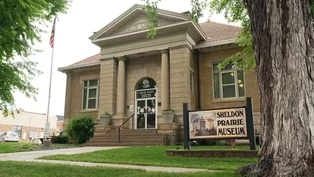
Clip: S3 Ep305 | 2m 16s | Learn about one northwest Iowa town's history at the Sheldon Prairie Museum. (2m 16s)
 New
NewWells Visitor Center & Ice Cream Parlor
Video has Closed Captions
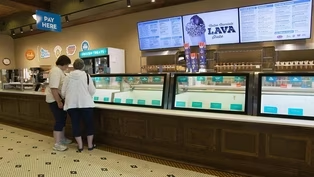
Clip: S3 Ep305 | 3m | Home to the Wells Enterprises, Le Mars is known as the Ice Cream Capital of the World. (3m)
Providing Support for PBS.org
Learn Moreabout PBS online sponsorship













Support for PBS provided by:
Road Trip Iowa is a local public television program presented by Iowa PBS