Inside the Cover: Expanded Edition
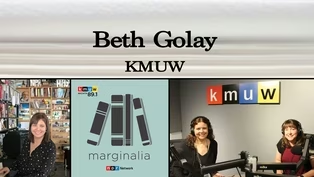
Beth Golay - KMUW
Season 3 Episode 304 | 26m 15sVideo has Closed Captions
Ted speaks with radio journalist Beth Golay about her reading podcasts and programs.
Beth Golay talks to Ted about her life and career, and what led her to the opportunity to speak with many prominent authors in her public radio broadcasts.
Problems playing video? | Closed Captioning Feedback
Problems playing video? | Closed Captioning Feedback
Inside the Cover: Expanded Edition is a local public television program presented by PBS Kansas Channel 8
Inside the Cover: Expanded Edition
Beth Golay - KMUW
Season 3 Episode 304 | 26m 15sVideo has Closed Captions
Beth Golay talks to Ted about her life and career, and what led her to the opportunity to speak with many prominent authors in her public radio broadcasts.
Problems playing video? | Closed Captioning Feedback
Where to Watch Inside the Cover: Expanded Edition
Inside the Cover: Expanded Edition is available to stream on pbs.org and the PBS app.
Providing Support for PBS.org
Learn Moreabout PBS online sponsorshipGood evening.
Welcome to another expanded edition of Inside the Cover.
As always, thanks for watching and supporting PBS Kansas and watching our show.
It is truly an honor and pleasure to have the opportunity for more time with you to discuss reading, books and authors.
In that regard, we are pleased to have a true bibliophile with us, and I believe you will enjoy the conversation tonight.
It is now time to go inside the cover.
Our guest tonight is Beth Golay from KMUW.
Beth oversees the station's marketing strategies, website, online streaming, and app.
She is also the host of the Marginalia podcast co-host with Suzanne Perez of the Books and Whatnot podcast.
Many of you will remember our fun interview with Suzanne here on Inside the Cover.
Beth is also the creator of the podcast You're Saying It Wrong, and creator of daily news podcast Wichita's Early Edition.
Not only is she a book lover, it appears that she knows her technology.
Since Marginalia launched in 2016, Beth has interviewed hundreds of authors, including Pulitzer Prize winners and Nobel laureates.
Dozens of those interviews have been featured in the NPR Books We Love App.
She is currently working towards a master's degree in Englis from Wichita State University.
As you can see, Beth Golay is talented and hard working woman and there is so much to discuss with her.
So let's get started.
Beth, welcome to our show.
Thank you so much.
It's a pleasure to have you with us.
I'd like to start and have our audience know a little bit about you.
So where did Beth Golay grow up?
I grew up in Garden Plain, just west of Wichita.
Wow.
Yeah.
So you havent strayed far?
No, I have not.
Was yours a family of readers, Beth?
It.
My sisters and I all read.
My dad read the newspaper.
He was a barber, and my mom just was this stoic German who always was working all the time.
So I didn't ever see her sit down to read.
But she always made sure we had books to read.
That was important to her.
Wonderful.
Yeah, well, and it is important.
And I won't get starte about talking about newspapers because I was a devoted newspaper reader myself back when we had newspapers.
Do you remember your first real book?
Beth?
The first book that I recall that actually showed me what books could be.
I remember in high school reading A Separate Peace by John Knowles.
And for a while I still had the copy that said Property of Garden Plain High School written in.
Wonderful.
But I looked on my shelf this morning and I bought a new one.
And I must have returned the old one, hopefully.
You know, I love that expression that showed you what a book can be, because so much of to me, our reading pleasure comes from that book and what it can be.
And that's a wonderful turn of phrase.
So how di you become a radio personality?
Oh, I was working at Watermark Books.
Ive heard of Watermark!
As their marketing manager, and I left there at the beginning of 2014 and tried to do a business on my ow to help independent bookstores across the country, and decided I needed a paycheck and realized or found out that KMUW was hiring.
And I had had a relationship with KMUW in the pas just because I was a listener.
I was a supporter.
We had the Literary Feast clu together, and so I was hired on as at the time, it was a digital content creator.
And then the next year I became marketing director.
I could go in a couple of directions there, but just briefly tell us about the Literary Feast.
The Literary Feast started in August of 2005.
KMUW approached Watermark Books and they wanted to have a book club for public radio listeners, and they wanted to have they wanted to discuss books that listeners would have heard on air.
Maybe maybe the author was interviewed on Weekend Edition or something like that.
So we would choose a book that we thought was appropriate for the NPR audience.
And we just celebrated 20 years of having that monthly book, that monthly book club.
Yeah.
That's wonderful.
That's wonderful.
And how did you acquire the skills or what led you into the technology aspect of all this?
That actually is wha my education was to begin with.
I graduated from Newman when it was still Kansas Newman College, and I had a degree in business administration and a and a minor, a concentration.
Well my concentration was marketing, but I had a minor in computer information systems.
And so I have never been afraid of the technology.
In fact, I remember I graduated and a friend of mine had the same degre and and he said, Beth, there's this new thing called windows.
We should check it out.
So everything I learned was just completely obsolete.
Except I was.
No.
I mean, what I learned was I'm not going to mess anything up if I come in here and try to code or if I. I mean, technology has never scared me.
And so that's why, I mean, I was able to blend marketin and technology and social media came naturally and working on the app, everything just kind of flowed from that first degree.
Was that a natural, innate interest of yours, or did you see the future and thought, this is an area I can benefit from?
I mean, I'm just fascinated how you read the tea leaves so quickly.
I think my dad read the tea leaves and he encouraged me.
Really didn't want you to become a barber.
No.
So tell us now about Marginalia and, well, tell us, tell us a little bit about the show.
Marginalia is a weekly show.
It started as a podcast.
I think my first three shows were monthly, an then we went to every two weeks.
And then I'm trying to think when we even started going weekly, I mean, it was almost more difficult to figure out which books to read and what authors to interview when I was only doing every two weeks.
So this just gave me more opportunity.
And in October, I believe it was the first weekend in October of this year.
It is now a show that airs ever Saturday at 11:30 KMUW on 89.1.
So it is now broadcast.
Fantastic.
And I was going to ask you I wanted you to tell our viewers where they could find your shows.
So that's excellent.
So what are the goals of Marginalia?
What are you trying to accomplish?
I try to well I read the book very carefully.
I'm a careful reader, and I try to just have a conversation with the author about just different.
I try to ask questions they wouldn't normally be asked, just in a in a short conversation.
Our interviews are anywhere from 20 to 30 minutes, and I just really try to look at the themes, look at look at what their influence.
I try to suss it out myself, try to figure out what influenced if they were influenced by other writers and just things like that.
Are the interview are the is the person with you or are you do it by telecommunication?
For the most part they are through Zoom.
Although when I have had authors in the studio with me, they have been my favorite interviews.
Because you can.
I mean, just like here.
Exactly.
We can we can follow.
I mean, Zoom, you get you get visual cues.
But I remember I had Jericho Brown, he, he won the Pulitzer for poetr for Traditions a few years ago.
And I had him in the studio because he was Poet in residence at Wichita State at the time.
And they had I mean, it was announced that he won the Pulitzer while he was at Wichita State for that month.
And I had him in the studio and I asked him, I know I asked him to read a poem, and he was reading the title poem, Traditions.
And as he was reading it, my in my mind I was thinking, I don't have a follow up.
I don't have a follow up question.
I do not know what to say.
And so he finishes reading the poem, and he shook his head, and he wiped a tear away from his eye.
And because he was with me, I was able to say, you're shaking your head.
And then he just started talking from there.
So when I've had the authors in the studios with me, it's just been really great.
Well, precisely because that's wh I so much enjoy doing our show and having a chance to interact with somebody.
It and our guests are always engaging and talented, so it's always a lot of fun.
So I totally get it.
And you know, when we did the introduction, I mentioned that you had interviewed Pulitzer Prize winners and Nobel laureates.
That sounds very intimidating to me.
And so.
Again, your preparation is always reading their book.
You read the book that's current or do you read a number of their works?
Usually the book that's current.
If I have time to go back and prepare by reading some of the other work, I will.
But it is difficult.
So typically it's just the book that they that has just been released.
And I'm not going to ask you to who your favorite interview was, but can you tell us some of the interviews that you-- were most enjoyable to you?
I think one of my favorites wa a gentleman named Hernan Diaz.
He actually was a Pulitzer winner for the book Trust, and there was just something about that conversation.
It maybe because it felt more like a conversation and less like a question and answer.
And so that was really, I mean, and it was also a fascinating conversation because that book is about four separate documents.
And he had to he had to have like guides for the people doing audiobooks so they would know exactly like a style guid for each of the four documents and things like tha just become fascinating to me.
Well, and, you know, I just have so many things that I would want to talk to you about, Beth.
But time is always a factor, as you know.
So let's just skip here a little bit.
And back in October, you told me about three books that had moved you.
Okay.
And I, as I indicated to you earlier, the books and authors I didn't know about.
Ian McEwan, because I've read many of his works and he's one of my son's favorite authors.
But the other two authors an books titles I had not heard of.
So let's just briefly, one of those books was John Boynes The Elements.
Why did that book grab you?
Well, John Boyne, I was a fan of his.
You might know him from The Boy in the Striped Pyjamas.
Yes.
Or The Hearts Invisible Furies.
Yes.
So the Striped Pyjamas, I remember.
So I've been a fan of his, but then he came out with this book called The Elements, and he wrote it in serial.
It was it was published Earth, Wind, Fire and Air.
When when Earth was bein published, he was writing Fire.
So he had to because something was already published, he couldn't go back and edit it.
And I found that fascinating.
But these four stories, they're linked usually by the characters, and it might be a minor character, but it looks it looks at abuse from four different perspectives.
And I'm going to get this wrong, but it's it's the perpetrator, the enabler, the victim.
And then one other one, I can't recall the enabler, the accomplice, the perpetrator and the victim.
Yes.
And so I mean, they-- What a fascinating topic.
It was fascinating.
And it wasn' all that pleasant to read, but I don't need my books to have bows tied up on them.
But it was really it was.
It's one I keep thinking about.
And that's to me, the mark of a good book is one I can't stop thinking about.
And then just briefly, th The Guardian and a Thief.
Yes.
Megha Majumdar.
This is her second book.
Her first book was actually longlisted for the National Book Award.
And so she's written two, and they have wrecked me.
I keep, A Burning was her first one.
They just they wreck me.
This one is set in the future.
There's not so different, not so distant future.
There are climate visas.
This one woman and her father in law and her daughter are trying to leave to get to the United States, where her husband has already gon to the University of Michigan or Ann Arbor.
He's a scientist, and he's he's looking, you know, for he's trying to find find cures for mosquito borne illnesses and to get out of the country where she is, you have to have this climate visa, which is very difficult to attain.
People only go out in the evening because it has become so hot during the day.
And they the three acquire, they have their visas and they are stolen during the night by a thief.
But the thing about this book, the thing that I loved about it, is each of these characters could be classified as a guardian or a thief based on their circumstances.
So it's a slight book, but it's very powerful.
Oh, it sounds like it.
Let's talk about McEwans book first, and then we'll go to the others you brought for.
Okay, Ian McEwan.
He has written more than 20 books.
Yeah, I know, prolific.
Yeah, this one is what we can know.
He's probably best known for Atonement or On Chesil Beach.
This book is set in two timelines.
You have present day, I think, 2014,and then you have the early 2100s where in 2014 a poet has written a corona.
It's called Corona for Vivian, his wife.
And it is.
He reads it alou as a birthday present for her.
And then the poem is lost.
And the only reason we know about this is because some people at the dinner party where the poem had been read, they talked about it.
And so, 100 years in the future you have people trying to study this poem, trying to find out what happened to this poem.
And so this book is set in the two timelines.
So the first, probably two thirds of the book take place in, in the future.
But then in the last part of the book, it takes place in the past and we find out what actually happened.
That sounded like the sort o creativity that he's famous for.
Is this his newest book?
It is.
Yes.
It just came out I believe, the end of September.
And now I want to make sure that you have a chance to talk about the 1000 books.
James Mustich.
Yeah.
Tell the audience, Beth why you chose to bring this one.
Well, I was just trying to think of books that have shaped me even as a reader, eve as somebody who has interviewed hundreds of authors.
James Mustich wrote a book called 100 or 1000 Books to Read Before You Die: A Life Changing List.
And it is just it's lovely.
He has the first, I don't know, the first 95% list the books, and his explanation of why these books are should be on your bucket list for reading them.
And then there's a checklist in the back.
And I think when I first bought this, I went through that checklist.
I mean, there are 1000 books on here.
I think I checked off 25.
It was very embarrassing.
And then I checked off probably another, another- Not embarrassing, a challenge!
It was a challenge.
I think I've probably checked off another 50 since I did.
Good for you.
Yeah.
And I too really enjoyed it.
And of course any resource for books to read or authors to read about.
That's an automatic to me.
Yeah.
And so that then I think a good segue, Beth, to in the time we have left, what kind of a reader are you?
Are you scheduled, are you determined or are you feel like you're just.
I don't want to say just, but you're reading for work.
And here I have to ask this question.
Do you write in the margins?
Absolutely I do.
I even dog ear sometimes.
I used to not, but I remember taking my first Shakespeare class and writing my first line in a book, and it was just it's very freeing and it helps me with my interview.
Absolutely.
I, I I'm deadline oriented which is probably not the best, best practice, best approach a lot of times, like I just had an intervie this afternoon or this morning and I was wrapping up the boo this morning, which is not good, but then it's always fresh in my mind.
So there are pluses and minuses for each one.
I so I'm, I'm not necessarily a scheduled reader but I am a very careful reader, and I always make sure I allo enough time to finish the book.
And yes, I do write in the margins.
Well, you know, I was always don't know whether I was taught, but, you know I grew up respectful of books.
And so it was a challenge for me to write in a book and certainly to dog ear a page.
I mean, that was a real no no.
But, you know, I guess three years of law school and lots of underlining and lots of writing in the margins corrected any thought I might have had that that was a bad thing.
And it's fun for me to go back after I read a book, let's say a few years, a few months, and to go back and read what was important to me at the time.
I read it, and I used to use those little book darts, the metal, and I would loan books out and people would come back and say, I'm trying to figure out what you were saying with this book.
Dart.
And I said, I really think it was just a page marker, sorry, it was keeping my spot.
Yeah.
There you go.
Well, here's the question I like to ask, and I think it would be a good one for you with your experience, Beth, and I had this conversation with my son over the holiday.
Does listening to an audio count as reading?
I think so for th most part, I will read a book, and if I have access to the audio, especially advanced, I will listen.
At the same time, I will do simultaneous.
It just helps me comprehend what's on the page and it it might get me into the book faster.
I talked to Marlon James.
He does the exact same thing.
So I'm going to say that it's an okay practice.
Although the interview I had this morning, it was it's called The Correspondent, Vanessa or I'm sorry, Virginia Evans.
And the book is complete epistolary form.
And I found like, if I would have to leave the book to go forwar a load of laundry or something, the book would continue in my ear, but I left it on the page and I didn't know who was writing the letter.
And so that is when I wish I would have not listened to.
I wish I would have just experienced it as as a lette was supposed to be experienced, just reading it on the page.
Well, here's a question that just.
And I should have asked it earlier.
How do you decide, Beth, who's going to be subject of an interview?
If I've heard about a book?
I really just try to pay attention to books that are coming out.
But I also receive probably 2 emails a day proposing authors.
Really?
Yes.
And a lot of the publicists, I, the publicists, I've worked with them before.
Or if they're sending me an author who I know, I've read the books before and I might not have read the latest one, but I know I've talked to the author o I'm familiar with this author, I will go ahead and say yes, yes, please.
But then there are some who I might hear a book as coming out, and I've received zero pitch, but we'll just will track down the publicist and say, is is this author available for interview?
Well, and I guess I should hav thought of this or known this.
You're the way you communicate is through either a publishing house or a publicist, right?
It's not like you're going to sit down and call McEwan up.
And say do you want to do an interview?
Right.
And are there people that.
Well, let me ask you this.
Are those publishing houses and publicists pretty amenable to your discussion?
Do you have to persuade them or they say, no, this is the real opportunity.
I mean, how do you how difficult or easy is it to engage in these, to schedule these interviews?
It's very it's very easy.
I mean, in the beginnin I was approaching the authors, but now they're asking me to talk to the author.
That's a great feeling and great acknowledgment to you and your work.
So congratulations.
Thank you.
That's got a feel good.
Are you a book collector?
Yes.
In fact, some of the books I was going to bring today, I couldn't find because they're in piles around my house and I'm out of shelf space.
But I have everything shelved, alphabetical by author, last name.
And I do divide fiction from nonfiction.
How many books would you say you have in your library?
Probably 2000, 2500.
Look at you.
I haven't read them all.
Well, I've recently discovered if I didn't know, that there are a number of books that have been on my shelves for years that I hadn't read.
And so, you know, it's a challenge.
But it's also fun to go back and, okay, I'm going to read this now, and I realize or recognize why I bought the book originally.
Right?
Are you a fan of little free public libraries?
I am, I do not use them myself.
I think a couple of times Suzanne Perez will take a picture of what's in her little library and I'll say, well, I'll take that book, but I, I am a fan, but I, I usually like to just own the book and I go to the bookstore and buy it.
Well the part of that, Beth, is that you don't like to give a book up.
Oh, I do donate.
I do donate to Little Free Libraries.
I just I'm not one to take out of the library unless it's a book that I really want on my shelf, I will.
Well it's amazing.
And as our viewers, regular viewers will know, I have one particular little free public library that's near our home.
And I check it out often, and I tell you the number of books that I have found there that I was not aware of that.
I mean, we've done a number of shows on book that I found at the Little Free Public Library.
So it's a it's a great resource.
And I love the idea of sharing and exchanging books and authors.
Yes.
So how does NPR become aware of your interviews?
They.
So for the Books We Love app This years just came out last week and so they they are aware of the sho and they will go to our website because our website is an NPR based website.
And they will, they'll just look to see if any of our interviews matc the 380 books that they came up with this year.
And they will they'll include our interview on the app.
How fun.
Yeah.
I wish we had more time.
It's been an enjoyable conversation.
I hope you've enjoyed yourself.
Thank you so much for spending your time with us and our PBS Kansas audience.
I have enjoyed our conversation and I hope there will be more of them.
Likewise.
Thank you.
That's our show.
Tonight's guest on this expanded edition of Inside the Cover has been Beth Golay from KMUW.
See you next tim right here on Inside the Cover.
Providing Support for PBS.org
Learn Moreabout PBS online sponsorship








Support for PBS provided by:
Inside the Cover: Expanded Edition is a local public television program presented by PBS Kansas Channel 8