Inside the Cover: Expanded Edition
Dr. Robert E. Weems, Jr. "The Merchant Prince of Black Chicago"
Season 3 Episode 302 | 26m 17sVideo has Closed Captions
Ted interviews Dr. Weems about his book on 20th century business mogul Anthony Overton Jr.
Anthony Overton Jr. was born to enslaved parents-- and then became one of the leading African American entrepreneurs of the twentieth century. Overton's diverse business empire grew in the Chicago area. His ties to other midwestern states, including Kansas, is explored by author Dr. Robert E. Weems, Jr. as he discusses the history of Anthony Overton with Ted in this episode.
Problems playing video? | Closed Captioning Feedback
Problems playing video? | Closed Captioning Feedback
Inside the Cover: Expanded Edition is a local public television program presented by PBS Kansas Channel 8
Inside the Cover: Expanded Edition
Dr. Robert E. Weems, Jr. "The Merchant Prince of Black Chicago"
Season 3 Episode 302 | 26m 17sVideo has Closed Captions
Anthony Overton Jr. was born to enslaved parents-- and then became one of the leading African American entrepreneurs of the twentieth century. Overton's diverse business empire grew in the Chicago area. His ties to other midwestern states, including Kansas, is explored by author Dr. Robert E. Weems, Jr. as he discusses the history of Anthony Overton with Ted in this episode.
Problems playing video? | Closed Captioning Feedback
How to Watch Inside the Cover: Expanded Edition
Inside the Cover: Expanded Edition is available to stream on pbs.org and the free PBS App, available on iPhone, Apple TV, Android TV, Android smartphones, Amazon Fire TV, Amazon Fire Tablet, Roku, Samsung Smart TV, and Vizio.
Providing Support for PBS.org
Learn Moreabout PBS online sponsorshipGood evening and welcome to yet another expanded edition of Inside the Cover.
I am your host, Ted Ayres, and I am pleased that you are spending time with us.
We have a great show for you, so let's get to it.
It is now time to go inside the cover.
Our guest tonight is a good friend and former colleague at Wichita Stat University, Robert E Weems Jr.
Doctor Weems has been the Willard W Garvey Distinguished Professor of Business History at WSU since the fall of 2011.
Before coming to WSU, he taught at the University of Missouri and the University of Iowa.
A native of Chicago, he received his Ph.D.
from the University of Wisconsin.
During his academic career.
Professor Weems has publishe and spoken widely in the areas of African-American business and economic history.
Besides his published book, The Merchant Prince of Black Chicago, which we will be featuring tonight, Doctor Weems has authored four other books in the realm of African American business history, as well as nearly four dozen journal articles, book chapters, and encyclopedia entries.
Professor Weems served as a historical advisor and appeared in the documentary “Boss The Black Experience in Business”, which premiered on PBS in April of 2019.
More recently, in June of 2021, Doctor Weems was the keynote speaker at a program sponsored by the regional banks of the U.S.
Federal Reserve entitled “Racism and the Economy: Focus on Entrepreneurship”.
During his time in Wichita, Weems coordinated the Wichita African-American Business History Project, where he gathered information relating to the history of local African American entrepreneurship.
In September of 2017, Professor Weems donate audio, interviews, transcripts, and documentary material he generated from this project to the Special Collections Department at Wichita State.
Doctor Weems has also served on the Board of directors of the Kansas African American Museum, holding the role of president for multiple terms.
He currently serves on th museum's collection committee.
We reviewed The Merchant Prince of Black Chicago in season three of Inside the Cover, and I'm excited to have Doctor Weems join us tonight so we can take a more detailed look at the book and Doctor Weems thoughts on Mister Overton, Chicago in the 1920s, and African American business history.
Robert thank you so much for joining us tonight on Inside the Cover.
My pleasure.
Ted.
And as we were talking before we started, there has been more in your activity, scholarship at Wichita State that you've recently finished.
Yes.
After I finished the Wichita African-American Business History Project, I've engaged in a couple collaborative projects with, WSU colleagues, Jay Price in the history department and Sue Abdinnou in the Barton Business School.
And recentl we completed a project called, “Wichita Nonwhite Business Owners Tell Their Stories”.
This was linked with a bigger project out of University of Kansas called “Stories for All: A Digital Storytelling Project for the 21st Century”.
And it was sponsored on that campus by the Hall Center for the Humanities, the Institute for Digital Humanities at KU, and was funded by the Mellon Foundation.
And “Stories for All”, in fact, was looking for similar type of projects in the state.
And we hooked up with them.
And in fact, they provided the funding for the, “Wichita Nonwhite Business Owners Tell Their Stories” project.
And ultimately, these interviews and transcripts- these were video we did video, recorded interviews with, five African American entrepreneurs, five Asian American, entrepreneur and five Hispanic entrepreneurs.
Wow.
And ultimately, these, recordings and transcripts also be stored in special collections.
Fantastic.
That sounds like a wonderful project.
Yeah, it it ties in nicely with my previous work.
And also, Jay and Sue had done some similar type of work with nonwhite entrepreneurship here in Wichita.
In the introduction.
Doctor Weems, I noted that you were a native of Chicago, but where at specifically?
The South side, on the south side.
South side.
Did you know President Obama?
No.
President Obama showed up on the scene after I left.
Robert, were you a reader as a young man?
I was a pretty active and avid reader.
Interestingly enough, and this is something that I remain indebted to my parents.
You know, they made a point of having a variety of reading materials around the house.
In fact, I was a type of kid that, they brought me the American People's Encyclopedia set, and I literally read the entire encyclopedia.
Among the books they had around the house, and I think which really helped influence my later career was Carter G. Woodson's classic book, The Negro in Our History.
So, yeah, I grew up with, a love for reading and.
Well, and of course, I love that and appreciate that.
And, I would suggest to you and our audience it has served you well.
Favorite authors, as you were growing up.
As a child of the 1960s and at that moment in time, th evolving black power movement.
You know, there were certain individuals that I follow very closely.
And one of them, there was important book published in 1967 called Black Power The Politics of Liberation, that was coauthored by, Charles V. Hamilton, who was the most prominent black political scientis at the period during the period.
And Stokely Carmichael, who later changed his name to Kwame Ture.
And in fact, one of th highlights of my life was that, Charles V Hamilton, in fact spoke at the Black History Month progra in my undergraduate institution, Western Illinois University.
And this occurred right after the, you know, the killing of Fred Hampton in December of 1969.
So there was a lot of tensio still related to that episode, because a lot of people in Western were from Chicago, and I'll never forget this.
And it ties back, interestingly enough to Mizzou in an interesting way.
There were two keynote speakers for this, Black History Month event.
The first one was Bobby Rush, who at the time was the Illinois chairman of the Black Panther Party.
But he was not in the apartment with Fred Hampton when Fred Hampton was, you know, killed by Cook County sheriff's personnel.
And Bobby Rush gave this rather impassioned speech.
And I remember the student newspaper afterwards, you know, they just roasted, Bobby Rush.
You know, he was crude he blah, blah, blah, blah, blah.
And two weeks later, Charles V Hamilton spok at Western Illinois University and he pretty much ha a similar message to Bobby Rush, but on a higher intellectual plane, because he clearly bega his presentation by saying that, you know, “My credentials are equal or exceed everybody's credentials in this room.
You may not agree with what I have to say.
So but you have to respect it.” And I couldn't wait to see what the student newspaper had to say the next day.
And it was literally crickets.
Fast forward about 22 years later when I was at Mizzou, and I think that was a 1992 Black History Month program.
And Charles V. Hamilton was the keynote speaker.
Small world.
And I had the opportunity to, you know, escort him around campus during the day.
He had just published a book on, Adam Clayton Powell.
And in my introduction, I sort of shared with the students, you know, the impact he had because that really struck me in the because I had never really seen because growing up on the South Side of Chicago, they really didn't come in contact with too many black scholars.
And again, Charles V. Hamilton just was so powerfu and self-assured in his message that that was somethin that, again, he was sort of a, a mentor fro afar for me as I was coming up.
You know, that is a wonderful story Robert, and really leads into, my question I had here.
At what point did you decide on an academic career?
Was it this experience tha helped push you towards academe?
Well, at Western Illinois, and I have to admit, when I first went to Western again, I was a first.
You know what they called their first gen student, I really wasn't sure what I was going to major in.
Even though I liked history all my life.
Well, I really wasn't sure what I was going to major in, but I sort of noticed how, you know, some of the history professors at Western they appeared to be respected.
The lifestyle seemed pretty good.
And also, I minored in in black studies at Western and the, chair of the Black Studies department at Western, who was an African scholar.
And I did well in those classes.
And one time he met with me after class and said, well, Robert, we need more African Americans seeking to get the pH D. And I had neve even really thought concretely about the PhD.
But hearing the word from Doctor, that was something that, you know really made an impression on me.
And again, just observing the history professors at my undergraduate institutio that really kind of put the bug in my ear in terms of wanting to pursue this for a career.
You know, I love that.
That's that's a great story.
So let's let's, turn to Mr.
Overton.
Okay.
And I'm going to read real quickly her the introduction from your book.
“Anthony Overton is widely regarded as one of the 20th century's most significan African-American entrepreneurs.
The first businessman to win the NAACP prestigious Spingarn Award, Spingarn Medal, in 1927.
Overton, at the peak, presided over a Chicago based financial empire that included a personal car products company, an insurance company, a bank, a popular periodical, and a newspaper.
Moreover, due to these accomplishments, he is currently cited by the Harvard University Business School's database of African or Excuse Me, American Business Leaders of the 20th century.
As the first African American to head a major business conglomerate”.
How did you discover Mr.. Overton?
I discovered Mr.
Overton through my sor of general interest in Chicago African American history and more specifically, Chicago African-American business history because of the fact my PhD dissertation and first book was on a local African American insurance company.
And, and looking at, you know, Chicago African American history, Anthony Overton's name continually came up.
So that was the thing tha really got Overton on my radar.
How long Robert did, your research for the book take?
It took about a little over ten years.
I actually began in 2009 and actuall finished up the writing in 2019, and the book was published in 2020.
Well, it's very clear from reading the book, and one of the things I really enjoyed was, to me, your efforts to really explain Overton and what he accomplished, ho he accomplished it, his family really dealin with a lot of the history.
But, it was clear to me that your work was very well researched and based on a lot of sweat and effort by you.
So I applaud you for that.
And it comes through in the book.
That your title specifically refers to Black Chicago.
Did he have an impact on the city as a whole?
Well, that's a great question Ted.
When we look at Chicago and a lot of major cities in the 1920s, especially, you had this growing notion of something called the black metropolis, where, in fact, we saw African-Americans, you know, increasingly coming to the conclusion that it would be in our best interest to, in fact, focus our attention on building up, you know, the quote unquote, African-American section of the cit to be the be as prosperous and, and is, you know commercially viable as possible.
And while other peopl in other parts of the city were, well aware of Anthony Overto and his activities were still, I think his focus was on trying to really make Chicago's version of the black metropolis, you know, the most successful, in the country.
I want to-- so many things I want to talk about.
Robert, I don't know whether one show is going to be enough, but, I want to make sure that we talk about, I was interested and learning about Mr.
Overton's ties to Kansas, including Lawrence and Topeka and also Oklahoma.
But it's of interest to me.
As you can imagine, there seems to be a bi of a question as to whether, Mr.
Overton earned a law degree or not.
Yeah.
That's one of the more fascinating things about the Overton work is that, you know, again, historians you know, we trai when you working on a topic to, you know, sort of pr examine the existing literature.
To first of all, see what's been written on the subject and that helps you to see, you know, how you could make an original contributio to, you know, Anthony Overton's, biography or biographical information.
And in looking at various, preexisting works, Overton was depicted as a literal young black Renaissance man, you know, between his 16th and 31st birthdays that sort of correspond to 1880 to 1895.
He was allegedly a teenage business prodigy in Topeka.
He went to Lawrence and earned a law degree and returned to Topeka as a municipal judge.
Also, he went to Oklahoma, you know, participating in the land rush of 1889 and establish, you know, some successful businesses in Oklahoma.
And you know, was electe to political office in Oklahoma.
And to top it all off, he worked in the sort of the quintessential black male occupation during this period, allegedly, he worked as a Pullman porter for a time.
So in doing, again, preliminary research, and there was this one important book on blacks in Topeka that I looked at, and Overton was absent.
Another important book on the black experience in Oklahoma, one of the more definitive works.
Overton was absent.
So, so what's what's going on here?
And what complicated matters even more, the Overton Project was especially challenging in that and I discuss this in the book, was that his business records were in fact destroyed by his great by his grandson when the business closed in 1983.
So again, you know, the the main core documents tha historians generally rely upon, you know, core like business records of what have you those have been discarded.
So the fascinating thin and I could laugh about it now, but at the time it really wasn't that funny, is that had literall had to be a historical detective and just find everything that I could.
And there was a lot of stuff out here about Overton, but then the task was determining what was true and what was false.
And one of the ways I was able to do that was to take, you know, detailed research trip to various points in his life.
Monroe, Louisiana, was where he was born and lived the first you know, 15 years of his life.
Overtons father who was an important influence on him, Anthony Overton senior, also known as Antoine, was a noted, black merchant in, Monroe.
He also served in the Louisiana State Legislature.
And in fact, when the Confederates retook control of Louisiana after 1876, Anthony Overton senior was targeted.
So, in fact, the family became part of the Exoduster movement to Topeka.
Fabulous history, fabulous history.
And as you were talking abou and I think you do a great job in the book, shall we say, these discrepancies in his history pointed out very politely, but very effectively.
But I guess it is clear that he did attend Washburn.
And Washburn comes in to play.
Is that Washburn, as late as the 60s, published information that Overton in fact, got his law degree from Washburn, I believe, in 1888.
And what complicates that story was that Washburn didn' start his law school until 1903.
So for a variety of reasons, I think when Overton became this very prominent individual.
You had some these other source that wanted to take advantage.
Exactly.
Or he had a great press agent.
Right.
Coming dow to the end of our show, Robert and I got so many questions I want to ask and talk about, but a couple things.
Let's get to, as quickly as we can before we have to end the show.
What caused Mr.
Overton the demise of his financial empire?
Part of the demise of this financial empire was a big part of it was the Great Depression, because there were some things that were beyond Overton's control, because you had a lo of business people of all races that were destroyed right during the Great Depression.
But interestingly enough, perhaps his greatest success during the 1920s was when he started the Victory Life Insurance Company.
And Victory was literally the first African-American and the first Illinois based insurance company that was qualified to do business in New York, because New Yor had very stringent requirements and that, among other things dramatically contributed to him winning the Spingarn Medal in 1927.
But when we get to the 30 and the New York territory was clearly the biggest territory in the Victory Life, orbit when it during the early part of the depression, the people from New York, they pressed Overton about putting more New York based people on the board of directors.
And Overton, in fact, had a board that was pretty much stacked with his children and other a friendly right, a very friendly board.
And that created a very public rift where Overton, in fact, suffered, you know, severe damage, you know, to his reputation, reputation and credibility.
Credibility, the Douglas National Bank, which he was the president of also, was one of the casualties of, of the Great Depression.
And one of the things, too, that again, hurt his reputation during, the depression was that, you know, because he was president of both companies and Overton was the type of gu that he'd like to be in charge, that he would move mone from Douglas National Bank from, you know, Victory Life Insurance Company to help prop up the Douglas National Bank.
And when this became, public knowledge that, you know, added fuel to the fire.
So there were a variety of things sort of external as well as internal things that caused his demise.
Real quickly, Robert, if you can summarize and I was I read the book originally and have looked at it, reread it again.
Can you summarize why Anthony Overton Jr's life and career is important today?
It's important in that, among other things, we see, you know, just the power of determination, you know, you know just determination to succeed.
And one the points I make in the book is that, you know, these attempts to sort of ove blow his early life on one level seem to be misguided in retrospect because his later success is undoubtable.
But I think knowing tha this was someone that really had to struggle in order to ge where he was, I think would help contemporary individuals to appreciate what he did all the more.
And the fact that even today, at this exact moment, you know, Overtons business, last business closed more than 40 years ago.
But still Overton's name is is highly thought of and to his credit, before he died in 1946, he was able to significantly rehabilitate his image.
So at the time that he died a lot of the negativity of the, 1930s, it dissipated.
And one final point, when we talk about Overton and his complexity on one level, Overton, you know he had a tendency to exaggerate, his just some of his past accomplishments, but he really wasn't a bragger type.
He was a non-- pretty non-assuming, non materialistic type of individual.
In fact, he reminds me a lot of Warren Buffett.
You know, someone that you know has made a lot of money in business.
But the perks of business really weren't that important to Anthony Overton.
You know, just a lot of strategic planning in the deal making because he never owned a car.
He walked to work, even though he was a millionaire.
Unlike some black entrepreneur like Madam C.J.
Walker, one of his main competitors who built this mansion on the Hudson, Overton, who was a widower by pretty much from 1950 onward, he pretty much lived in the spare bedrooms of his children.
Interesting man, interesting man.
And, interesting book.
That's our show.
Tonight, our guest has been Doctor Robert E Weems Jr, and we have bee talking his book about Anthony Overton Jr, The Merchant Prince of Black Chicago.
Great book, fascinating history, very well told and Robert, it has been a real pleasure to have you on the show.
I'm sorry it's taken me so long to get you here, but thank you and good night, ladies and gentlemen.
We'll see you next time on Inside the Cover.
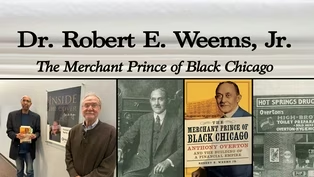
Dr. Robert E. Weems, Jr. "The Merchant Prince of Black Chicago"
Preview: S3 Ep302 | 30s | Ted interviews Dr. Weems about his book on 20th century business mogul Anthony Overton Jr. (30s)
Providing Support for PBS.org
Learn Moreabout PBS online sponsorship












Support for PBS provided by:
Inside the Cover: Expanded Edition is a local public television program presented by PBS Kansas Channel 8