Empowering Seniors
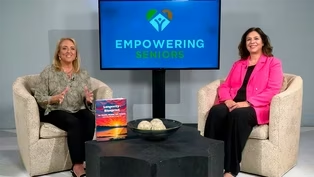
Empowering Seniors Episode 601
Season 6 Episode 1 | 25m 45sVideo has Closed Captions
Empowering Seniors with Katherine Ambrose Fridays at 8:30pm
Empowering Seniors with Katherine Ambrose Fridays at 8:30pm
Problems playing video? | Closed Captioning Feedback
Problems playing video? | Closed Captioning Feedback
Empowering Seniors is a local public television program presented by PBS Kansas Channel 8
Empowering Seniors
Empowering Seniors Episode 601
Season 6 Episode 1 | 25m 45sVideo has Closed Captions
Empowering Seniors with Katherine Ambrose Fridays at 8:30pm
Problems playing video? | Closed Captioning Feedback
How to Watch Empowering Seniors
Empowering Seniors is available to stream on pbs.org and the free PBS App, available on iPhone, Apple TV, Android TV, Android smartphones, Amazon Fire TV, Amazon Fire Tablet, Roku, Samsung Smart TV, and Vizio.
Providing Support for PBS.org
Learn Moreabout PBS online sponsorshipFrom the Alvin and Rosalie Sara Check studio.
PBS Kansas presents Empowering Seniors.
Welcome to Empowering Seniors.
I'm your host, Katherine Ambrose.
Today we've got the longevity blueprint for you.
Meet doctor Carina Loya.
She drove up from Texas to be here for PBS Kansas viewers.
Welcome, Karina.
Thank you so much for being here.
Thank you, Katherine, for having me.
I love your book.
It is so detailed.
What inspired you to write this?
You know, Katherine, I work with a lot of seniors and their families, and one of the things that I saw over and over again was the fact that all of a sudden, they would have a medical crisis.
And before you knew it, there was a financial crisis.
And it wasn't just for the couple.
It was for a generation as family members started to make decisions about how to care for mom and dad, and then they started having to take money out of their pocket or quit jobs.
And so it really has a huge impact.
So that's what drove me to write the book.
And so tell us a little bit about the book, how you helped prevent that and helped families prepare.
Okay.
Well, I began the book with purpose because it is so important that as we get older, we recognize that we're still human beings and we still have passions and purposes that we want to be able to leave a legacy.
And so finding out what it is that drives people is really important.
And, you know, also from a health behavior point of view, that's what's going to keep them on track with new behaviors.
And one of the things that I want is to try to help people plan ahead, take care of themselves so that when they get to be older, they're able to have the best quality of life possible, because that is going to predict how long they live, how well they live, how much they have to depend on other people.
And it seems that when people kind of lose purpose or lose being forward focused, that that really is depression.
And so what can individuals do or families do to recognize that and bring joy back in?
Well, the most important thing to do is to recognize that if your family member seems to be telling you the same story over again, right.
Well, what did you do?
Oh, I didn't do much or I just, you know, did the garden and you realize that they're just doing things that keep them at home.
You need to ask, well, when's the last time you got together with your friend Susie?
Or have you gone out to lunch with this group or that?
And really prompt and encourage them to do those type of social events.
And if they're not doing that, we need to find out why.
Is it because they're concerned about driving?
Is that because they have hearing problems and then they can't hear and get overwhelmed during that?
So there are lots of different reasons why people stop socializing yet, but it's important to keep them engaged.
That's the most important thing.
What is the danger of being at home all the time?
The biggest danger is that depression, you know, and the other thing that people don't really recognize is that falls 60% of them happen within the home.
So if you've become isolated and you've become depressed, then you're moving less.
So then your muscles are starting to be weaker and your balance is starting to go.
And so it is a snowball effect that happens.
Whereas if you're going out and engaging, you're at least walking to the grocery store, walking to meet your friends.
That keeps you going.
And it also keeps you thinking about taking care of yourself more, because the more isolated you become, the less you talk to people, the more monotonous your life becomes and you start losing your appetite.
You've stopped taking care of yourself and you really just stop moving.
And we all think that as we get older, we need to slow down.
But that is such a myth.
There's so many people that they retire 60 or 65 years old, and they decide that they're going to change their life and start exercising, In fact, you know, one of the greatest things I think that has happened to our aging society has been this whole pickleball craze.
Because people who have been quite sedentary, because of their jobs suddenly are finding a new way to engage with people.
And this physical activity is so critical to getting us to have higher quality of life as we age, because the healthier we are when we get older, the more likely we're going to be able to keep our independence and be able to do anything and everything we want to do as we get older.
That's so true.
So, you know, prevent yourself from misery and and be able to still take care of yourself as long as possible by being active.
I've never heard anyone say that.
That society tells us it's time to slow down, when in fact danger will Robbins.
That's maybe not what you want to do.
No it isn't.
And you know, our whole life we get taught to save for our retirement, right?
And everybody goes trying to climb that ladder.
And then they also try to make more and more and more money.
Right.
And that usually means more and more time in front of the computer and sitting down.
But what they don't talk about is how important it is to save your body for retirement, because that's going to predict the quality of life that you have.
Do you want to travel when you get older?
Do you want to be able to squat down and have fun with your grandbabies, right?
Or chase them around and play tag?
I mean, I think those are such important things about being an older adult, but we think, oh no, you know, I get home from working out or being, you know, going to work and I'm so tired and all I want to do is sit in my recliner.
Well, that recliner is killing you.
It literally is putting your body in a position in which you're squashing down on your lungs.
And yeah, you're getting more tired because you're not breathing, right.
And a lot of people don't understand the importance of sitting up straight and the posture and the whole movement biomechanics, what they call the movement of the body in giving you energy.
And a lot of times, the reason exercise gives you so much energy is because suddenly you're upright again, you're moving around, you're bringing lots of oxygen into your body, and then the energy just kind of multiplies.
But there's a whole science behind that because, Doctor Cuddy studied the effect of the power pose, which is that, you know, the Superman pose or Wonder Woman pose.
And in two minutes, it totally changes the biochemistry of your body.
That would be the hormones.
So now you feel powerful.
Now you feel the energy, and it totally transforms you.
But you gotta get up out of that recliner and do something, anything.
I just was listening to something yesterday where they're talking about the mind body connection, that we think of them as being two separate things, but they're really connected.
So that's really resonating with me, that the exercise improves how you're thinking as well.
Well, the fitter you feel, the more able you feel to do things, the happier you're going to be.
It also probably, makes a difference on how people treat you too, if you can maintain your vitality as long as possible.
Well, it does.
I mean, just think about the older folks that you know, and you see some of them and they're all hunched over and they have the cane.
What do you think about them?
They immediately look frail, right?
Whereas you can see some other people who are 90 years old and they're standing up straight and proud and tall, and you look at them and you're like, oh, wow.
They look like they're 70, 72.
And in fact, they're 93, 95.
And it really is all about these little lifestyle choices they've made all along the way.
And a lot of people think, well, you know, I have an exercise in 30 years, I'm doomed.
No you're not.
That's the beauty about the human body is it is super forgiving.
And even if you have to start with just a five minute walk because that's all you can do.
Start with your five minute walk.
But just don't do it once.
Do it like five times a day, and that gives you 25 minutes worth of walking.
And then next week, let's push it up a minute so that you're up to six minutes.
Now you're doing 30 minutes.
And eventually you'll be able to do 15 to 20 to 30 at a time and then go from there.
There's also functional medicine treatments and other holistic treatments that can help if someone's already hunched over, to help help do things with modern technology and modern science so that maybe you can get back out there.
Well, let's talk about people that maybe are homebound at this point because of their disease process or whatever it might be.
When people are homebound, if they're really isolated, maybe they're not eating that.
Well, what are your thoughts kind of on that?
Well, I think the most important thing is you have to have a human connection every single day.
And the reason that is so important is, well, there's a couple of reasons, but my most important reason is I don't ever want to hear of somebody who fell and wasn't found for three days.
That happens all the time.
It happened to one of my great uncles.
His family only checked in on him twice a week, and he happened to fall in right after hanging up the phone with them.
He spent three days on the floor.
And when people don't realize is that the amount of time that you spend on the floor predicts how long you're going to live afterwards.
And one third of falls require an hour visit.
And if those a third of them end up hospitalized, and of the third that end up hospitalized, a third of them die within 30 days and another third die within the year.
Wow.
So we need to prevent falls, and they're preventable.
Well, and the thing is, if you fall, can you get back up?
And we really need to talk about that.
Yeah.
Can you get back up?
Should you be living at home?
If you're in the kind of condition that you fall, you can't get up and you're at the mercy of someone coming to save you.
I mean, that's a big question right there.
Well, you shouldn't live alone if you're in that condition.
Now, if you have a spouse that's there, that's different.
Maybe.
And I say maybe because I've seen the spouse that is five foot two with the spouse six foot seven, she's never going to be able to get him up.
She might even hurt herself.
And even if you're about the same height and weight, you can hurt yourself.
So that's an issue.
So you really need to consider is the home that I'm living and working for me?
Yeah, I run into a lot of spouses where they're both falling all the time, and so that's not good.
No, but there is one thing maybe that you could talk about, which is age, tech, how modern technology could help.
If you're able to holler out to Alexa or to Siri, Siri, call my son.
Yeah, Alexa, call 911.
Absolutely.
And if you wear smartwatch, they can even detect the fall.
There's a ring thing that can also detect if something's fallen.
with Alexa, you can definitely call out and say, Alexa, call 911.
Alexa, call my daughter or whoever it is, right?
And that works really well as long as you're conscious.
But sometimes you're unconscious and you haven't fallen.
You have diabetes and you're in a diabetic coma in your bed.
Who's going to find you?
Are you going to help get the help that you need during that time?
People don't think about these things and they're really important.
And doctors don't even talk to you about them, which is one of the things that I'm working on, is trying to get that message out, that it's really important that you either set up a best friend or family member to text every morning, hey, I'm awake, have a great day.
Hey, I'm going to bed.
I have a great day.
And if any one of those two are missed, then somebody needs to reach out on the phone and make sure that everyone's okay.
Right.
So important.
So the reason why people stay at home, even though they have these things happening, is they want to maintain independence.
But just the reverse can happen if you're not able to, get yourself taken care of in case of an emergency.
And then now the independence could be gone.
That could be the end of it.
One fall could could make that all go away.
And so being able to have measures in place to be able to come back home.
Well and that's really important.
People really think that the most important thing is their independence and they want to stay in their environment.
And I understand that because, you know, you built this environment.
It has memories.
It's comfortable.
You've set everything up where you want it.
And some people even have a command center of all their stuff around them, which, you know, could be clutter for some and dangerous and cause the fall for others.
But it is a comfortable place.
But the other thing you have to think about is elder abuse.
Right.
And neglect.
And most of the time we don't have conversations about that.
But if somebody is living alone and they're not feeding themselves, they're in a situation which they're neglecting their basic needs.
And one of the things about not eating right as we get older is something called sarcopenia.
We all know about osteoporosis, right?
Our bones get porous.
They get brittle.
But sarcopenia is where our muscles start to waste away, Wolf.
Our muscles waste away.
We're not able to move as well.
Our balance goes.
We're more prone to falls.
Our metabolism goes down.
We gain fat, weight, not healthy weight.
And so we need to focus on getting enough protein multiple times throughout the day.
But that message isn't getting out there to our seniors.
And that is so important.
And that actually needs to be getting out to people in their 30s, because women, especially this whole sarcopenia osteoporosis decline starts in your 30s.
So we need to get that message out.
But going back to the neglect part of it, you're neglecting yourself.
Maybe you're neglecting yourself and your spouse because you just can't take care of yourself.
And so when you start looking at I'm not eating right.
I'm not sleeping well, I get up to the bathroom, I'm falling.
We don't need to wait till the seven red flags happen before we seek help.
There's so many places where we could go.
Where we could be safer.
You know, and have a lot more fun.
Oh, absolutely.
You know, talking about maybe, multi-generational living.
Yes.
Or senior living communities where you're living amongst cohorts.
What can that do for you, living among people that you know, came up in the same time you did and raised for families and had similar life experiences?
Well, I think there's so many things that can happen.
I mean, I remember as a kid, one of the most fun thing to do was run outside in the morning.
A Saturday morning, right?
Go three houses down.
My best friend was there and then we played and had a great time.
When you live in the senior community, you can have that same kind of a situation because they also are looking for something to do.
And many of these communities, gosh, I mean they're so beautiful nowadays.
They're like going on a cruise ship on land, like living on in it over and over every day.
They've got entertainment, they've got educational programs.
I mean, they're incredible places.
And I think people are just scared of, oh, well, you know what?
If it ends up being that nursing home of way back when I was a kid and would go visit granddad and that nursing home stank and, you know, it's not going to be the quality I want.
But when they start experiencing it, it's like transformational for a lot of people.
Well, the beautiful retirement communities are amazing.
And so you can really maintain your independence there because they have so many activities where you can come and go if you're able to drive.
And then those that aren't driving, they have so many ways to provide transportation for you to, take groups of people that want to go to participate in different things, but also right there in the community, there's so much to do.
So you're actually moving into what I think is kind of a mansion environment where you can stay in your royal quarters, your private quarters, that you can then go out and go to the fancy theater.
You can get your hair nails done, you can go the fitness center, you can listen to music, arts and crafts, just all kinds of things.
Yeah, I mean, it is really a neat environment.
And if you embrace that, one of the things that you find is you're actually walking more because even though you're inside, you're going down these hallways to go to that activity, then you're going down the elevator to get to the next activity.
Now, if you really want to be healthier, you may take the stairs on the way up.
Going up is easier on the knees than going down.
And one of the real important things about that is that there's a lot of studies that show that the strength of your leg muscles is a really good predictor of your longevity, as well as that quality of life that you're going to have.
And so I encourage people to go up the stairs.
It's easy on the knees going down the stairs.
It's a little bit more risky.
And it is a little bit harder on the knees.
So go up the stairs.
Okay.
Well then the neat thing too, you know, in Kansas it gets cold and and so a lot of times people are very isolated in the winter in their home.
And they may not have that much room to really walk and exercise.
But if you're in senior living, you can, you know, walk the halls and do different things.
Yeah.
And many of them have all sorts of equipment in a room.
And, you know, if you love to read, I tell people, go read on the stationary bicycle.
Get a little bit of extra movement and exercise.
Yeah.
Very good.
What else do you cover in your book?
How does this book really help people prepare?
Because it kind of is like a workbook to it is kind of a like a workbook.
So I wrote it in a way as if you and I were having a conversation.
I was coaching you through the most important things you have to prepare for in life.
And I titled it health, Wealth and Purpose because those are the three key things that I address.
So the purpose we talked about that earlier in the segment, finding out your passion, your purpose, what are you going to do in this last part of your life?
The wealth.
I'm not going to make you wealthy, but I am going to help you protect those assets.
So I talk about the team that you need to be able to protect those assets.
A lot of people don't know about the five year Medicaid clawback, and they think that you have to spend down to under $2,000 before you can qualify for Medicare.
And that is not necessarily true.
And so it talks about strategies to be able to do that and who to talk to for that purpose.
And then the health part of it is a huge portion of it.
And one of the things that it also addresses is all those documents that we've like, put off forever that we think is for seniors only, you know, the wills, the trust, the DNR, the employees, medical power of attorneys, the durable power of attorney as well.
But the reality is that those are things that are adulting 101, and we really should have put them in place when we were 18 years old.
And then we should be updating them since.
But, you know, less than 50% of people in the US have a will.
Wow.
And the will is just starting point.
It is just so there's many essential documents that you should have only if you're 18 years of age or older.
Correct?
Right.
It's only if you're 18.
Yes, yes.
So many of us are 60 years behind on getting those documents in place.
We should be talking to our great grandchildren about getting these documents in place.
We really should.
Exactly.
And especially the medical power of attorney.
But you don't just give somebody the medical power of attorney.
You have to write a living will, which is what do you want to have happen to you in different circumstances.
And even, you know, how do you like your coffee?
Do you like oatmeal?
Because if they try to feed you oatmeal and you're like, spitting it out because you don't like it, and they think, oh, she's just being difficult.
Well, no.
You've never liked oatmeal.
Why are they feeling you of milk?
Because you never told them you don't like a bill.
Right.
And so you need to express some of these things and honestly writing them down.
And you don't have to sit down and do it all the time.
I would get a bunch of notecards and just hold them and start writing little notes about, oh, I don't like oatmeal.
Oh, I like my coffee with cream and two scoops of sugar.
Or I prefer a different sugar substitute, whatever it is.
But you have to let people know otherwise you're not going to get the care and treatment you need as you get older.
It's important.
Yeah.
Good point.
So this is only if you want to be nice to yourself.
Yeah I mean yeah.
And do you want to make have them make all the choices.
Or do you want to make the choices and give some instructions about the care and feeding of you.
As Sam Craddock says the carrot and feeding of you.
Karina, what led you to become a gerontologist?
Well, you know, it's actually a very interesting story.
So I grew up in Mexico City, and when I was finishing high school, we got a phone call from my grandfather asking if the family would move back to San Marcos, Texas, to be able to help with grandma who had Alzheimer's.
And my mom was like, there's no way my dad was working for the government's milk industry.
And so there was nothing we could do.
And I said, well, wait a second, mom, I can go.
I'm going to be done graduating here in a month.
Why don't I go?
And I just really, honestly wanted out of Mexico.
The traffic was horrible.
Quality of life in my opinion, was horrible.
So going to live with Grandma and grandpa, that's how like a blast.
So at 18 years old I like this.
Sounds really good.
It's how hard can it be?
So I moved in with Grandma and Grandpa.
Call them Mama Hank and Papa Coke.
Amazing.
I always love spending time with them.
Well, three months after I get there, I get woken up.
And because I heard.
Help, help.
And so I went looking to see what happened.
And my grandfather had fallen in the bathroom floor.
Now it turns out he did just fall.
He had a stroke.
But I got him up off the bathroom floor, got him in that chair.
Eventually, we ended up taking him to the E.R.. It turns out, you know, he had a stroke and ended up wheelchair bound.
And so now I have a grandmother with Alzheimer's, a grandfather that's wheelchair bound, and that he was six foot seven.
Yes, 280 some pounds.
And I'm only five foot nine.
And I'm having to now help take care of him.
Well, three days after that, I turned 19.
So I was thrown into caregiving for older adults.
And I always loved working with them.
And honestly, at first I didn't know what I was doing and just kind of learning by trial and error.
And I'm sure I made a ton of mistakes, but I really enjoyed the experience.
And so that's what led me eventually to work with older adults is because I had that life changing experience with them.
Wow.
And that's set you on a path that's just been incredible.
Yes it did.
And then you also own a restaurant.
I tell us what you're doing for seniors with your restaurant.
So at the restaurant the restaurant's called Salerno Cucina Italiana.
And I decided the perfect name for the senior group would be Salerno Seniors.
And so we're promoting Salerno seniors.
It's a fun way for other seniors to get to know each other and also to learn more about aging, healthy and longevity.
And so on Tuesdays at lunch, we're telling people to show up for the No Senior Eats Alone program so they show up between 1145 12.
We greet them, we get to know them a little bit.
We either sit them at a small table so we don't ask them if they have hearing problems.
We said, do you prefer to sit one on one or do you prefer a large group?
If you don't want to ask them about their hearing issues?
But we know that if they want to sit one on one, that's what it is.
But if they want to sit with a group, then we put them at a very large table.
We have a 12 person table and we can add to it.
And so that's on Tuesdays.
And then on Thursdays we're going to start mid-October doing the I call them mini lectures.
And so every Thursday there's a different theme.
So one of the things is like as a health care professional, so we'll have them come in for 15 20 minute mini seminar and then they can ask questions and we'll all be together and just get to know each other.
Another one would be the Longevity Lunch.
So talk about longevity.
The first one of the month is first things first.
So it always be a topic about maybe putting your health first or putting your finances first, or your documents in place first.
Right?
It just depends.
And then the other one is, I know a lot of authors and a lot of seniors love to read, and so I'm bringing authors to kind of tell their story about why they wrote that book.
And, be able to just get to know people.
Wow, that is so inspirational.
And I'm sure you're adding a lot of joy to people's lives and you're bringing more people into the restaurant.
Yes.
And just making it, a wonderful experience.
It is.
It has been wonderful.
Well, thank you so much for everything that you've contributed.
With Longevity Blueprint and everything else you're doing.
We really appreciate you traveling to Kansas to be on empowering seniors.
Of course.
Thank you so much for having me.
It was our pleasure.
And thank you so much for tuning in.
If you have questions about this topic or anything else that we cover, please reach out.
You can reach us at 316-686 4500 or email us at Empowering Seniors at KPTS.org I'm Katherine Ambrose and I'll see you on the next Empowering Seniors.
Empowering Seniors Episode 601
Preview: S6 Ep1 | 30s | Empowering Seniors with Katherine Ambrose Fridays at 8:30pm (30s)
Providing Support for PBS.org
Learn Moreabout PBS online sponsorship
- News and Public Affairs

Top journalists deliver compelling original analysis of the hour's headlines.

- News and Public Affairs

FRONTLINE is investigative journalism that questions, explains and changes our world.












Support for PBS provided by:
Empowering Seniors is a local public television program presented by PBS Kansas Channel 8