Empowering Seniors
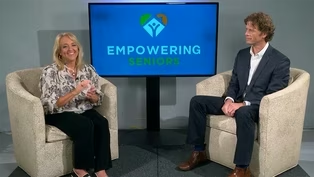
Empowering Seniors Episode 604
Season 6 Episode 4 | 25mVideo has Closed Captions
Empowering Seniors with Katherine Ambrose Fridays at 8:30pm
Empowering Seniors with Katherine Ambrose Fridays at 8:30pm
Problems playing video? | Closed Captioning Feedback
Problems playing video? | Closed Captioning Feedback
Empowering Seniors is a local public television program presented by PBS Kansas Channel 8
Empowering Seniors
Empowering Seniors Episode 604
Season 6 Episode 4 | 25mVideo has Closed Captions
Empowering Seniors with Katherine Ambrose Fridays at 8:30pm
Problems playing video? | Closed Captioning Feedback
How to Watch Empowering Seniors
Empowering Seniors is available to stream on pbs.org and the free PBS App, available on iPhone, Apple TV, Android TV, Android smartphones, Amazon Fire TV, Amazon Fire Tablet, Roku, Samsung Smart TV, and Vizio.
Providing Support for PBS.org
Learn Moreabout PBS online sponsorshipFrom the Alvin and Rosalie Sara Check studio.
PBS Kansas presents Empowering Seniors.
Welcome to Empowering Seniors.
Today we're going to talk about real estate and how the real estate industry really needs to adapt to serving seniors better.
Meet Marc Weisz.
Marc, thank you so much for being here.
Thank you for having me.
So you've traveled to Kansas.
From where?
Waukesha, Wisconsin specifically greater Milwaukee.
Okay, fantastic.
Thank you for being on the show.
And how long have you been kind of working in the senior end of things?
As far as real estate goes, my father, since 2017, when I started caretaking for him, but, specifically helping other families going on for years now.
Okay.
So you're was working with your father.
Was that part of, That was the gift that led me here?
Okay, so tell us a little bit about that.
So I went to visit some friends one evening back in 2017 and decided I should stop and see my father and discovered that he had been in his recliner for four days and garbage was everywhere.
It was not a good situation.
And that started a six year path of caretaking where I moved him six times in six years.
I did a lot of.
Right and a lot of wrong.
Wow.
And so what, what do you feel like you did right.
Being there consistently when I didn't always want to be.
It was a challenge.
I'm not that patient.
With a loved one, a parent sometimes where you have difficulties, you don't have the best, relationship.
Always.
Takes a little bit of extra effort.
But you dig deep, you find it and you persevere.
And what are the things that maybe you regret or maybe you know better now.
Yeah.
You know you're not always your best self in stressful high stressful situations.
Demanding unusual uncomfortable things that you're dealing with.
And you know I've since learned from a number of my clients who some of them nurses, some of them in hospice.
And when they tell you things like Marc, I'm in this business.
And I froze and I didn't know what to do.
It's easy to see that anybody else can.
And while I have project management background and so forth, that doesn't help you with all of the things that you encounter.
you're saying even experienced health care people when it's their own parents.
Okay.
It really throws you for a loop.
It can.
Yeah.
And and every family dynamic is different.
Some are great and healthy and some are not.
And part of this process is helping them get through that.
Very little of my conversations with folks are real estate related.
Especially in the early stages of this.
As you shift through it becomes more about the transaction.
But prior to that it's about the emotions.
It's about the pain.
Primarily the loss which was huge.
The adult children or family members.
They don't always recognize that.
And you have to help them remember what their parents are dealing with.
And if you've experienced massive loss before in your life, it becomes really easy to help them all see that.
Yeah.
I often say it takes a team aging as a team sport.
And the sooner you realize that, the better your outcomes might be.
Yeah.
And real estate's not just real estate.
When you're dealing with your parents selling their last home.
Or, could be you selling your last time.
There's so much emotion involved.
So residential real estate has always involved emotion.
Yes.
That usually it's kind of the highs and lows of finding the right house and negotiating.
And there's a lot of emotion in residential, commercial or residential real estate.
Not so much commercial.
Correct.
All right.
Residential.
We know there's emotion, but this is a whole different scale.
When you are dealing with older, mature homeowners that have complex decisions to make regarding their house.
We know 84% don't want to move, at least.
And so they don't oftentimes.
And then what happens when they don't make a proactive decision.
And what happens?
Hope is not a plan.
And when you fail to plan, you plan to fail.
Right.
And so the majority of the times when I'm called in, it's crisis.
It's it's too late.
The rug has been pulled out from underneath and in one fell swoop, it is the house.
Your stuff, your your ability to drive.
You didn't know that.
You didn't get to say goodbye to all those things in those memories.
And you trade your life for dollars.
And those dollars are spent on stuff that we're somehow attached to, maybe more than we should be.
And that's all hard to part with.
And your world comes crashing down real quick.
Yeah.
And that's difficult to deal with.
So, it's to help people remember that and get through that process is something that not everybody is equipped for.
It's not a fast moving process.
So I'm guessing that your hope is that people do make a plan and they deal with the stuff.
They deal with the real property, the real estate in advance before crisis.
It's all preventable.
And unfortunately a lot of times I see that that isn't the action that was taken.
And so in your area you're known as the guy.
I would say you could say that you're, you're humble a lot a lot of the, the referrals, the partners that I have, I have because they feel that way.
And all realtors are working with seniors.
It's just that happenstance.
They're not usually really prepared to help with all of the different issues.
And and that's okay.
Let's say if the house is already empty and you just need to sell the house, that when you're dealing with the urgent crisis situation, all the emotions with family members.
I bet it helps to have a specialist.
It does.
It's a lot to unpack and you know, the Hey I know a couple people or, you know, do this and call me when you're ready.
Doesn't work.
And you even when it's just, even if you can knock it out of the park on the real estate side of things.
There's way more to it than that.
Yeah.
It's kind of like our industry is evolving.
So there's residential real estate.
Commercial real estate.
I feel like now there's empowering seniors real estate.
It's a totally different thing.
And so.
Realtors that want to specialize in this arena I'm guessing.
What percentage of realtors do you think it's widely said that it's less than 3%.
It might even be lower than that.
Yeah.
But we're we're ill equipped as we are for many things in life that we've never done before.
You don't know what you don't know.
And none of us have ever been here today.
We've never been now.
And, if you extrapolate that into real estate, there's no way that you could possibly know it all unless you are immersed in this on a daily basis.
So how are you immersing and how are you equipping all the time to get better and better at helping these families never stop learning?
Focus.
Hyper focus, maybe even on nothing but this, daily.
I'm on a call.
8 to 9, sometimes 10:00, Monday through Friday.
And that's the world I live in.
Breathe in.
So you're layering in every day.
That's mastermind.
Yeah.
Gerontologist.
Doctors functional medicine.
You know, senior move managers.
So placement.
So you, like, know this world, you know, the whole ecosystem.
So you're a resource to the resources in your area?
Yes.
And, you know, for my failures, I have to make up for what I didn't give for my dad that I could have done better.
And for those that I said, I don't want them to be in the same position that I was.
They need help through it because we're massively underprepared for what's coming.
We're only at the beginning of this and there's a large learning curve and every homeowner is different.
So.
Yeah.
What do you do to kind of evaluate the situation and figure out what their options might be.
Because this is way beyond what a realtor does.
I often say the last thing you need is a real estate agent.
You need somebody like Marc.
So what kind of options do you talk talk about with people?
Every situation is unique.
There's no box that you're going to fit into.
I'm going to help you design that yourself.
And it starts with a lot of Q and A that is not, related to real estate.
It's what's the medical event that got you here?
Where are you going medically?
Not just physiologically, but, you know, physically.
Are you in rehab or, you know, or are you in the hospital?
What is your timeline before you have to go where you need to go?
What is the cost and the fallout if that is not.
And then knowing their financial situation the legal side of things, are you prepared with your pay for your estate planning and all of that.
And there's a lot of things my hands will be tied if you haven't prepared properly.
And sometimes it's too late depending on the cognition.
So from that regard I help.
And usually it's a 30 to 60 minute phone call to start.
And evaluate all of that first before you really get too deep into the real estate world.
Yeah.
Wow.
So, like, after maybe an hour long phone call, what comes next?
Yeah.
So then it begins with, the property inspection where I'm looking for defects.
I'm looking for a situation.
What?
What's the game plan?
What needs to be strategized?
And what that timeline is going to look like, depending on what each of the options are that choose.
And so an inspection.
So that doesn't sound like the normal real estate agent.
This is a little high end.
You're looking at the property trying to figure out the whole thing.
And you're looking at the stuff.
Yes.
So I have a strong construction and remodeling background as well, prior to real estate.
So there's that element of it as well.
I'm also underwriting the property for what it is that we do.
As a loan originator.
For potential bridge loan as well as other financing options.
Okay.
So, you see, you just really dig in and figure out what's going on financially.
Do they need cash right now or that house?
Do they need the house improved to.
How can we do that.
So you're just figuring all that out and looking at options for them?
Absolutely.
To be a true consultant.
Make sure that, that they get exactly the advice they need for their situation.
It might be a quick cash offer, from my partner and I. It might be that we facilitate cash offers with other investors.
Maybe it's putting it on the MLS as is.
We're getting it cleaned out first.
There's subcategories of each of those options as well.
And and bridge loans sometimes come into play also so that they have some cash.
So they can make their move.
Correct.
And that's whether it's an outside source or my partner and I, they would offer the bridge loan and where everything is being analyzed simultaneously for a quick result, because sometimes speed is crucial.
Yeah.
Because they could be discharged out of rehab and they've got to make a move and they might need might need cash at 4 to $500 a day.
You can really, exhaust whatever self-pay period you may have.
Wow.
This is a lot of information.
I really want to know more.
But first we're going to go to another guest and another state to find out more about how she's addressing the complexities regarding aging and housing.
Meet Caroline Glidden here from Denver, Colorado.
Caroline, thank you for driving to Kansas.
To be on the empowering senior Show.
Thank you so much for having me and Katherine.
It's great to be here.
you've been a realtor for how many years?
30 years.
30. so how is your business now changed after 30 years?
Well, I've worked with so many different families over the years and now my business naturally evolving to work with seniors.
Okay.
Because of probably a lot of friends my age whose parents are growing older.
And maybe they need to move out of their home.
It's just it's just naturally evolved this way.
So it's most of my business now.
what do you call yourself now because you're, you're evolving into I would imagine helping people with more than just selling the house.
Right.
Well a senior home coach because I'm helping them with so many aspects of the whole entire transaction.
And so how are you helping people beyond just the real estate part?
Well, my joy is the people.
So I think is strength or something I love is that when I go over, I'm sitting with them.
I want to take the time to hear about their home.
I had one recently, and the lady was moving to Tennessee with her daughter who had lived with her, but they were going to move to Tennessee to be with more family and more great grandchildren.
But she and her husband bought the home brand new in 1964.
So when I went over, she said, well, I might cry.
And I said, and I might cry right along with you.
We sat at the table and she told me stories about, you know, when they purchase the home and what they were picking out and how different the was and the, the kids growing up there, the grandkids.
And she did cry.
And it's okay.
I said, that's okay.
And then we talked about where she was going and that she was going to be with more family and get to see her grandkids more often.
it was around Christmas time and I had brought her some chocolates and nuts, and she happened to love that.
So every time I go over, I bring her some chocolates and nuts and by the time we worked throug And so it worked really well.
And so what does that take to be ready to sell a home that's very special.
And maybe make a long distance or big move.
it takes a lot of planning.
You know, the daughter and her husband who had lived with her for 13 years, they took the time to start packing ahead of time because that did help the home sell to have some of the clutter removed.
You're going to have to pack it anyway, so you may as well do it before it goes on the Marcet.
But again for her the whole process of just talking about it each day and her daughter was the poha.
So she signed all the documents, but we still her mom was there and made the decisions, and her mom just said she had actually talked to a couple other people and said, no, I want to work with Caroline.
And then what happened about a year later they referred me to the brother who lived a few blocks away, who had also bought his home with his wife.
Brand new, 1964.
So what is a poha?
A poha is a power of attorney.
So sometimes the children might it might be easier for them to do the signing.
And so we'll get that in place before the process begins.
So did they go to Tennessee too?
Here I am.
I'm just curious about this family.
Actually, no.
They went into, independent and assisted living.
But mom made all the decisions.
That daughter was just there to help.
Probably make the paperwork go faster.
Yes, because most of our contracts are electronic now.
And some decisions.
Mom just said no.
You do what you want to the daughter.
Okay.
How do you see families supporting or not supporting?
Because the family situation.
That's got to be unique every time.
Yes, it is unique.
And I see some family members who are very involved and some not as involved.
I had a client recently, and, you know, they're helping their father.
Their mom had passed away helping dad.
And she said, well, my brother and I, you know, we're different.
And she said, there might be some family drama.
I said, I'm youngest of 11 kids.
I absolutely understand family drama.
And it's a lot of stuff to go through.
When you're helping your parents through this move, it's emotional for everybody involved.
And so what are you doing for your community or thinking about doing for your community to address these complexities?
just getting the word out more, even on my own personal Instagram, I'm starting to do little snippets to let people know, you know, get your will in order, get your trust in order.
And, as you were talking about Nipsey, what kind of things can you do to adapt your home?
There's if they do want to stay there, stair gliders, you can get an elevator put into your home for a much more reasonable cost than it used to be.
They can adapt.
Showers.
So I'm just trying to educate the public as much as I can.
And Facebook and Instagram has been a great resource for that.
I plan to do some seminars and possibly some TV segments myself.
Okay.
And while it sounds like you're just doing phenomenal work there, Caroline, thank you so much for doing your part to empower seniors.
And, we appreciate you coming to Kansas.
Thank you so much for having me.
I've had a great time.
You are a delight.
You do?
And now we're back with Marc.
All right.
Marc.
So there's a lot going on in the United States of America as far as training and certifications and organizations.
That people that started off in real estate are now doing and really kind of creating a whole different level of service.
So what are some of the things that you've gotten attached to?
whether it is CSA, which I'm working on, certified Senior Advisor.
Npcc, which I'm starting a chapter for Wisconsin and Greater Milwaukee.
Wow.
So National Aging in Place Council starting that where I'll bring that to your state.
That's really cool.
It is.
It's the other end of the spectrum, to a degree from a lot of what I do.
It's the preventative side.
It's the education side.
It's my anxiety that drives where I don't want to be, where a lot are today and the industry as a whole.
Okay.
And your senior home coach.
So it's almost kind of like a whole new thing.
It is really just piling on the tools and the ways to equip and inform the public.
And so how does this feel to you to work in this manner fulfilling, which drives true happiness?
It's very rewarding and healing.
A lot of these situations are triggering for things that I dealt with or haven't yet.
you've really just thrown yourself into a mission.
Does it feel like a mission to you.
No.
It just feels natural.
Normal.
And did you anticipate this when you first started getting into real estate.
I know that your dad really had an impact on you.
Yeah.
Yeah.
I keep calling it his gift.
There wasn't a lot that he gave me, through my youth.
But just makes up for it a bit.
Yeah.
So you got you started on this path?
Yes.
And so, do you have a success story to share with us or.
Yes.
Okay.
Yeah.
Being, you know, immediately on the spot.
Yeah.
My everyone's happy to write a review, a testimonial, and, there's some really touching ones in there that have been very humbling and, gratifying.
And, and it sounds like most of your business is a referral that you almost entirely.
So who's referring these families to you, these clients to you.
Well, it's it's starting to become my, my clients and their adult children.
Okay.
This is a growing, thing, and that is that is a growing part of it.
But a lot of it's the attorneys, the, the placement specialists and placement specialist.
What do they do?
Whether in home or out of the home, they're advising on services based on their needs, whether it's OT, whether it's health care or just assistance in the home, or whether it's finding the right community that will serve their current and future need.
Okay, so health care support in the home and home care support, true advisors within that realm okay.
And what does that do for them and their clients.
Brings a little bit of relief and serenity in the end.
Maybe not immediately, but, we get there, and most of them say quickly.
So even in that first call, it's, it's, it's assurance that somebody who's been there, who's walked in their shoes.
And it's not just a real estate agent that's going to list the house.
That somebody that really knows how to dig in and assess the property, assess the financial situation, assess everything that's going on and then offer many different possibilities.
And then the homeowner decides or the family decides it's the last big decision that they get to make at a time which they have few options.
And to have as many options and feel like you're in control is important to them.
Yeah.
That need to feel in control.
Absolutely.
And then how do you feel when you go home at the end of the day?
I sleep well.
Yeah.
Well, we can really see your heart in this.
Yes.
And, what do you think you're going to going to do next?
Any epoxy for prevention?
Okay.
Education.
Community outreach.
Okay.
And so when you talk about prevention and the national aging in place Council, it sounds like you're meeting people where they are, like, I want to stay in my home.
And so what would you share that help them achieve it in any way you can?
And how can people maybe stay in their home longer?
Being better with your lifestyle for one.
Well, that's a big, big rabbit hole.
Yeah.
But preparing financially, and, preparing, I guess, with your home and making modifications.
To help assist you where you might lack.
Okay.
So McDonald's safer.
Make it safer, brighter, probably more light.
Absolutely.
More lighting.
The clutter, the stuff.
Yeah.
So is a big problem a big problem.
So tell us what the deal is with the clutter.
Because that's the normal thing and the shame attached to the clutter.
There is there is shame.
There is emotion.
They're in over their heads.
And it happens faster.
It's not necessarily the mental health side of things that cause hoarding.
It's the just.
And they don't always have the help, and they think they have it under control and it just rapidly snowballs out of control.
Well thank you for the work that you're doing as a senior home coach and meeting people where they are to help them edge their way.
And if things go awry that you are offering solutions.
So we need much more of that in the world.
And you truly are empowering seniors.
Thank you.
Thank you for having me.
My pleasure.
And thank you for watching.
I hope this is helpful.
If you have questions about this topic or anything else that we cover, please give us a ring at 316-686-4500 Or you can email us at EmpoweringSeniors@kpts.org I'm Katherine Ambrose and I'll see you on the next Empowering Seniors.
Empowering Seniors Episode 604
Preview: S6 Ep4 | 30s | Empowering Seniors with Katherine Ambrose Fridays at 8:30pm (30s)
Providing Support for PBS.org
Learn Moreabout PBS online sponsorship
- News and Public Affairs

Top journalists deliver compelling original analysis of the hour's headlines.

- News and Public Affairs

FRONTLINE is investigative journalism that questions, explains and changes our world.












Support for PBS provided by:
Empowering Seniors is a local public television program presented by PBS Kansas Channel 8