
October 23, 2026
10/23/2026 | 55m 37sVideo has Closed Captions
Pastor Bob Roberts Jr.; Min Jin Lee; Tamryn Spruill
Pastor Bob Roberts Jr., Co-Founder, Multi-Faith Neighbors Network, discusses bridging America’s religious and political divides through interfaith cooperation. Min Jin Lee, author, “American Hagwon,” discusses her novel, set across California, Seoul and Sydney in the '90s. Tamryn Spruill, author, “The W,” examines the WNBA’s history and its unprecedented growth (Originally aired 10-5-26).
Problems playing video? | Closed Captioning Feedback
Problems playing video? | Closed Captioning Feedback
October 23, 2026
10/23/2026 | 55m 37sVideo has Closed Captions
Pastor Bob Roberts Jr., Co-Founder, Multi-Faith Neighbors Network, discusses bridging America’s religious and political divides through interfaith cooperation. Min Jin Lee, author, “American Hagwon,” discusses her novel, set across California, Seoul and Sydney in the '90s. Tamryn Spruill, author, “The W,” examines the WNBA’s history and its unprecedented growth (Originally aired 10-5-26).
Problems playing video? | Closed Captioning Feedback
Where to Watch Amanpour and Company
Amanpour and Company is available to stream on pbs.org and the PBS app.
Watch Amanpour and Company on PBS
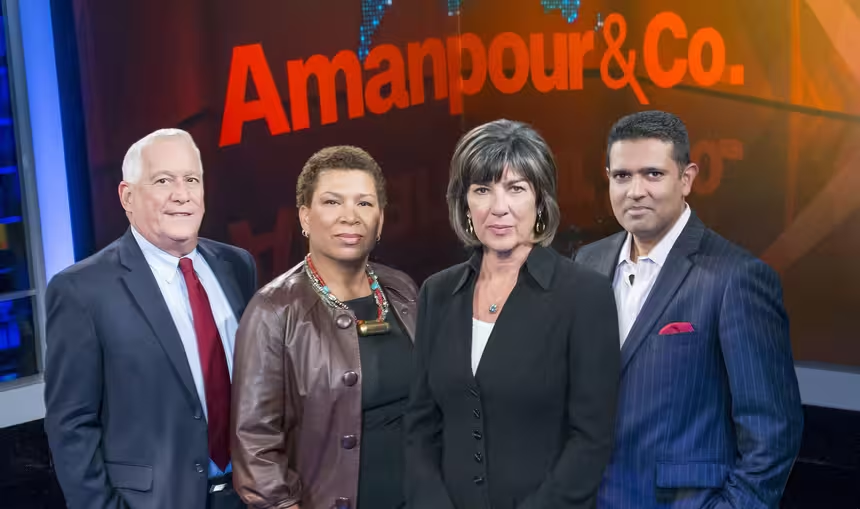
PBS and WNET, in collaboration with CNN, launched Amanpour and Company in September 2018. The series features wide-ranging, in-depth conversations with global thought leaders and cultural influencers on issues impacting the world each day, from politics, business, technology and arts, to science and sports.Providing Support for PBS.org
Learn Moreabout PBS online sponsorship♪ - Hello everyone and welcome to Amanpour & Company.
Here's what's coming up.
- I begin to realize as evangelicals, we have the worst negative view of Muslims of any group in the world.
- Faith and politics collide, divisions deepen ahead of the US midterms.
But what, if anything, can bring Americans together instead of driving them apart?
I speak to conservative evangelical pastor and bridge builder Bob Roberts.
Then, I think that Koreans are so misunderstood.
And perhaps it's because we're not visible in the culture.
From the best-selling author of Pachinko, a new story about Koreans in the world, novelist Min Jin Lee on immigration, identity, and the price of the American dream.
Also ahead... The women's league had been so pushed into the margins that people didn't know the players and in this case that the league even existed.
Author Tamron Sproul speaks to Michelle Martin about the struggles that shaped women's basketball and her new book, The W.
♪ Amanpour & Company is made possible by the Anderson Family Endowment, Jim Atwood & Leslie Williams, Candace King Weir, Charles Rosenblum, Monique Schoen-Warsaw, the Sylvia A.
& Simon B. Poita Programming Endowment to Fight Antisemitism, the Strauss Family Foundation, the Peter G. Peterson & Joan Gantz CUNY Fund, Kou & Patricia Ewan, committed to bridging cultural differences in our communities, Barbara Hope Zuckerberg, and by contributions to your PBS station from viewers like you.
Thank you.
Welcome to the program, everyone.
I'm Christiane Amanpour in London.
With less than two weeks to the US midterms, religion is once again taking center stage in American politics.
In Michigan, Democratic Senate candidate Abdul El-Sayed was challenged by a former Republican staffer to disavow the Muslim Brotherhood.
El-Sayed did so, but questioned why his faith was being scrutinized in the first place.
I'm going to swear an oath to the Constitution of the United States.
And that Constitution guarantees us all the right to practice whatever faith we want or no faith at all.
And now you assume, you assume, Tommy, that because I am Muslim, that somehow I would have some allegiance to something that is not our Constitution.
I'm not running to be a Muslim senator.
I'm running for U.S.
Senate and happen to be Muslim.
That exchange comes as Christian nationalism and religious polarization are increasingly part of America's political debate.
But one conservative evangelical pastor from Deep Red, Texas, is calling for a different approach.
He is Pastor Bob Roberts of Northwood Church.
He has joined forces with a Muslim imam to bring Christians, Muslims, and Jews together, building bridges across those religious divides.
I spoke to him about the rise of Islamophobia, the spike in anti-Semitism, and how faith can help bring Americans together instead of driving them apart.
Pastor Bob Roberts, welcome to the program.
Let me just start by saying we've seen this film, this story about your mission, about what you're doing.
And you really say the public square used to be a place where people came, discussed, talked, resolved their difficulties, just came in communion.
What's happened since?
What is it now, the public square?
- I fear the public square has become a place of interrogation, a place of inflammation.
It is not a place where we are exchanging ideas, to listen to one another, to learn from one another.
Instead, we are showing up with our position and we're fighting to win the public square instead of listening to all the voices present in the public square so we can learn how to live together and compromise where we need to.
- Pastor, you do some of your work, a lot of this bridge building work with a partner who is a Muslim cleric, Imam Mohamed Majid.
We tried to have him with us on this conversation, as you know, but unfortunately, he's not feeling well.
But in the spirit of your work together, you've called the public square now kind of a fighting ring, as you're discussing.
And he's basically said that we've got to get back to it being a place for the actual exchange of ideas and to try to resolve issues in a human way.
Why did you two choose to work together?
We didn't choose to work together.
We accidentally met one another.
I'm a very conservative evangelical pastor and I grew up in a little town of a thousand people and the other religion was the Methodist church.
That was it, I'm a Baptist.
And I didn't know what a Muslim was.
I knew very little about the world.
I knew a little bit about Judaism, but when I got out and I began to experience the world and I got to know people, I realized that I knew a lot about the Bible, but I knew very little about people.
And I began to see all the ways that we conflicted and that we didn't get along, and I realized that there's this bigger picture of all of us inheriting this space on the world to live, and faith ought to be a thing that brings us together, but instead it was pulling us apart, and it was the exact same thing with Madjid.
And so what we did, we mapped out together, how did we shift?
How did I come to still hold on to my faith, not compromise my theology, but what did I experience that caused me to be friends with a Muslim?
And what did he experience that caused him to be friends with a Christian?
And then I begin to realize as evangelicals, we have the worst negative view of Muslims of any group in the world.
The only group that were that's worse are evangelical pastors.
So just think about it.
It's what members here coming from the pulpits that's driving that.
And I realized Muslims could never change that.
But I could.
I'm evangelical.
And in Pakistan and other parts of the world, Muslim majority countries, Majid can do the same thing with the Muslim community and challenging them.
And we learned, frankly, more by challenging our own tribes than by challenging the other tribe.
If we work together, we could see change.
And it's, it's been incredible.
- You know, I think that's remarkable.
And again, to quote Majid, he's talked about the public square needing to be a marketplace of ideas.
Can you give me one, just one or two kind of results that you feel have come from both of your work?
How have you challenged your own tribe and what results have you seen?
- Well, when I challenged my tribe, a perfect example that I look to a lot is in the northwest in Seattle, a white Christian supremacist burned down a mosque.
And one of the pastors had been to the retreat, to the gathering, and this imam had been a part of it as well.
That pastor was one of the first people on the spot where the mosque was burning.
And he handed the guy the keys to his church and said, look, this is unacceptable what this man did.
And we want to make sure that you have a place to worship.
That may not be a big deal for a liberal church or a liberal Christian, but for a conservative Christian, that's a big deal.
On Manji's side, for the Muslim aspect of that, the best illustration I can give you would be Pakistan, where a year and a half ago, you may remember some churches were burned, houses were burned, lives were taken, and all of a sudden you had imams rushing to the scene, stopping what was taking place.
And these were imams that we had trained, that we had been with, that we had worked with, and saying, "You can't do this in the name of God.
This is wrong."
And so we see these changes taking place.
But Ms.
Almanpour, the key is, not that we're giving them more information, not that they've discovered a Bible verse or a Koran verse.
What we do is we have a three-day retreat where they get to know one another.
We build a relationship.
And it's not lectures.
It's all relational and it's facilitated.
And through those relationships, we help them understand we're all human beings.
And so how do we live where all religions are all present now?
Every religion is everywhere.
It's no longer where Christians are just in the West and Muslims in the East and Chinese are Buddhist in the Far East.
It's where all religions are everywhere.
So we have got to learn how are we going to relate to one another moving forward.
I think it's so inspiring listening to you but again let me bring it back to the United States because as you know you talked about, I'm going to put words in my mouth about you know the prejudice against Muslims.
It's been said that Islamophobia is the one major continuing acceptable bias and it seems to be true.
When I say acceptable there's very little accountability in the United States for that and it's been weaponized in the US and it's been politicized especially during this political cycle.
I don't know whether you watch the viral video where a Muslim American who's running as an American under the American Constitution to be senator in Michigan was confronted by a conservative Christian, that's how he I believe described himself, and essentially, you know, back and forth about essentially implying that perhaps El Sayed of Michigan had some kind of sympathy for terrorism or etc.
And I wonder how you read that?
What did you think when you saw that if you have in fact come across it?
I've seen it and it made me very sad.
I'm from Texas and I've watched the whole political climate in the last year just be ramped up in a horrendous way.
And I think it's driven primarily by politicians, politicians that are fighting to get elected.
And so they have thrown the Muslim community under the bus, so to speak.
And I think it's unacceptable.
I see it taking place across our country.
I listen to what Tommy Tuberville said, you know, on the Senate floor.
And I listen to things that are being said.
And this is not the America that we put together, that we designed.
This is America where we believe in religious freedom.
And it's horrible that it's considered acceptable.
It should not be acceptable for Christians to say this person and their religion has no right to practice here.
That's not who we are.
That's what we came to America for historically, theologically as a Christian.
That's not what the Bible teaches.
I mean, there's nowhere in the Bible that says that we're to make a Christian nation.
It says that we're to have disciples in every nations that influence nations.
But the way that we are responding is un-Christlike in every way.
The very people that we would want to reach the good news of Jesus with, we malign them, we put them down, why are they going to ever be open to the gospel that we want the world to follow if we're trashing people?
You don't have to trash somebody else's religion for you to stand in your own.
Pastor, then what happens when we're confronted with the situation that we're in right now in the United States?
You've got an openly Catholic vice president who talks about his religion, and particularly, you know, not just as religion, but in terms of politics and national security.
You've got an openly or self-avowedly conservative Christian defense secretary who talks about the war on Iran as some kind of spiritual mandate by the United States to complete.
We know that there are these very conservative prayer groups based inside the White House, and you remember when a group of religious Christians sort of put their hands on President Trump shortly after the war in Iran began.
Now this is employing Christianity and Jesus Christ to justify a war.
I think when we use our faith to justify violence, hateful speech, we've left our faith.
Jesus didn't just give us a message, he gave us the character that goes with that message, the way that we're to speak, the way that we're to talk, the way that we're to communicate to other people.
And his message was one of love.
And listen, I disagree with Muslims.
I believe Jesus was God.
I disagree with Jews.
I believe the Messiah was Jesus and he was God.
So I would believe fundamental core essential differences, but I also believe in religious freedom.
And I also believe that when this country was put together from Benjamin Franklin, who said that religious freedom is so important that the grand Mufti of Istanbul should be here to come and preach.
Thomas Jefferson, I mean, we don't need a lesson in religious history and church history and the constitution, but that's what holds us together.
And here's the thing, as a Christian, it is the Bible that holds us together.
As a nation, it is the constitution that holds us together.
And that's critical.
I'm a conservative Christian, and that is something that we have forgotten.
But if I believe I've got to be this Christian nation, why do I want to go back to what Europe was?
I mean, we saw what happened there.
And then we're left with, then the government deciding, well, what's Christian?
I'm a conservative Christian.
So what does that mean about liberal Christians?
What does it mean about other religions?
How do we define who's in and who's out?
What do we say to Latter-day Saints?
I would disagree with all of these at different points, but it's not just freedom of religion.
It's freedom of conscience.
It's the ability to own your own mind, to think for yourself.
I don't want to be in a, quote, "Christian nation," where people are forced to be Christians.
And if they're not, well, we're not forced, but you're less than.
I want to be in a country where everyone is free and equal.
I work in Syria a lot, and I've met with many of the Syrian Christians.
I've been there recently.
I'm going again in a few days.
And one of the things that Christians have told me is we don't want to be viewed as minorities.
We want to be viewed as people with equal rights.
And I think we Americans need to go back to American history 101 and realize what put us together.
Pastor, you must be paying some kind of price amongst your own tribe, as you call it, for these views.
I think you've said that when you first started talking about this and first started working with Muslims in America, that you lost a couple of hundred members of your own congregation and your own members.
What how how is it going?
Have you managed to, you know, bring them around?
And what what does that say to you when you have people walk out on you?
That is a very important question.
And there's two ways I want to answer.
Yes, we rebounded and God is blessing our church.
And, and yes, it was very difficult.
But what it said to me was, we were not doing a good job of teaching our church about what Jesus expects of his followers to love people and what he expects of us at the point of bringing people together and what that looks like.
It's like we have just forgotten it.
And I think something has happened to the American evangelical church.
I think we've been captivated by consumer Christianity, culture wars, and celebrity pastors.
And as a result of that, our primary measurement, our dashboard, if you will, is how many new converts do we have?
How many people come to our church?
How many people come and listen to me preach?
That is a growth mindset, and it's important.
But our mindset is not just to be concerned about reaching more people to come to our church.
It also has to be a prophetic voice.
And sometimes we have to speak truth to our own tribe, because when we don't, if we let false things continue to be said and believed, and we don't challenge them because we're afraid we're going to lose some people, then we will lose the church, but it'll be the next generation.
Because we didn't have the courage to do the course correction that was necessary.
I want to ask you one final question.
There has been a massive spike in hate crimes and hate speech and hate action in the United States and elsewhere since October 7th, particularly pitted of Jews and Muslims against each other.
Have you come across that when you work with Imam Majid?
Are you trying to get Muslims and Jews also to talk to each other again?
- We are.
And there's another part of this trinity.
It's called Bob Majid and Rabbi Ambassador Davis Faberstein.
He's a part of this as well.
And we deal with it all the time.
The reality is that many of the interfaith organizations cratered during this time.
And still, they're struggling.
And we've had struggles, but we've survived and we've actually grown and we've continued to spread out across America and the rest of the world.
But here is why we build relationships.
And what we try to do, we show up with our opinions and positions, and we fight to win an argument or debate, and we fail to listen to one another.
And so I think one of the goals that I have personally is, how do we continue to build relationships among Christians and Muslims and Jews and others, so that we can have these conversations?
I'll tell you something else that happens.
When you become friends with an imam or a pastor or a rabbi, it changes your rhetoric and it changes how you view how other people treat them.
You know, because, you know, the big thing I hear is, well, we've got to stand up for the truth and I love them, but man, I got to tell them the way it is.
That's right.
You should.
But if you can't you can't do that in love.
And if they don't recognize the fact that you love them, it doesn't matter whether you say you love them or not.
What matters is, can they tell that you love them by how you care for them?
Jesus is the perfect alternative to hate.
He's love.
And we don't have to compromise our theology.
We just have to be kind.
Why do we think we have to be mean and hateful and harsh in order to get our point across?
If we have to do that for the sake of our truth, we've lost the truth.
Well, Pastor Bob Roberts, thank you.
This has been incredibly hopeful, this conversation.
You've really, you know, really highlighted the power of community and the need to get back to there.
So thank you so much indeed for joining us.
Thank you and thank you for all the years you've been at CNN.
I'm one of your fans and I'm grateful for you and I'm going to miss you.
You've probably read or at least heard of the book Pachinko.
Millions of copies were sold when it came out back in 2017 and it made Korean-American author Min Jin Lee a household name and it became a series on Apple TV.
Now she's back with American Hogwan and while Pachinko was historical fiction set in Korea at the end of Japanese colonial rule, this new book takes us to California in the 1990s via Seoul and Sydney.
It's a tale of migration, assimilation, and the pursuit of education and success.
These are, of course, poignant and topical themes in this current moment in the U.S.
in its politics and culture, and issues that are deeply personal for Min Jin Lee herself, as she told me when we sat down together here in London.
Min Jin Lee, welcome to our program.
Thank you so much for having me.
It's wonderful to have you.
I mean, you're legendary now because of certainly Pachinko, and it was such a massive hit, plus a series, and people have seen it, read it.
Now, "American Hagwon."
What were you saying with this book?
-I wanted to write a book trying to understand why education is so important to Koreans, not just in Korea but around the world.
As I started to research it, it got kind of depressing because it made it the worst part about education, about certification, about pedigrees, about transactionalism and networking.
I found that to be really sad because that's not the way I thought of education.
So then I decided to pivot and ask the question, "How do you live a wise life?"
Because wisdom is very distinct from education, I think.
So basically you're saying that you're focusing on the wisdom, the way maybe Americans see it or immigrant communities in America, education is to get ahead, maybe to integrate, but to make money, to get ahead, to be a successful immigrant.
And you're saying it's time to look a little differently.
Yeah, very well.
That's very well put.
So, I think that if you look at education as only a path to social mobility, then I think that there are dangerous things that can happen along the way.
Well, I want to ask you that.
I'm glad you set that up, because you've got an epigraph in which you quote the great author James Baldwin, who says, "The paradox of education is this, that as one begins to become conscious, one begins to examine the society being educated.
Is that some of the danger that you're talking about?
Yeah, because as soon as you figure out, oh, this is what the world wants of me in my education, then you start to actually follow that script.
But that may not be very good for you or actually good for society.
How did you absorb your education?
Well, my mother is very laissez-faire.
She really doesn't believe in telling a child what to do.
She studied music at a very fancy university in Korea, and then she became a piano teacher.
So her whole theory is you can't make children practice piano, you can't make children do their homework, you just have to see, well, what does a child want?
So I was actually given the option, do you want to take piano lessons?
And I said, no.
And she said, fine.
And that's really the way she has approached everything for not just me, but my sisters as well.
- And you raise it a little bit in the book where one of the main teachers, he sort of says, no one needs to be a superhero.
Our children should not have to save us.
What are you saying there, following on what you've just spoken about and about the American dream, maybe.
Yeah, so I think a lot of working class parents and middle class parents, and now even upper middle class parents, that everyone's really afraid of losing their status because people are feeling very uncertain and precarious right now, especially because there are so many changes.
So then they keep really pushing this idea that you have to get a very brand name education in order to be okay.
And consequently, the children are feeling a kind of performance anxiety.
I keep hearing it over and over again.
And there's a lot of breakdown.
So when a parent spends, let's say, a good portion of their income, giving the sort of shadow education to supplement whatever the formal education is.
Sometimes parents ask the question of return on investment.
Now children, as we know, aren't investments.
Children are children.
They're human beings.
They're just younger than we are and they can't really bear this kind of pressure.
So one of my characters makes that speech.
What is your writing technique?
You, I think, take a long time to write these epic books.
Tell me a bit about it.
When did you come to reading and writing?
Oh, I came to reading and writing very early in Korea, and then also very early in the United States.
But I came very late to speaking.
That's it was really, I didn't really start talking publicly until almost middle school.
And what does publicly mean even in school?
Yeah, I didn't really talk.
So I talked at home, if I had to, but I was incredibly quiet in Korea as well as in America.
But is that shy?
I think I wanted to speak.
It's just that I couldn't quite figure it out, and I found other children very intimidating.
Adults were very kind to me because they could tell how much I was struggling.
So I think I was saved by a lot of my teachers.
Were you bullied at school?
Very much so.
I was bullied a lot.
I was very big for my age, and when we came to America, we didn't have much money.
And then also I was nearsighted, and I didn't have corrective eyeglasses until I was probably too late.
- And so your refuge was in books.
- In books, books, reading, my sisters.
So I'm the middle of three girls, and they both were very canny and can handle things, so they watched over me.
So what made you reach back into your heritage of homeland to write these amazing books that you've written?
- Oh, that's very kind of you.
You know, in my books, I'm not a minority.
I mean, it may be very well true that I am a minority racially, like in terms of statistics, that there aren't that many of me in certain groups.
However, in my universe, I feel like I can be the center.
And I think in my books, I write about Koreans, and we can focus on a person's character rather than a person's race.
I think very often when we think about things just in terms of race, not as a piece of information, but as the whole lens, we lose things, in the same way ethnicity.
So when I wrote my second novel, it was about the same race, but about two different countries and two different cultures and how we could hate each other only because of different languages.
And I found that to be really shocking.
It must affect you a lot then what you're seeing in the United States right now.
I don't know whether it's directed towards Asians, but certainly towards all sorts of people of color who are being deported and the whole ICE and immigration crackdown.
Does that raise, does that bring back bad memories or does it, how does it affect you?
I find the focus on deporting poor undocumented immigrants shocking.
I think it is the worst of who we are right now and I think that most Americans do not like the methods of how ISIS is attacking parents and children and people who are working very hard.
And I think even employers are shocked by the fact that this is a terrible economic decision.
Employers and churchgoers, we've heard how a lot of churches are trying to protect their communities.
A lot of these people who are being cracked down on are actually the Catholic community or, you know, other Christian communities and... And taxpayers.
Yeah, and taxpayers.
And taxpayers.
But I bring up faith because it features in your book, and it also features in your life a lot, doesn't it?
Tell me a little bit where that came from and how it affects not just your life, but your writing.
Well, my grandfather was a minister, and he was a pastor as well as a headmaster of an orphanage.
So he took care of children who were orphaned during the war and during the colonial era.
So when there are bombs in Japan, in Hiroshima and Nagasaki, there are many Korean children who were sent back and repatriated to South Korea.
They came to Busan and my grandfather was in charge of an orphanage.
So I grew up in the church.
I like church.
And it features very strongly in the way I think about the world.
That said, I think for those immigrants in new countries, not just in America, very often centers of faith are very important in terms of having a third place, another space in which you are somebody, even if the larger society says you're nothing.
-Because you tell so many stories, because it's the focus of many of your books, your own community.
What are you trying to tell the bigger world about Koreans, Korean Americans, Koreans who were trapped in the horrors of World War II and post-World War II?
-Oh, you know, I think that Koreans are so misunderstood.
And perhaps it's because we're not visible in the culture.
So for me, through my research and through my interviews, I've actually learned the incredible variety of humanity of Koreans.
And I write it in English.
I write my stories in English, and that's very important because English is the lingua franca and the default language of science and the internet and medicine and everything in the world.
And because of that, and because I write in a Western style, I am taught primarily by 19th century novels that I love.
So by using the form of the 19th century novel and through my focus, and by the fact that I have the command of the English language, I'm able to write these stories in which I want to talk about and explore Korean humanity and our diversity.
- The final novel of this quartet is going to be about the Marshall Plan of 1948.
It happens to be one of my most favorite things in the world.
- Oh, really?
- I mean, just what was achieved.
- Me too, me too.
- And what turned these horrendous Axis, you know, dictatorships, killing machines into some of the strongest democracies in the world, I think is fascinating.
But what is your focus going to be?
- Well, it really starts from that premise.
I think that the Marshall Plan was the greatest thing America did in the 20th century.
I think it was very smart.
And also, it wasn't just generous, it was good political thinking.
So I think it's very good economics.
My book is called "Marshall Plan" because I'm using it as an organizing metaphor for the remittances and the reconstruction of South Korea.
So in the 1960s, South Koreans went to West Germany to work as miners and nurses, about 20,000 of them, and they took jobs that nobody wanted in West Germany.
Those remittances and their earnings in Deutschmarks were sent back to South Korea very often.
And then those individuals who lived in West Germany, some stayed, some went back to South Korea and others moved elsewhere.
I'm also writing about South Koreans who went to Europe to become artists because they learned about opera and performance and orchestras and filmmakers and photographers.
They came to England, they got PhDs in literature and classics.
I'm also writing about South Korean women who married GIs.
So I'm writing about all these different types of people who left, but they always had a connection to their homeland.
And I want to write about this idea that in the face of devastation, will we respond with generosity rather than punishment?
But I guess for me, the parallel, I suppose, a little bit is USAID and all that it did after the Marshall Plan and now being rolled back in such a dramatic way as to almost negate all that trust and goodwill that America had spent so many years cultivating around the world.
Soft power.
Do you ever think of that when you're... I think about it all the time.
I think that the damage that has been done to the American so-called brand, I'm not even sure if it can be repaired.
Because to reach hearts and minds requires not just a one transaction of trust, it's constancy and consistency.
And I think that you know this very well, that they must feel deeply betrayed.
At the heart of the verb betrayal, what requires is intimacy.
And that intimacy and trust, which has been established for a long time, when that's betrayed, it requires, that engenders a kind of, not just cynicism, but a kind of hard-heartedness.
Because once again, somebody has abandoned us.
And I think that's something that we have to really rethink in our current foreign policy.
Do you think eventually it can be restored?
I think we can always restore human relationships, but I think we have to have truth and then reconciliation.
So we have asked you to read a passage that you would like to sort of exemplify the story.
D.H.
was the first to take his mother's hand.
"Thank you for being our mother."
Bo and Mido sat silently, grateful that D.H.
could say this for them.
John smiled.
"Our baby lawyer, D.H., is speaking for us."
"It hurts when I laugh," Helen said.
Mido couldn't speak.
She had never seen a person die, and she could not have imagined that the person, who had always seemed tireless, could transform into this shadowy frame before her eyes.
She was near her mother's feet, and she held them in her hands.
"Children," Helen said, "I will miss your graduations, your weddings, and the births of your children.
I will not be here to take care of your wonderful father, who has been my guardian angel.
But I want you to know that in heaven, your mother will ask the Lord to protect you and watch over you every single day.
Maybe the Lord will take pity on me for missing so many valuable things with you that He will have to listen to me.
I don't know why I have to go, but I still believe God is fair."
Beau got up from his seat and put his arms around her.
"Bless us, Amma."
Helen reached for her children.
"I will ask God.
I will argue with Him.
I will ask the Lord for satisfaction, for cutting short my life.
The Bible says that God likes a wise servant, so I will plead for Him to take my life in exchange for the protection of my family."
That is so beautiful.
Thank you.
So emotional.
Wow.
Who did this to me?
You've read it, you wrote it, and it's still as if it's the first time you've thought about that.
Ah, golly.
I just lost a lot of people this year.
Yeah.
Well, you've given a huge amount of joy to so many people.
Thank you.
Through your words, through your writing, through your stories, and through the humanity that you share.
Thank you.
And now, packed-out arenas, a billion-dollar team, and viral on-court rivalries, women's basketball is at an all-time high.
But how did it get there?
Author Tamron Sproul joins Michelle Martin to unpack the WNBA's history of sexism, racism, and underfunding, and what the future now holds for this growing game.
Tamron Spruill, thank you so much for joining us.
It's a pleasure.
Thanks for having me here.
You've written this fascinating history of the W, as the WNBA is called.
They're in the middle of their playoffs.
I mean, record attendance, new contract, all the things, but you obviously have been working on this for a while.
What gave you the idea?
Just less than 10 years ago, this wasn't the case.
I was editor-in-chief at Swiss Rappel and I was first teaching in academia and teaching college and decided to... Swiss Rappel being what?
Women's basketball site and I'm the first woman, so therefore the first black woman, to run a women's basketball site and that was 2018 and in that year I was speaking to my then eight year old niece and asking her, you know, do you even know of any women's basketball players?
And her answer was no.
She didn't know Asia Wilson, even though she's living in South Carolina, but she could name LeBron James and Stephen Curry.
And that really galled me that the women, um, the women's league had been so pushed into the margins that people didn't know the players and in this case that the league even existed.
Asia Wilson, having gone to the University of South Carolina, you know, powerhouse women's basketball program, you know, the coach, Dawn Staley, you know, Olympic gold medal winning coach.
So the WNBA tipped off in 1997 with the slogan, We got next.
Talk about those those early years, if you would, I'm in Washington, DC.
And it was, my recollection was that a lot of fan support from the beginning.
But that wasn't the case everywhere.
People felt like in our culture that something major had shifted.
You had like Tipper Gore at the first, in 1999, at the first All-Star game.
And the soccer team that won the World Cup that year, Mia Hamm and others were there to cheer these women on, Whitney Houston singing the national anthem.
So there was widespread embrace.
But from the sports world and sports columnists especially, it was a lot of degrading, you know, kind of ruling them out before even game one.
And it's not going to be a slam dunk because women don't dunk the basketball as if that is basketball.
And we see today where it's okay, dunking was a thing and now it's the three point shot.
And but still, that's not the full game.
So a lot of people were sports columnists mainly were, you know, pretty derogatory towards the league and its players and the commentary is very sexist.
And then referring to some players as, oh, they look like these are mugshot pictures and just, you know, racist undertones.
And people felt okay to say this, you know, it's like, it's their job to be a columnist for these papers.
And this is what they were putting out.
And on the court, the sport, you know, there was room to grow the three point shot wasn't what it is now.
The first game and the first couple seasons were pretty sloppy.
But over time, the game has evolved and the players coming in are much more prepared.
You mentioned Don Staley and we have other former players now teaching in collegiate programs.
So these players now are getting out of college and are really ready to play at the pro level.
There were some really great players just from the beginning.
Would you talk a little bit about them?
Absolutely.
My goodness, of course, the ones who come to mind that kind of shocked everybody is the Comets.
Because you have Cynthia Cooper, who had been playing professionally in Italy for, you know, almost 10 years at that point.
She's a mid 30s rookie.
And I don't think anybody expected that a 30 something Cynthia Cooper was going to be as dominant as she was winning four straight titles.
And I believe she was finals MVP with each of those wins.
And of course you have Cheryl Swoops and Tina Thompson with her and Rebecca Lobo and Vicky Johnson and Teresa Weatherspoon in New York.
And of course the league originally really wanted an East Coast-West Coast rivalry.
They wanted New York-LA and that didn't manifest because the Comets disrupted everybody's plans.
But what happened to the Comets though?
They folded and it is just really unfortunate that the league did not do enough to try to preserve the franchise and to, even if it had to assume ownership and floated until another owner came along.
And it's just their legacy, their histories just kind of suspended.
What does that tell us?
The fact that this team on the court was so dominant, but then couldn't in those early years, but then couldn't sustain itself.
So what does that tell us about how these teams were viewed by the NBA overall?
- As I explore in the book, a lot is about value.
What do we value and what commitments are we going to make?
What do we think in our society is worth protecting?
And I can look through the history and see that in modern NBA, the teams have struggled, teams have lost money, none have folded.
And, but for the women's team, it's, oh, we're not making the money we thought we would.
Instead of making an adjustment to the original business plan, it was easier just to get rid of the teams.
And sometimes very callously, I mean, if a four-time championship, four straight champions, four in a row, if that's not worth protecting, then what is?
- There are just so many interesting structural things that you point out in the book that I'm not sure a lot of people think about.
For example, there are a lot of gay women in the league, and it seems as though there was not a rush to promote them in the way that they might have been promoted had they been straight.
When did that change, or has it changed?
It's changing.
I don't think I would consider it changed until there's somebody like Olivia Miles who just won Rookie of the Year is promoted as the face of the league, the face that you see on the viral commercials when you turn on WNBA League Pass.
And the league even struggled to put Asia Wilson in that position, even though she's straight and in a relationship with an NBA player.
She's still a very tall black woman.
And the league and marketers have not, again, it goes down to value, have not been able to see the beauty and the marketability in these women.
And the women themselves, thanks to social media and their own platforms and getting better agents who are able to put them forth in commercials and other spaces.
Then people kind of catch on, oh, you know, it is marketable to have two professional basketball players in a secret commercial, Paige Becker and Asia Wilson.
Who better to advertise deodorant than professional athletes?
And these are things that have been missing that have not allowed these women to be, you know, cultural mainstream.
Yeah, but let's just talk about Caitlin Clarke for a minute, because this has become like a huge thing this season for lots of reasons.
I mean, she's a great player, she's consistent, and making those three-point shots from half-court, it's super exciting.
Oh, yeah.
Right?
On the other hand, she seems to have been, in the minds of some, sort of pitted against Angel Reese, who is black, who is from Baltimore.
And the two of them seem to have sort of been cast as these, as kind of hero and villain.
You know, neither of them asked for this.
In fact, Kaitlin Clark has said many times, "I just want to play basketball.
I do not want to participate in this discourse."
And Angel Reese is similarly.
She says, "I'm here to play.
I'm here to win.
What's the problem?"
So who is it or how is it that this is being sort of placed on them?
It really does start with media and sports writers and who's in those newsrooms and who's not and what perspectives are being pushed forward.
In working on this book and doing research, I found a study where the 2020 season when Sabrina Ionescu came into the league, the number of mentions of her name versus people who were winning, had awards, what have you, was just exponentially higher.
And so when you have two great players coming in and only one is getting the shine, then the fans of the other kind of take issue with it.
And of course, online, there's the discourse, but media bias not only impacted individual athletes, but degraded the entire league by not just showcasing the storylines that are developing from the court and showcasing the players who were doing the amazing things and letting that determine the narrative rather than having it imposed.
And because of what Caitlin Clark looks like as a white woman, who people can relate to, we have the great white hope where people want to see a white athlete succeed in sports that are dominated by black people.
And I feel like a lot of people put that pressure on to her, and that's not going to allow her to just play.
And coming into a league like this, I feel like the newer players need to understand what these women have been through, especially the ones who've been in the league a long time, and have respect for that position and even want to know what their experiences are, because it is loaded.
Well, so let's talk about some of the things they've been through.
Like in 2018, the Las Vegas Aces players posted pictures of themselves on airport floors after more than 25 hours of commercial travel delays before ultimately deciding that they were just too tired to safely play their next game.
How did letting the public kind of see the behind-the-scenes image of their lives change things or what did that open up?
That opened up two things.
First, it changed or just gave an understanding of for fans of the league what the women were going through.
And then I think it kind of cracked something on the inside with the players because the players, I interviewed Monique Curry, who was with the Washington Mystics at the time.
And she was like, this is crazy.
I can't believe that that they're choosing not to play.
Because this is stuff that we've been dealing with.
And we think they should basically suck it up and you know, show up and play the game.
And so it kind of shows the different mindset in the different eras where players... - 'Cause I'm sorry, the men would have had a chartered flight.
- The men would have had a chartered flight.
And I think that the players in the past, like kind of getting up to that 2018 area, lacked the leverage to demand better.
And the league was always saying that it was losing money.
But putting an image to it, you know, you see De'Erica Hamby laying on airport chairs and other players sleeping on the floor and taking a stand, forfeiting that game by choosing not to play, they counted that as a loss and they didn't make the playoffs because of that.
They needed to win their last game of the regular season and did not.
And if they played that game that they forfeited and won, they would have been in the playoffs.
So there were consequences for the team, but they collectively were saying, "This is enough."
And the players who'd been in the league a while, you know, at first they were resistant to the idea because they'd just been conditioned to, you know, put up with the stuff.
But it really did spur a change.
So talk about taking a stand.
The 2020 season stands out because after the killings of Breonna Taylor and George Floyd, the Atlanta Dream players publicly opposed their own co-owner, then-Senator, United States Senator Kelly Loeffler, after she criticized the league's support for Black Lives Matter.
So what is it about that episode that stands out?
First of all, it was a, the success of their activism was very much a result of the moment when society was at another reckoning point over race and police violence.
I think it was Sue Bird who made the suggestion that we can help force her out by campaigning for her rival in the Senate race.
So she was up for re-election and the players like Elizabeth Williams, who was a big part of the players union.
She wanted to sit down with Raphael Warnock and to see if his values aligned with theirs before they're going to throw their support.
And he met with them and the attention they gave his campaign just transformed his campaign.
It just shows the the power that this league has to force progress when people really work together.
But we can see how now we have a backlash to that.
And I feel like in the 30th season, a lot of the storylines that are coming up are resulting specifically from that power that was exerted.
And then now you're visible, we're going to attack you, you know.
One of the other things that's happened this season is that there seems to be this debate about whether trans women should or should not play in the WNBA.
To my knowledge, there are not any trans women or self-identified trans women currently in the WNBA.
But the fact is, this is a thing that has emerged.
What do you think it's about?
- I think it's about attacking a league that has been socially progressive and now includes players who maybe don't have those same views and values.
Sophie Cunningham of Indiana Fever, who kind of said something about wanting to protect the locker rooms from biological males, which is a very dog whistle for anti-trans beliefs.
And it's not any current issue that I know of on any team of any player.
- Was she talking about in the WNBA, in the W, the professional league, or was she making a general statement about girls sports at the lower levels?
All of sports and at the lower levels.
And there's a movement banning trans kids from playing on various teams, it's happening all over the country.
And it's really her statement was kind of aligned with that movement and what those values and agendas are.
And it's, you know, kind of hijacking a beautiful season, 30th celebratory season, to interject these issues that are not even relevant right now.
There's been one trans player in the league, Leisha Clarendon, who came out first as non-binary and then trans and towards the end of their career, had, underwent surgery and is living, you know, a great life and doing activism to this day.
But it hasn't even been a topic in the league that I am aware of.
But this is the first time there's been a player who's outspoken about issues kind of on the opposite side of, for example, where the league was in 2020, which is all about equality and justice.
So these are the kinds of internal challenges I feel the league needs to work out.
So before you go, where do you think this goes next?
The current commissioner, Kathy Engelbert, is retiring at the end of this season.
As we've pointed out, there's just record attendance and viewership, rapid expansion, rising franchise values.
The Golden State Valkyries.
Billion.
The first billion dollar team.
Women's team.
OK, so that's a wow.
Where do you think it goes next?
I feel like the players need to have a common goal that they're going to galvanize around.
So the league was able to survive because people were just like, we need to keep the league here.
We need to grow it.
We need to, we'll do whatever we can in our communities and to build this thing up.
Now that there's so much money involved and players are kind of coming in with a kind of privilege because they're getting much more airtime in college and maybe don't know about the history.
Some of the players now, the stars were born when the league started.
Sabrina Ionesco, Enrique Gumballali, 96, 97, they were babies.
And so I feel that especially around these divisive issues that are kind of being imposed on the league, the union and the players need to work with the new commissioner to kind of have a hard stance on preserving what it defines as, you know, the culture of the WNBA.
And making sure that that message is in the world and everything that it does to hopefully tamp down some of these, you know, negative storylines that are creeping up the season.
Taryn Spruill, thank you so much for talking with me.
Thank you so much for having me.
It's been a pleasure.
- And that's it for our program tonight.
If you want to know what's coming up on the show every night, sign up for our newsletter at pbs.org/amanpour.
Thanks for watching and goodbye from London.
♪ Amanpour & Company is made possible by The Anderson Family Endowment Jim Atwood & Leslie Williams Candace King Weir Charles Rosenblum Monique Schoen-Warsaw The Sylvia A.
& Simon B. Poita Programming Endowment to Fight Anti-Semitism The Strauss Family Foundation The Peter G. Peterson and Joan Gantz Cooney Fund Kou and Patricia Ewan, committed to bridging cultural differences in our communities Barbara Hope Zuckerberg and by contributions to your PBS station from viewers like you.
Thank you.
You're watching PBS.
♪
 New Episode
- News and Public Affairs

Top journalists deliver compelling original analysis of the hour's headlines.
 New Episode
- News and Public Affairs

FRONTLINE is investigative journalism that questions, explains and changes our world.






 New Episode



 New Episode

Support for PBS provided by: