Empowering Seniors
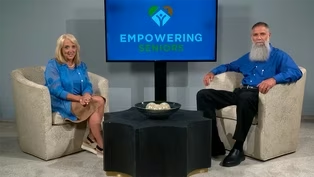
Empowering Seniors Episode 613
Season 6 Episode 13 | 28mVideo has Closed Captions
Empowering Seniors with Katherine Ambrose Fridays at 8:30pm
Empowering Seniors with Katherine Ambrose Fridays at 8:30pm
Problems playing video? | Closed Captioning Feedback
Problems playing video? | Closed Captioning Feedback
Empowering Seniors is a local public television program presented by PBS Kansas Channel 8
Empowering Seniors
Empowering Seniors Episode 613
Season 6 Episode 13 | 28mVideo has Closed Captions
Empowering Seniors with Katherine Ambrose Fridays at 8:30pm
Problems playing video? | Closed Captioning Feedback
Where to Watch Empowering Seniors
Empowering Seniors is available to stream on pbs.org and the PBS app.
Providing Support for PBS.org
Learn Moreabout PBS online sponsorshipFrom the Alvin and Rosalie Sara Check studio PBS Kansas presents Empowering Seniors Welcome to Empowering Seniors.
I'm your host, Katherine Ambrose.
On this episode, we're talking about creating your forever home.
Chris Moore, a national expert, flew from Virginia to Kansas to bring his wisdom to you.
Chris, thank you so much for being here.
Thank you for having me.
I'm always delighted when people are willing to travel to share this wisdom.
You are a national expert, and I am just so proud to have you here in studio to talk to our Empowering Seniors audience.
Yeah.
So why is it important for people to start thinking about how to create their forever home?
most of the houses that we have in America and much of the world are what I refer to as Peter Pan Housing.
They're housing built for people that never grow old.
Studies show that only 15% of us will go through our entire life without a mobility impairment of one kind or another, 15%, 15%.
Maybe it's temporary.
Maybe you broke your leg skiing or you sprained your ankle playing volleyball.
Or maybe it's more long term and it's something you live with for a long time.
But whether it's temporary or permanent, getting around a house that has too many stairs, too narrow of doors, poor lighting, trip hazards everywhere.
When you're struggling with mobility can be a real challenge.
And as our society ages by 2034, there will be more people in our country over the age of 65 than under the age of 18.
For the first time in history and so a larger and larger segment of our population are dealing with these issues of housing and of aging in place, which is the term we use when people decide that they want to live in the home that they're comfortable in, rather than moving to some sort of, senior living facility.
And many people choose that.
Most of the surveys show that large percentages of people, when asked, would you prefer to live in the home you're living in now for the rest of your life?
Or would you prefer to move to some sort of facility?
Large, large percentages of people say, I want to stay at home.
Yeah, it's 88% or more, right?
There's study after study in 88% as a very conservative number.
But the percentage of people who will proactively explore options of what preparations would make sense to make, to make that successful is more like 10 or 15%, if that.
And what's the result of that?
If they they're not proactive, they don't make the modifications that would keep them safer because you were talking about comfort and comfort.
It's important.
Getting around is important.
But we're really talking about keeping yourself safe.
Like if you want to stay independent, you want to maintain agency and control over your own life.
You want to keep yourself safe, right?
Well, in Caps, we teach that the priorities are number one, life safety.
Right.
Number two fall prevention.
And number three accessibility and and comfort.
So life safety has to be first because falls are the leading cause of death in older adults.
And they're the leading reason that people no longer can live independently because people fall they break a hip or they break another bone and then they lose their confidence.
My mother, when she was living, she had a heart condition and she had balance issues.
And so she was prone to falling.
And she would go through this cycle.
She would fall, she would go to the hospital.
She'd be in the hospital.
She would go to inpatient rehab.
She would come home from rehab and have home health care.
She would have physical therapy and occupational therapy.
And just about the time she was start ING to really regain her strength and her balance and starting to feel pretty good, Medicare would stop paying for her rehab.
And she would sit down in her recliner and she would start to lose that strength and that balance.
And it wasn't long.
She would fall again.
Yeah.
And there's so many older adults that are going through this same this same cycle.
Yeah.
Until they decline so much it just is a cascade.
So to get people to be proactive in terms of working on their balance, I mean, there are programs like Silver Sneakers, there are programs that can help people, you know, be active and and help prevent the fall in the first place.
Right?
Grab bars in strategic places, railings, watching the the floor transitions and loose throw rugs and clutter and all those kinds of things that can help prevent a fall in the first place, because one fall can change at all.
It can.
So she started sitting in her chair lot.
And you mentioned confidence.
So I there's a couple issues on dig into a little bit deeper.
Because when people are afraid of falling and going through that whole cycle again, they may have a tendency to sit more, which leads to atrophy of the muscles, which you lose strength, and then you lose confidence, and then you start moving very tentatively because you're afraid of falling.
And so your your strength declines, your balance declines, and your overall health declines.
Setting yourself up for another fall.
You are because you need these muscles.
You need to develop your muscles here and be practicing squats so you can get in and out of the chair.
I just read something that there's a line that people cross, like all throughout your life.
There is, for most people, the opportunity to physically get better, that the body wants to heal itself.
But once you cross that frail T line or fragility line where you can no longer get up and out of your chair.
That that's really it's really hard to reverse.
That is it is hard.
And the longer you sit the the harder it becomes.
but having a home environment that is well suited for mobile ity, is such a asset to that whole process.
And I've, I've started describing disability in this way recently, in that I view disability not so much as an inability to do a certain thing, as a disconnect between your ability and the environment in which you're living.
And so if I walk up to a home and that home instead of the traditional seven inch tall steps, this home has seven foot tall steps.
And so I'm disabled in relation to that home because I can't climb seven foot tall steps.
I'm six foot four.
I'm not I'm not stepping up a seven foot tall step.
So by the same token, a person who uses a wheelchair for mobility comes up to a home that has one three inch step.
Maybe the whole rest of the home is perfectly accessible.
Maybe there's three foot wide doorways throughout the entire home, and maybe there's a curb light shower, and maybe the lighting is perfect and the circadian rhythms are wonderful.
And the floor surfaces and the kitchen is wide open and completely wheelchair accessible, but there's a three inch step getting in the front door.
And that wheelchair can't jump that three inch step.
So that one feature has made that person disabled in relation to that home.
I've never heard that described before the disconnect between the environment and the ability.
And that was a beautiful way to explain it.
And so if you can help some of those disconnects go away through modifications, you can be able to to thrive longer.
Right.
And the challenge from, from the perspective of, of a remodeling contractor is for people to, value and accept and buy the services of home modifications.
Because what I found in 25 years running my business is that there is a large contingent of people who really, really need my services, but they don't want them.
Yeah, they don't want them because their perception is that if I agree to let you put a grab bar in my bathroom, that means that I'm surrendering to the ravages of aging.
And I just given up.
Yeah, because they associate getting older with getting weaker and sicker.
And so having the conversation and educating people about actually you're not surrendering.
You're being a wise planner.
Exactly.
You're proactively saying that if I make my home more user friendly today, I have a much greater chance of living independently without assistance for longer.
and we're not talking about your grandma's grandma.
You know, we're not talking about the grab bars that people think about where you have a hospitalization.
Look.
So tell us what, and you mentioned Caps, which stands for certified Aging in Place specialists.
You also mentioned remodeling contractor.
And I went I was said, whoa, we want to talk about remodeling contract owners that are qualified when it comes to aging in place, we're talking about certified aging, a place specialist, and people that have invested and gone on to a lot of training.
So they know exactly where the grab bar should be in relationship to the individual human being and how it gets installed properly.
Like there's a lot that goes into this.
If you're going to be smart, let's be all the way smart, right?
Well, and I have a podcast entitled Aging in Place is a team sport.
So, you know, I'm a remodeling contractor.
I know how to remodel homes.
But the other players on the team could be an occupational therapist who understands the likely progression of a progressive disease that someone might be struggling with.
Transportation becomes a huge issue when people are living at home alone.
It's one of the key pillars, and being able to play is this transportation, because people may not be able to safely drive anymore.
And that's a whole nother issue because driving is not just driving, it's independence.
And it represents all these things.
But having young people don't necessarily even drive today.
They may just Uber.
And so that's kind of a mindset shift for for those of us that are older that driving doesn't have to be about independence.
You just have to figure out what your workarounds are.
Just like the three inch gap.
How are we going to work around this?
Yeah, and it's interesting because our what we what we know of as subdivisions today.
Right.
Originated after World War II, Levittown and Long Island.
And it was all built around the automobile.
Right.
Because prior to that, people live close to town centers because, you know, you'd walk to the market and get your groceries.
And and then with the automobile, people are living, you know, farther out of town in these subdivisions.
Yeah.
And these same subdivisions that are auto centric now as as the population is getting older and driving, it's becoming more difficult sometimes for people.
It changes the whole paradigm.
It becomes, it can be social isolation.
If if we're not using a team approach to providing the services that people need in order to live a successful life in their in their home, that kind of touches all that, right?
Social isolation is one of my biggest because just like a fall can change it all, fall can take you down.
Being socially isolated, it is proven that it takes us down.
Yeah, that you're you can lose cognitive ability by being socially isolated.
So yeah, that's another thing for people to keep in mind.
Well, in the findings that I've read that that blow my mind is that shows that loneliness can be as hazardous to your health as smoking 15 cigarets a day.
Absolutely.
I, I know that from everything that I've seen with clients and doing these shows.
And so there's a lot of components that go into aging in place and thriving.
And, and it's unfortunate when people aren't really planning and thinking ahead.
Right.
Well, and we talked about that.
I'm not ready for that mentality that people have.
And I liken that to car insurance right?
We all carry car insurance and we hope that we never have to use our car insurance.
I've never heard anybody at the end of the policy year say tag on it.
I didn't have an accident this year.
I've wasted my car insurance premium.
Or if I got car insurance, that would be admitting that I might have an accident.
And that scares me so much.
I'm just not going to get car insurance, right?
Right.
But people do that about modifying their homes about, you know, preparing for potential.
I had a conversation with a eldercare attorney a number of years ago, and we were talking about people's reluctance to modify their homes, the reluctance to get a will in place, reluctance to get their their financial documents in place.
And I said, why is it that people will go to a seminar on their 401 K on saving money for retirement because it comes with the state, it comes with a stake.
But besides that, you know people people don't mind having that discussion.
But when it comes to modifying their bathroom or riding a wheel, they don't want a part of it.
And he said, well, that's easy, because when people are thinking about saving money for retirement, they're thinking of all the fun things they're going to do with that money.
When they have time, we're going to go on a cruise.
We're going to drive our convertible down on Winding Mountain Road.
We're going to walk barefoot on the beach.
We're going to travel to the Mediterranean and the Caribbean, and we're going to do all these fun things.
And wow, that's that's exciting to think about.
But when we think about putting a grab our in our bathroom, we're thinking about not being as able bodied as we are today.
When we're thinking about writing a will or a power of attorney, we're thinking about, you know, being dead or being disabled or being, you know, incapacitated.
Which is not a fun thing to think about.
So what we have to do if we're going to move the needle in, how many people are proactive, we have to flip the script on how they view making these changes that we can present to people, that this is a way to preserve your independence.
Right.
And what I found interesting is that the vast majority of people that I've talked to over the years who took that approach, who were proactive and were saying, I want to stay in this house.
I want it to be user friendly, are people who have been caregivers, and they're people who have seen what the other side of the equation looks like.
They have cared for a parent or a loved one or a family member in a home that was not well suited, and one of those homes where the caregivers injured their shoulders or their back because they're physically lifting someone in and out of bed and in and out of the bathtub, and they've experienced that, and they don't want to put their children through the same experience they went through.
That drives a lot of caregivers learn from their parents or who they're caregiving for, and they're like, I'm not going to do that to my kid.
Exactly.
And, how do we get the house set up so I can maneuver and I can, be, well, for as long as possible?
That's huge.
Huge.
So what are some of the things let's talk about?
Lighting has an example.
Why is the lighting important?
Well, lighting is important because number one our eyesight diminishes as we age.
And number two good lighting can help prevent falls.
Right.
I mean if, if the lighting is good and we can see where we're going, it can prevent falls in the kitchen where we're working with hot scalding dishes.
We're working with sharp knives.
Having good lighting can help prevent accidents.
I've recently been doing some research into circadian rhythms, which is the natural light in the morning.
Is brighter, tends to make us feel more awake in the evening as as the sun sets the golden hour and it starts to relax.
Yeah.
And I just started the blue hour after the golden hour.
I'd never heard of that before.
Right.
read a post about some good time for a reflection of your day, but, it's a photography term, so I thought that was interesting.
It is?
Yeah.
The sun's gone down, but it's not really quite dark yet, and it's like the time of just to take a deep breath and settle down for the night.
And we can we can replicate some of those lighting wavelengths in our home, especially with LED lighting.
Now we can adjust the, the kelvins, which is the temperature of that light, and create cool, task free our task lighting in areas where we're, where we're working and softer, more warmer tones like in bedroom areas or when we're trying to we're trying to relax for the night and and get into it.
Okay.
So just want to wrap that up that the tapping into the circadian rhythm can help you sleep better.
Help your mood energy.
Right?
you know, we think of a house as just a place to live, but really our our house is our home, which is the place where the rest of our life is going to happen.
It's the backdrop.
Right.
And so we are shelter.
It needs to be our refuge, our place where we can we can relax and feel safe.
And yet most accidents do happen at home.
And so what can we do to make our home refuge friendly, shelter friendly?
So that's something really to think about.
It is, how do we keep ourselves safer and and so we're talking about, like, the important lighting that people could have in their house.
And yet when I go visit people's homes and, you know, not to pick on his generation, but let's say, you know, someone in their 80s, maybe living alone has we walked into the house.
They're turning off every light as we go through.
The whole house is dark like a cave.
There's no sunlight coming in.
Everything is closed.
And so what type of hazards or diminishing energy you think that that causes?
Because I think they're thinking that I'm safer from the outside world, and I am saving electricity.
Saving electricity, because a lot of the older generation, particularly those that lived through the Great Depression, you know, are very conscious of of costs.
They they have in their life experience times when money was very, very tight and it might be for them now it's a habit.
It becomes a habit.
There's several things.
I mean, putting, putting lights on motion sensors right where they come on automatically when you walk in the room and they turn off automatically when you leave, even when you put your feet on the floor, you can have a light that comes on under the bed, right?
Yes.
And that's great for it at nighttime because it's a it's a enough light to see where you're going so you don't fall, but not bright where it's going to wake you.
You can't go back to sleep.
So people have a habit maybe of saving electricity and maybe winter break that habit.
And now it's about saving our body.
Right.
How do we save our body.
And so we need more lights.
Right.
Because what's the what's the cost of a broken hip?
You know, you could you could power the electricity in your home for probably several years.
Okay.
Yeah.
What a broken hip is going to cost you.
Not including just the potential loss of independence and the pain, suffering and everybody else that has to be involved in that.
And so might as well keep the lights on.
what or maybe the two most important in addition to lighting things that people should consider the the two biggest modifications to make to a home, to make it a forever home are almost universally across the board.
Two things one, a zero step entry.
There should be some way to get into your house without having to climb stairs and people think about a wheelchair.
And yet that's great if you're using a wheelchair for mobility.
But the same features that help someone using a wheelchair helped a young couple with the baby and the baby stroller.
The man delivering your refrigerator is going to love you if you have a zero step entry.
Yeah.
And so it makes it makes life just so much easier for everything, for everybody.
And that should be a universal feature of the home we have lots of discussions with.
Why don't builders build this way?
And why don't you know it is what it is?
And builders would tomorrow morning build every house in America with a zero step entry if and only if the buying public tomorrow morning refused to buy a house without one.
Okay, which is why education is so important, right?
If consumers demand a certain feature, then builders will want to build houses that way.
And so we're not talking about a ramp.
So you're walking up a ramp.
You're talking about you.
It could be a ramp.
What else could it be.
It could be a a home built on a level where you grade the lawn to come in seamlessly.
So the elevation could be grade A, the the most elegant way to do it is with an attached garage.
That's the same level as the house.
Normally we see garages that are one or 2 or 3 or more steps lower than than the house.
But if you just make the attached garage same level as house, put a three foot door between the garage and the house.
There you go.
You're in.
Yeah.
The people in and row right in the house.
But the second feature would be an accessible bathroom.
The bathroom is a room in the house where falls are very, very likely to happen for a number of reasons.
It's wet.
It's slippery.
People, you know, get out of the tub.
They're relaxed.
Maybe they've been in the tub and they relax.
They're not really paying attention.
Floor slippery.
The back door into the bathroom is almost always the narrowest door in the house.
And so creating a bathroom that has a wide enough door to get in has non-slip flooring, has a curb, or what we call a beach entry shower where you just roll right in to the shower can be quite elegant and luxurious.
Fall prevention grab bars, bright glare free lighting and moisture protection.
A fan to control the humidity.
And you've got an accessible bathroom.
And so if if we have those two features, most likely you're going to be okay.
There are certainly other rooms that we want to address.
The kitchen can be an area.
Outdoor living can be an important feature for a lot of people.
They love being outside.
And so having accessible gardening beds and and that kind of thing.
Exercise rooms, we really, really want to encourage people to continue to be active throughout the course of their life, help prevent falls.
But the zero step entry and the accessible bathroom are the are the two pillars, if you will.
Very good.
And an accessible bathroom also means that if you needed caregiver to help you, even if it was for a temporary condition, that somebody could get in there and help you move around.
I mean start for starters.
No clutter, right?
In the bathroom.
Yeah.
Thank you Chris.
And has an expert national expert and agent in place to safely.
And being an instructor for people that are learning how to provide this kind of modifications, what do you think are some of the most important things for people to know?
The biggest thing is have the have the conversation, you know, have the have the discussion.
Don't shy away from talking about what your what your plans are, what your goals are, what your expectations are.
Many people will avoid having that conversation and then nothing is done.
Nothing is done until there's a crisis.
And then at the time of crisis, your options are severely limited.
Yeah.
And so talk about with your with your family members, with your loved ones, assemble a team, talk to providers in your community ahead of time.
Talk to remodelers.
Talk to occupational therapist.
Talk to geriatric care managers.
Talk to people who are involved in in senior care in your community and find out what your options are and get, you know, people vet providers ahead of time and, and for anybody that's interested in finding a Cap certified provider, you can go to npr.org.
And there's a directory that you can look up and find people in your community that have that certification.
And that's a great place to start.
Okay.
So that's the National Association of Home Builders.
So the National Association Builders thought it was a good idea to train builders and contractors to prepare for this population shifts.
But who showed up for the training?
Well, I've had, I teach the course.
I've had builders and remodelers.
I have a lot of occupational therapists.
I have physical therapists.
I have interior designers and architect, I have realtors, I have, manufacturers of accessibility products.
And which points out, again, the point that aging in place is a team sport.
And assembling your team before it's time to run on the field makes good sense in sports.
It makes good sense in Aging place, it'd be like you design the field too.
You design the field for a successful game.
All right.
Yeah.
Well, thank you so much, Chris.
That was extraordinarily helpful.
We appreciate you being on the show.
Well, thank you for having me.
It's been a pleasure.
And I hope that, you know, it makes a difference in, in people's lives.
I do have, YouTube channel, senior remodeling experts.
People can go and learn more about planning and what what to have in place to make the rest of their life the best of their life.
Thank you very much Chris.
That is fantastic.
And thank you for watching.
We have resources on our nonprofit website Empowered senior.org for local resources.
And then also you can reach out to the station here at EmpoweringSeniors@kpts.org Until next time, I'm Katherine Ambrose and this is empowering seniors.
Empowering Seniors Episode 613
Preview: S6 Ep13 | 30s | Empowering Seniors with Katherine Ambrose Fridays at 8:30pm (30s)
Providing Support for PBS.org
Learn Moreabout PBS online sponsorship New Episode
- News and Public Affairs

Top journalists deliver compelling original analysis of the hour's headlines.

- News and Public Affairs

FRONTLINE is investigative journalism that questions, explains and changes our world.




 New Episode





Support for PBS provided by:
Empowering Seniors is a local public television program presented by PBS Kansas Channel 8