
April 2nd, 2026
Season 2026 Episode 14 | 28m 45sVideo has Closed Captions
Potawatomi Zoo New Electric Train, South Bend: Built by Baseball, Main St. Roasters
This Week on Experience Michiana: Wild Rides, Baseball History, and Local BrewsJoin us as we explore the innovation and stories that define our region. This week:All Aboard at Potawatomi Zoo: Courtney visits the zoo to premiere their brand-new, all-electric train! Executive Director Josh Sisk explains how this eco-friendly addition supports the zoo’s conservation mission and ...
Problems playing video? | Closed Captioning Feedback
Problems playing video? | Closed Captioning Feedback
Experience Michiana is a local public television program presented by PBS Michiana
April 2nd, 2026
Season 2026 Episode 14 | 28m 45sVideo has Closed Captions
This Week on Experience Michiana: Wild Rides, Baseball History, and Local BrewsJoin us as we explore the innovation and stories that define our region. This week:All Aboard at Potawatomi Zoo: Courtney visits the zoo to premiere their brand-new, all-electric train! Executive Director Josh Sisk explains how this eco-friendly addition supports the zoo’s conservation mission and ...
Problems playing video? | Closed Captioning Feedback
How to Watch Experience Michiana
Experience Michiana is available to stream on pbs.org and the free PBS App, available on iPhone, Apple TV, Android TV, Android smartphones, Amazon Fire TV, Amazon Fire Tablet, Roku, Samsung Smart TV, and Vizio.
Providing Support for PBS.org
Learn Moreabout PBS online sponsorship1234.
Get my shoes in.
Out the door.
Five.
I'm lost.
Six.
Seven.
Eight.
Feels great.
I'm gonna shine.
After I do what I'm gonna do.
I do it again.
Yeah.
Look at the sky with the beautiful color.
But never just for me.
You gotta share it with another.
I got to show, to give.
Let I want singing show.
Take a look and say a beautiful morning that turns into a beautiful evening.
And together make beautiful art.
And if you wanna see that, come along with me.
That's right.
Welcome to Experience Michiana.
We're so glad you're here to join us.
We're at Pottawattamie Zoo right now.
You're going to find out a little bit more about that.
But on this week's show, Dave had the opportunity to check out a new partnership that we have with the Elkhart County Convention and Visitor Center, and they are going to be doing some really cool things in the county.
We're going to tell you all about what you need to know.
Also had the opportunity to learn about a new documentary that's going to be debuting.
It's All About Baseball built right here in South Bend.
We'll share with you all those fun details as well.
Here first, we are at Potawatomi Zoo.
The new train is going to be coming out.
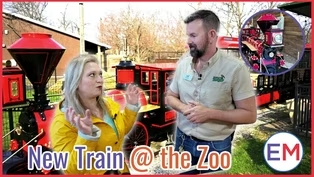
It is an electric train, so get ready to come on board.
All aboard the Zoo express.
It's right here.
It finally here.
It's here.
Yeah.
Exciting.
You know, I've been coming to the zoo.
My oldest one is 18, at home.
And we've been coming here for more than 20 years to the Potawatomi Zoo.
This is new.
This is news.
This is exciting.
And for the last 25 years, we had a gas powered engine train, which, you know, was fine at the time.
That, it's like purpose, but that gasoline engine ran all day long.
Yeah, it did, even from just a conservation standpoint, having an electric train.
Now that serves the same purpose is going to be so much better for our mission and everything.
So we're pretty excited to be introducing it to people.
Is that the big reason why you guys shifted from the old train to this one, or what was the intention?
Well, then I mean, the other train was 25 years old, and if you remember right, you probably came here a lot and maybe broke down or their signs of speed training was underway.
It was definitely showing its wear and tear.
So we knew we had to get another train and there are huge investment to train like this is about $650,000.
So I know.
So when you're buying those $3 admission ticket, you'll understand why I said, yeah, I got that right.
Yeah.
So it's but being a nonprofit, it's so important for us because you think about thousands of people coming to the zoo and riding the train.
It's what sustains everything from the animal care to the zoo keepers to our vet.
You know, a lot of times you don't think of a zoo.
You think, how how's the train associated with that?
That's a great piece of information.
It is so, yeah.
So everything from our illuminate events that we do to the attractions, the carousel, the trains that also supports this zoo.
If you can think about all the expense we have, that's not revenue generating, the feed animals to pay keeper staff, all that kind of stuff.
We have to have these things to be able to sustain.
So and I know I used to live over here in River Park and we could hear the train engine from our house.
It's a staple if you ever look at anybody's pictures when they've been to the zoo.
Yeah, they've been on the train.
And don't worry, everyone was always worried with an electric train to be silent.
No, it actually okay.
And does that.
We can't do it now.
But it does the whole chugga chugga chugga chugga it actually.
So that Chuck know you did it whistle.
And yeah, it's got all the sound features of all the, what the other train has it actually a little bit more, actually.
And this whole thing is brand new.
It's a whole brand new good speaker system.
Everything.
I don't remember the old train.
I was like, my number one.
Yeah, you can hear it like Charlie Brown.
Yeah.
You can now hear actually what's happening when you walk around the place.
So yeah.
So we're really excited about it.
And this is going to be debuting this season.
Yeah.
This season.
And the album opening, we're officially open now.
So we've got our other attraction still the carousel that everybody loves.
You know, with that attraction pass, you can do the carousel, you can ride the train, you can do giraffe feeding.
And then on line, we're gonna have all these options to meet animals so you can do a meet and greet with I love that that is such a unique experience.
Because if you're not necessarily wanting to do a party here, which is available to you, if you wanted to have like a birthday party, but you just want your kiddo to have a special experience, or even for a date night or a girls night out, something like that.
Well, it helps us tell our story of what we're doing.
So many people who may have, you know, they may be against zoos or not understand what we do when you can get back and meet a sloth, or you can meet a capybara and talk to the zookeepers about what we do.
It really does change people's perspectives.
So, we're pretty excited.
And then the new rhino, we got, number of a bar, southern white rhino.
I know you and I had to go back.
I know, I know, I still have that.
That's my picture.
I love that one.
It was such a cool experience.
But if you remember, he had to go to the Columbus Zoo for breeding, this past year.
So we got to see.
Doing a good job.
He's doing great, Ricci.
We've seen pictures.
He's in a beautiful field.
I mean, he's doing great, but Frankie is 1,000 pounds heavier.
He's 5,200 pounds.
He's coming to us from Florida.
And so later this spring, he's going to be coming in, and we're going to be introducing him to the public and hopefully doing the same.
Meet and greets that we were with him.
But we hear he's a really good boy, so we're excited to go with the transition.
When you bring a zoo animal into your zoo, like, how long does that transition take him?
So we always talk about that.
Every animal comes into the zoo, it goes into a 30 day quarantine.
We just got to make sure that they're healthy and everything's good before they go out with the animals.
But as you can imagine, a big animal like a rhino can't really stay at the clinic.
So he will actually he will actually go to the exhibit.
I know that our vets really knows that the public want to see him, so we're probably going to get him out on exhibit a lot sooner than 30 days.
Okay.
But so it'll probably be a couple weeks after he arrives, but we'll just wanted to calm down.
You know, when you come to, he's going to be in a crate.
You know, and so he's going to come out.
He's going to not know the people around him.
He's not going to know the zoo.
So we're going to want to really kind of just baby him, give him everything he wants for a couple weeks, and then then he'll get to come out to exhibit and, debut for the public.
I love that, I love that, and of course, the giraffe have been here for a while now to hear you continue to expand so much.
Well, let's talk about the draft for a minute, because that's another opportunity for people to get a little bit more hands.
Yeah, absolutely.
So we have the giraffe feeding every day.
If it's bad, whether it's in the barn, if it's nice to do it, if you do it.
Yeah.
Yeah.
So we're yeah.
Yeah.
So we do it indoors too.
If the weather's not great, we got Hadassah.
The little.
She's actually, believe it or not, about a year now, she was, born about a year ago.
Yeah.
So we have we have quite a herd of giraffe out there now.
At least three of them now are coming up and feeding, so it's.
Oh, that's great.
I love the frolicking videos that you guys have posted.
Yeah.
They're getting I get the zoomies.
They start running around, which is so funny right.
Because I have dogs and watching them.
But watching the giraffe at the zoo, it's.
Yeah, I mean we're getting we're a little nervous.
We're like, oh my gosh, please don't get hurt.
At the same time as this time of year because yeah, yeah.
This train a little bit makes.
Yeah.
Absolutely.
Yeah.
Because this is just beautiful and it is brand new.
It is brand new.
So yeah I mean it's it's all shiny and nice.
So there's actually a company called Chase trains out of Topeka and they literally build trains for, theme parks and zoos.
So, there's not very many companies like that, but it's a CP Huntington.
So if you're a train person, you know what that means.
I know we have train people out there.
I know that, you know, this is your sweet spot because we were telling you, I was telling you guys earlier, we sold our old train to a dairy farmer up in, Canada.
Was still getting lost.
Yeah, he's a farmer that happened to have tracks, and he, I had some grandkids, and he wanted to buy the train, so.
And we posted it in a train magazine.
So there's, like this whole network of train people out there that's all about the train.
So definitely fit more people on the train.
It's about the same as the old train, only because they have a fit into this tunnel that we had, and our track, the size of it and everything.
But we're going to be is this new was always here.
We've always had handicapped.
But this is much better.
This is much more friendly.
Yeah, yeah.
So this is the olden was a little bit higher and there wasn't as much space and everything.
So this will be much easier.
You can get a whole, electronic card on here if you need to, and everything.
That's wonderful for your accessibility.
And then we're going to be building a ramp that's separate from there, because that ramp can be a little hard to get up on.
Okay.
And just kind of even building some steps for people to get on because it was always kind of hard to climb into the train car.
So there's some more work we have to do.
But, one of the cool parts of Indiana, Michigan Power Foundation, they're the sponsor of the train.
They've given us $50,000 a year, for the next three years.
So just a means just to help maintain that.
So when you come, you'll see their logo around the train.
And they've been huge partners of the zoo.
And being in the electric train, it was a perfect partnership.
It's all about electricity.
I know you guys have something else coming up, too.
Oh.
Oh, okay.
Yeah.
What is this?
Yeah, that's.
That is the electricity.
What we were just talking about.
That's it.
So just like your electric car, you can see it plugged in over there to the side.
So we'll plug that in.
Just like an object.
Just like at home.
That's exactly, exactly.
So, the train driver, we'll have to plug that in as we're waiting up there at the station.
So we will be able to run as often.
Yeah.
Well, so he can run all day long.
So it may need to be.
There's a charger also at the station.
So when they plug it in there, if they say even 30s gives it enough charge that it'll keep it going all day long.
So that's really nice.
Yeah.
Yeah.
Okay.
So you have any issues.
All right.
So we're talking about electricity but we're going to be lighting things up here pretty soon.
We are.
Yeah.
Good segue.
Good segue right.
Yes.
We are going to be lighting it up is illuminate I love this I went last year.
It is phenomenal.
Oh such an experience.
You were walking around.
You're seeing some of the lanterns coming in right now.
They're setting them up.
It's all under the sea.
So it's crabs to sea turtles to fish.
And, I haven't seen a single duplicate of what was like here last year.
Yeah, it's going to be pretty amazing.
So we're excited for those people who haven't been here before.
Illuminate.
I mean, it is an all encompassing experience.
It is.
It's a check in with it.
It's a Chinese lantern festival, but it's not what you think of with the lanterns that you light.
And it's all 3D animals, life size crabs and animals and sea turtles and all kinds of stuff.
It's just it's magical.
Like the zoo just comes alive with lights.
It's pretty amazing.
Is it an extra fee for it?
Yeah.
So that's a nighttime event and it's going to run from 7 to 11:00 at night, because we're going to be running clear through June with this.
And it gets dark so late June.
It's going better.
What a nice time.
In the summertime when it's warm, you can come out here and, you know, we got to, I know we try to be careful how we say this, but we have a three way liquor license now so parents can come out and have a margarita or a cocktail and walk around that.
Yeah.
So it does it for the night.
It's.
Yeah, it's going to be a fun summer event.
Awesome.
Well, thank you so much.
Yeah, yeah.
I'm excited.
Let's just blow this train horn a little.
One more time.
More time.
All right.
Can I push the button?
All right, so here's the bell.
Okay.
Now push.
Oh, there you go, I think, yeah.
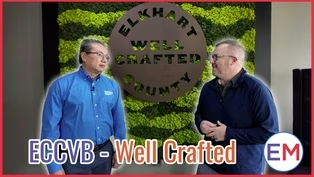
So I'm here in Elkhart at the Elkhart County Visitor Bureau, and I'm here with Terry.
Terry, tell me a little bit about ECCVB and all the things that you do for Elkhart County.
We promote tourism and hospitality throughout Elkhart County.
We represent small businesses, attractions, artisans, a lot of fantastic, fun things happening in our community.
And we encourage, both our residents and visitors to seek those out to come stay a night or 2 or 3 and really enjoy what the best of Elkhart County.
Sometimes when we have a show called Experience Michiana, people are like, is there stuff to do around here?
And, you know, maybe sometimes people think about Elkhart County, like, what are the big tourist attractions?
Because there are a lot of things that people from all over come here for.
So what would be like the top three that just off the top of your, top of your mind or the top three would definitely start with Amish Country.
We have, what, one of the largest Amish settlements in, the United States here in, northern Indiana between Elkhart County and Lagrange County.
So many people like to come and experience a little bit of a slice of that Amish lifestyle.
The cooking, the craftsmanship and the, just the calmer, slower pace of life.
Yeah.
And then, in the summertime, there's the quilt gardens, which are free.
They're beautiful, gigantic gardens planted in quilt patterns, and they're really fun for people to, both see them and then to try to find all 17 of them this year.
And then, the last thing is outdoor recreation.
The Pumpkin by nature trail is, hugely popular.
And connects three communities and brings a lot of, both local residents and visitors to experience that.
And I know there's lots of great museums, too, like the, you know, the RV Hall of Fame.
I like that one myself.
Like, even as someone who lives close by, I love going to that one too.
And with well crafted, I mean, you have this here as you walk in.
Why is it so important for the visitor Bureau to really focus in on the word craft and, well, craft as well?
Elkhart County has a long history of quality craftsmanship.
Entrepreneurs who started businesses here and made, high quality products, things that really are meant to, last a lifetime.
And so we wanted to highlight, that tradition of what is what is whether it's artisan crafts such as woodworking or quilting or pottery, or fine arts, down to, RVs.
Recreational vehicles are a major, major industry in this area.
So this is all kind of brings all of those ideas together under one umbrella.
But as you said, it's not just the, you know, the huge RV factories that are here.
It's also like individuals in Goshen and, and people that might be doing smaller things, but still very much adding to the well crafted scene in this community.
Yeah, very much so.
There's, many artisan guilds, many of them are based around Goshen.
There's a painter skilled, a photographers guild, a, clay artists organization.
So there's a long, deep tradition and all those, areas.
And I know that over the last couple of years, you've had this well crafted video series.
And throughout the next few months here on Experience Michiana, we're going to be showing some of them to partner with you to show some of them.
So what's the first one that we're going to be watching on this episode?
So we have, really wonderful business in Nappanee called Main Street Roasters.
It's, you know, from outside, you may think that it's, just a coffee shop, but it really goes much more beyond that.
It's really a community hub there many people who come in to enjoy their coffee, their espresso drinks and their baked goods.
So it is, a family owned, local business that has really exemplifies what, well crafted Elkhart County means.
All right.
And they're very generous, giving family as well to the community.
So let's watch that one.
The first one of Main Street Roasters in Nappanee here on Experience Michiana.
Main Street Roasters is, intended to be a place where people can gather from, you know, any demographic or any, age group or anything like that and find a place to feel community and feel at home.
That's one of the most important things for us is just a is to create an environment where people feel that and have a feeling of wanting to, wanting to be here.
This was kind of a side thing.
We started this as, as a side business, something to do in the winter when I, when my other job was slow and something for Deborah to do, after we were married, as opposed to just being a stay at home mom.
So, it started as a small side thing and kind of grew into, into what it is today.
So the atmosphere here at Main Street is very important to us.
Deborah has done, pretty much all of, the behind the scenes, in regards to the atmosphere and, and just the feeling.
And here, Main Street, there's part that Marcus does really well with, actual design, like layouts and plans and stuff like that.
That's more his strengths.
And then actually, coming alongside that and coming up with the actual feeling I like, I like doing that part of it.
So one of the things we, we thought we wanted to, to do was set ourselves apart a little bit from some of the competition.
And three years in, we decided to start roasting our own coffee.
And bringing that in-house allowed us to to have a better control over quality control, consistency and the freshness.
That's a big part in, in the good, good cup of coffee is how fresh it is after it's roasted.
The coffee roasting process, we, via coffee or green coffee from, importer in South Bend, Theta Ridge Coffee Company.
And we roast fresh, when, when we get an order, especially for the wholesale orders.
The larger orders.
When those orders come in, we roast fresh for those orders.
So the coffee going out, our door being shipped to our to our clients is hours old.
Usually, within a day, after it's roasted, it's it's in the mail and being shipped.
The coffee that we use here in, in the shop is, usually a couple days old, if that is set.
Except for our espresso.
We, like to use that when it's when it's had a little bit of time to age.
About a week.
Here at Main Street Roasters, we are known for our coffee, but we also offer fresh baked goods.
We also have fresh soups and salads and sandwiches every day.
We also serve those in the evening.
We have a fairly simple menu, but, it's well received in the area and it's usually something that works well for a light lunch or, you know, a quick dinner.
And we also offer a lot of ice drinks.
I would say in the summer that's probably over half of our sales is just iced coffees and and refreshing drinks.
We give a lot of credit to all the credit, really to God.
And, first and foremost.
But I think the community around this has made, Main Street what it is today, I guess, for myself and for Marcus, the reason why it's important, how people feel about Main Street or our other business as well, is just that.
To me, that's almost more important than the product or the different things we offer is just if a person has an experience where they feel included or invited or or at home, obviously they'll feel accepted, but then also just they'll want to experience it again.
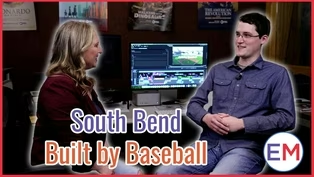
Well, we are back here at home at WNIT and I have with me my new friend Nathan, who is the producer of a documentary that really talks about community.
But baseball right here in South Bend, in South Bend is a pivotal point for how baseball really kind of has come together, especially in our community.
Nathan, thank you so much for joining me today.
Thanks for having me.
This is a documentary that you guys have been working on for quite some time.
When did this whole process start?
We started this back in spring, summer of 2024.
So it's been about a two year process.
A two year process that pretty typical for a documentary.
Sometimes yes, sometimes no.
It depends on some of the timelines we have here at the station.
But also the time it takes to tell a story the right way.
Yeah, and that's what you guys are doing.
So talk to us a bit more about what is built by baseball South Bend, built by Baseball is a documentary about baseball in South Bend, right.
But it goes deeper than that.
We're not focusing so much on the statistics of players and things like that.
We're really focusing on how the people who played the game in South Bend really built the community into what it is today.
And I mean, we know the South Bend Cubs.
I mean, that's where we're at now.
And we've watched that grow over the years.
I'm certainly even more recently more exponentially.
But talk to us about the very beginning and how we got started with that.
So baseball in South Bend, we have records going back to 1866.
We made earlier.
Oh my gosh.
So it's been around that long.
And just to see how it touches every aspect of the community, from people working in factories and people, farm workers.
Right.
It touches everybody in this community.
And that's something that we were really excited to discover as we worked on this project.
And when you were doing that, what were you finding about the community itself at that time?
Because that was really kind of the revolutionary time where we were all coming together.
With, with the industries in Michiana?
Absolutely.
So one of the things we dive into, are some of the more underrepresented communities, like the African-American community, the Latino Hispanic community, and finding that, there were black teams in the Studebaker factory, the Foundry Giants.
That's one team we really dive into.
And how they navigate playing ball, but also segregation at the time.
Oh, and for the Latino Hispanic community, that community formed a Mexican American League.
That has spanned decades.
And how that really served as it became sort of a hub for community organizing over time and just learning about all of this as it's been truly a joy.
That's awesome.
And let's talk about the ladies because that was a really pivotal point, because we're one of the four locations right where women's baseball got started.
Absolutely right here in South Bend.
And the Blue Sox were just amazing in every respect.
And one of the things we also dive into is a lot of them stayed in South Bend after their playing careers were done because they really liked the community.
You know, we all love this community.
And in particular, Betty Jochum, who passed recently.
The she was a gym teacher for nearly 30 years, I think, at an elementary school in the community.
So that just really speaks to, again, just the community roots of this project.
Absolutely.
Now, putting this all together, I'm sure, was a lot of work.
Talk to us about the process.
Yeah.
So we've we've interviewed, you know, about 20 people for this project.
And because it's baseball it is a bit seasonal.
So we need we needed a couple of summers to help, get everything we needed to support the sure right way.
But really, everyone we've talked to about this project, from the people we've interviewed to researchers, just and community members, they've been so excited and incredibly helpful also.
And that's been something that's, really been touching and encouraging.
And I know I've learned a lot about our baseball history at the History Museum right here in South Bend.
What is the connection been with them?
Have you been able to get a lot of information within that partnership as well?
Yes, they've been extraordinary both in terms of people we've interviewed over there and archival research as well.
And it's not just the History Museum, right?
The Studebaker Museum has also been helpful in terms of that.
The factory side of things.
Yeah, absolutely.
Okay.
So now this documentary itself, when is it coming out?
Because we have to be able to tune into this, right?
Yes.
Okay.
And it's going to be on it.
Yes.
So it will premiere on April 9th at 8/7 central, both on our broadcast channel 34.1, as well as our YouTube channel.
And it will live forever on our YouTube channel as well.
I love that.
I love that.
Now, I'm sure there were some challenges along the way of doing this.
I mean, two years into a documentary, you're going to have some spots that are a little bit rougher than others.
What were some of the bigger challenges that you faced along the way?
Well, I should mention that this is actually my first documentary producing.
Well, congratulations.
Thank you.
Oh my gosh.
So there were challenges and just me learning how to do this, but some of the more interesting challenges I would say were, a couple of the on location shoots, we tried to do a lot of them outside, which is great, but lighting can be tricky.
You make it interrupted by any number of things, like lawnmowers.
Oh, a lot of trains.
Actually, there's a ballpark called Foundry Field, which is a terrific ballpark.
On the southeast side.
You should go check it out.
Okay.
And that's pretty central to this documentary, actually.
But the outfield wall is actually, right below, train track.
So when we could do an interview there, you'd every five minutes, you know, Amtrak goes by and it's it's a whole thing.
You just you just have to wait.
You learn more about the community.
That's something you do.
Absolutely.
Now let's talk about.
So focus mainly on the three different kinds of organizations.
Correct.
So I'd say it breaks down mostly into four parts.
You have kind of the early history as well as the baseball and softball and black communities.
Then you have the South and Blue Sox, the Latino Hispanic community, and then the, South Bend minor league franchise.
And I know you're going to talk about it in the documentary, but maybe give us a little hint of how you have seen things develop into baseball being such a primary component of the South Bend community over that time and into today.
I think it just starts with people love to play it.
It is your, after all.
It's a kid's game.
You're hitting a ball with a stick.
You're having fun.
And it's just a way to enjoy life in the midst of all the work that you're doing.
And I think that's a central theme that covers all generations, and really sticks with people as kind of an activity.
They love to do, and just serve as a community connector.
It's a multigenerational, you know, sport.
I remember when I was a kid and I remember, okay, baseball for me.
I remember growing up with my grandparents on that big box television, going to visit them every Friday night.
My grandma was a huge Detroit Tigers fan, and I remember falling asleep to it every, every week because I was a little kid back then.
But I remember that was how I was introduced to baseball, was through my grandparents.
And do you talk about kind of that multigenerational, generational component within this?
Yes.
And I'd say one of the things that jumps out is we have, one of the founders of the Mexican-American League.
Chico Rodriguez, he tells a wonderful story of how this got started.
But his son Freddy actually painted a mural of him, of his father, as part of the Foundry School mural.
And the foundry field mural kind of, revisits all of this history that we talk about in this documentary and brings it to life in such a really cool way to.
So to see a son honoring his father in that way was really cool.
I bet you're so proud of this documentary.
It's been a pleasure to tell this story and to work with everyone to bring this, this history to life.
And, yeah, I'm a bit proud of it, I'll say that.
I think everyone's got really going to enjoy this, especially with our love for baseball here in the city and regionally, quite frankly.
So again, tell us again when we can see it and how we can find it.
And I think you even have a podcast coming out with it too.
We do.
So the documentary will premiere April 9th at eight seven central on our broadcast channel 34 one and on our YouTube channel.
And if you like the doc, that's good news.
We have a podcast coming out that ties in to kind of the weird and wacky stories of some of South Bend's, early history, when it comes to baseball.
Awesome.
Well, thank you so much, Nathan.
And congratulations.
All right.
I think now we're going to look at the trailers.
Let's go ahead and take a look.
When you think about the classic baseball towns, South Bend has that exact same DNA.
People from diverse backgrounds doing hard, dirty work, looking to unwind on a ball field at the end of the night.
That's what made South Bend such a great baseball town then, and that's never left the DNA of the city.
The Blue Sox and the the teams that were playing against them, I think that they paved the way for all women in all sports baseball and softball.
It was something recreationally for folks to get involved in, but very quickly transformed organically into a grassroots movement, organizing.
It's building South Bend in terms of our population and our community institution.
It's building South Bend in terms of our cultural life that builds our community in different ways to.
Thanks for joining us this week on Experience Michiana.
Next week we're going to dive a little bit deeper into Potawatomi Zoo and find out why these little guys need to stay on their own.
Want more from Courtney, Dave and Kelly?
Follow us on social media and visit our website for exclusive behind the scenes content, extended interviews, and full length features.
Stay connected and experience it all today.
This WNIT local production has been made possible in part by viewers like you.
Thank you.
 New
NewComing Soon to WNIT - A New Baseball Documentary!
Video has Closed Captions
Clip: S2026 Ep14 | 9m 9s | No description (9m 9s)
 New
NewThe NEW Electric Train is Here! | Potawatomi Zoo Season Preview
Video has Closed Captions
Clip: S2026 Ep14 | 9m 27s | No description (9m 27s)
 New
NewWhy Main Street Roasters in Nappanee is More Than Just a Coffee Shop
Video has Closed Captions
Clip: S2026 Ep14 | 8m 7s | No description (8m 7s)
Providing Support for PBS.org
Learn Moreabout PBS online sponsorship













Support for PBS provided by:
Experience Michiana is a local public television program presented by PBS Michiana