
Coming Soon to WNIT - A New Baseball Documentary!
Clip: Season 2026 Episode 14 | 9m 9sVideo has Closed Captions
No description
⚾✨ Baseball isn’t just a game — it’s part of the story of our community. On this week’s Experience Michiana, we sit down with Nathan Krebs, producer of a brand-new documentary that explores how America’s pastime helped shape South Bend. “South Bend: Built by Baseball” dives into the deep connection between the sport, the people, and history that define our are...
Problems playing video? | Closed Captioning Feedback
Problems playing video? | Closed Captioning Feedback
Experience Michiana is a local public television program presented by PBS Michiana
Coming Soon to WNIT - A New Baseball Documentary!
Clip: Season 2026 Episode 14 | 9m 9sVideo has Closed Captions
⚾✨ Baseball isn’t just a game — it’s part of the story of our community. On this week’s Experience Michiana, we sit down with Nathan Krebs, producer of a brand-new documentary that explores how America’s pastime helped shape South Bend. “South Bend: Built by Baseball” dives into the deep connection between the sport, the people, and history that define our are...
Problems playing video? | Closed Captioning Feedback
How to Watch Experience Michiana
Experience Michiana is available to stream on pbs.org and the free PBS App, available on iPhone, Apple TV, Android TV, Android smartphones, Amazon Fire TV, Amazon Fire Tablet, Roku, Samsung Smart TV, and Vizio.
Providing Support for PBS.org
Learn Moreabout PBS online sponsorshipWell, we are back here at home at WNIT and I have with me my new friend Nathan, who is the producer of a documentary that really talks about community.
But baseball right here in South Bend, in South Bend is a pivotal point for how baseball really kind of has come together, especially in our community.
Nathan, thank you so much for joining me today.
Thanks for having me.
This is a documentary that you guys have been working on for quite some time.
When did this whole process start?
We started this back in spring, summer of 2024.
So it's been about a two year process.
A two year process that pretty typical for a documentary.
Sometimes yes, sometimes no.
It depends on some of the timelines we have here at the station.
But also the time it takes to tell a story the right way.
Yeah, and that's what you guys are doing.
So talk to us a bit more about what is built by baseball South Bend, built by Baseball is a documentary about baseball in South Bend, right.
But it goes deeper than that.
We're not focusing so much on the statistics of players and things like that.
We're really focusing on how the people who played the game in South Bend really built the community into what it is today.
And I mean, we know the South Bend Cubs.
I mean, that's where we're at now.
And we've watched that grow over the years.
I'm certainly even more recently more exponentially.
But talk to us about the very beginning and how we got started with that.
So baseball in South Bend, we have records going back to 1866.
We made earlier.
Oh my gosh.
So it's been around that long.
And just to see how it touches every aspect of the community, from people working in factories and people, farm workers.
Right.
It touches everybody in this community.
And that's something that we were really excited to discover as we worked on this project.
And when you were doing that, what were you finding about the community itself at that time?
Because that was really kind of the revolutionary time where we were all coming together.
With, with the industries in Michiana?
Absolutely.
So one of the things we dive into, are some of the more underrepresented communities, like the African-American community, the Latino Hispanic community, and finding that, there were black teams in the Studebaker factory, the Foundry Giants.
That's one team we really dive into.
And how they navigate playing ball, but also segregation at the time.
Oh, and for the Latino Hispanic community, that community formed a Mexican American League.
That has spanned decades.
And how that really served as it became sort of a hub for community organizing over time and just learning about all of this as it's been truly a joy.
That's awesome.
And let's talk about the ladies because that was a really pivotal point, because we're one of the four locations right where women's baseball got started.
Absolutely right here in South Bend.
And the Blue Sox were just amazing in every respect.
And one of the things we also dive into is a lot of them stayed in South Bend after their playing careers were done because they really liked the community.
You know, we all love this community.
And in particular, Betty Jochum, who passed recently.
The she was a gym teacher for nearly 30 years, I think, at an elementary school in the community.
So that just really speaks to, again, just the community roots of this project.
Absolutely.
Now, putting this all together, I'm sure, was a lot of work.
Talk to us about the process.
Yeah.
So we've we've interviewed, you know, about 20 people for this project.
And because it's baseball it is a bit seasonal.
So we need we needed a couple of summers to help, get everything we needed to support the sure right way.
But really, everyone we've talked to about this project, from the people we've interviewed to researchers, just and community members, they've been so excited and incredibly helpful also.
And that's been something that's, really been touching and encouraging.
And I know I've learned a lot about our baseball history at the History Museum right here in South Bend.
What is the connection been with them?
Have you been able to get a lot of information within that partnership as well?
Yes, they've been extraordinary both in terms of people we've interviewed over there and archival research as well.
And it's not just the History Museum, right?
The Studebaker Museum has also been helpful in terms of that.
The factory side of things.
Yeah, absolutely.
Okay.
So now this documentary itself, when is it coming out?
Because we have to be able to tune into this, right?
Yes.
Okay.
And it's going to be on it.
Yes.
So it will premiere on April 9th at 8/7 central, both on our broadcast channel 34.1, as well as our YouTube channel.
And it will live forever on our YouTube channel as well.
I love that.
I love that.
Now, I'm sure there were some challenges along the way of doing this.
I mean, two years into a documentary, you're going to have some spots that are a little bit rougher than others.
What were some of the bigger challenges that you faced along the way?
Well, I should mention that this is actually my first documentary producing.
Well, congratulations.
Thank you.
Oh my gosh.
So there were challenges and just me learning how to do this, but some of the more interesting challenges I would say were, a couple of the on location shoots, we tried to do a lot of them outside, which is great, but lighting can be tricky.
You make it interrupted by any number of things, like lawnmowers.
Oh, a lot of trains.
Actually, there's a ballpark called Foundry Field, which is a terrific ballpark.
On the southeast side.
You should go check it out.
Okay.
And that's pretty central to this documentary, actually.
But the outfield wall is actually, right below, train track.
So when we could do an interview there, you'd every five minutes, you know, Amtrak goes by and it's it's a whole thing.
You just you just have to wait.
You learn more about the community.
That's something you do.
Absolutely.
Now let's talk about.
So focus mainly on the three different kinds of organizations.
Correct.
So I'd say it breaks down mostly into four parts.
You have kind of the early history as well as the baseball and softball and black communities.
Then you have the South and Blue Sox, the Latino Hispanic community, and then the, South Bend minor league franchise.
And I know you're going to talk about it in the documentary, but maybe give us a little hint of how you have seen things develop into baseball being such a primary component of the South Bend community over that time and into today.
I think it just starts with people love to play it.
It is your, after all.
It's a kid's game.
You're hitting a ball with a stick.
You're having fun.
And it's just a way to enjoy life in the midst of all the work that you're doing.
And I think that's a central theme that covers all generations, and really sticks with people as kind of an activity.
They love to do, and just serve as a community connector.
It's a multigenerational, you know, sport.
I remember when I was a kid and I remember, okay, baseball for me.
I remember growing up with my grandparents on that big box television, going to visit them every Friday night.
My grandma was a huge Detroit Tigers fan, and I remember falling asleep to it every, every week because I was a little kid back then.
But I remember that was how I was introduced to baseball, was through my grandparents.
And do you talk about kind of that multigenerational, generational component within this?
Yes.
And I'd say one of the things that jumps out is we have, one of the founders of the Mexican-American League.
Chico Rodriguez, he tells a wonderful story of how this got started.
But his son Freddy actually painted a mural of him, of his father, as part of the Foundry School mural.
And the foundry field mural kind of, revisits all of this history that we talk about in this documentary and brings it to life in such a really cool way to.
So to see a son honoring his father in that way was really cool.
I bet you're so proud of this documentary.
It's been a pleasure to tell this story and to work with everyone to bring this, this history to life.
And, yeah, I'm a bit proud of it, I'll say that.
I think everyone's got really going to enjoy this, especially with our love for baseball here in the city and regionally, quite frankly.
So again, tell us again when we can see it and how we can find it.
And I think you even have a podcast coming out with it too.
We do.
So the documentary will premiere April 9th at eight seven central on our broadcast channel 34 one and on our YouTube channel.
And if you like the doc, that's good news.
We have a podcast coming out that ties in to kind of the weird and wacky stories of some of South Bend's, early history, when it comes to baseball.
Awesome.
Well, thank you so much, Nathan.
And congratulations.
All right.
I think now we're going to look at the trailers.
Let's go ahead and take a look.
When you think about the classic baseball towns, South Bend has that exact same DNA.
People from diverse backgrounds doing hard, dirty work, looking to unwind on a ball field at the end of the night.
That's what made South Bend such a great baseball town then, and that's never left the DNA of the city.
The Blue Sox and the the teams that were playing against them, I think that they paved the way for all women in all sports baseball and softball.
It was something recreationally for folks to get involved in, but very quickly transformed organically into a grassroots movement, organizing.
It's building South Bend in terms of our population and our community institution.
It's building South Bend in terms of our cultural life that builds our community in different ways to.
 New
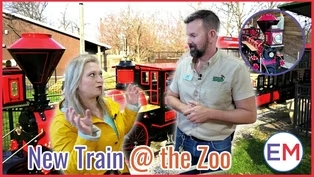
NewThe NEW Electric Train is Here! | Potawatomi Zoo Season Preview
Video has Closed Captions
Clip: S2026 Ep14 | 9m 27s | No description (9m 27s)
 New
NewWhy Main Street Roasters in Nappanee is More Than Just a Coffee Shop
Video has Closed Captions
Clip: S2026 Ep14 | 8m 7s | No description (8m 7s)
Providing Support for PBS.org
Learn Moreabout PBS online sponsorship













Support for PBS provided by:
Experience Michiana is a local public television program presented by PBS Michiana